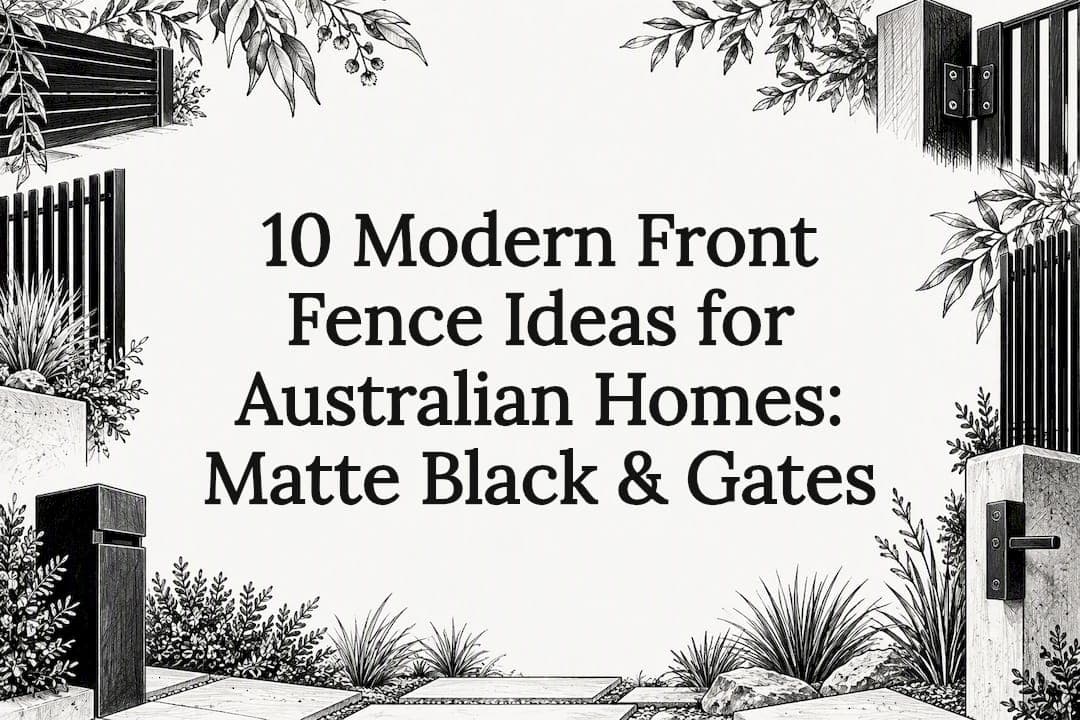
The cleanest modern look right now pairs a matte-black slim-profile slat fence or a timber-and-metal hybrid with just enough transparency to satisfy council sightline rules. These directions read as contemporary from the street, work with most house styles, and avoid the maintenance headaches of solid masonry. The trade-off is balancing privacy against streetscape visibility, which is where a specialist like Gatecon can tailor a compliant, custom design.
TL;DR:
- In Victoria, front fences within 3 meters of the street are generally limited to 1.5 meters, though some Transport Zone 2 areas allow 2 meters; confirm local rules.
- A privacy gradient keeps street level slats or mesh open, with denser panels set farther back and planting adding screening without increasing fence height.
- Bushfire prone sites generally favor noncombustible steel, aluminum, or concrete; coastal installations need stainless steel fixings and marine grade coatings to limit corrosion.
Table of Contents
- Why matte black and minimal geometry are leading 2026 fence trends
- Ten modern front fence ideas you can copy
- Materials and finishes built for a modern look and the weather
- Balancing privacy with street presence and council rules
- Designing modern gates and hiding the automation
- A simple framework for choosing your design and budget
- Security features that work with a modern aesthetic
- Sustainable and eco-friendly material choices
- What considered fence design actually rewards
- How we help bring a modern front fence to life
- FAQ
- Sources
Why matte black and minimal geometry are leading 2026 fence trends
Matte black powder-coated aluminum and steel finishes, paired with horizontal slat geometry, are the dominant look in residential fencing this year, and they pair naturally with stone, concrete, and timber facades. The appeal is partly visual and partly practical: dark matte finishes hide dust and water marks better than gloss, and horizontal lines make a fence look lower and wider even at full legal height.
The underlying design principle is restraint. Clean lines, minimal visible hardware, and materials that echo the house itself read as considered rather than decorative.
- Matte over gloss: powder-coated matte black resists fingerprints and glare better than reflective finishes.
- Horizontal over vertical: horizontal slats visually widen a narrow frontage and soften tall sections.
- Material echo: matching a fence's metal or timber tone to window frames or cladding ties the whole facade together.
This consistency also tends to support resale appeal, since a fence that looks integrated with the house reads as intentional rather than added on.
Ten modern front fence ideas you can copy
Each of these works as a mood-board starting point. Pair the description with a material sample and a photo of your own facade before committing.
- Matte-black slim slats: horizontal aluminum slats on a hidden steel frame, best for brick or render homes wanting a sharp contrast.
- Timber-and-steel hybrid: vertical hardwood battens set into a black steel frame, suited to Scandinavian-style or weatherboard houses.
- Honed concrete plinth with slat screen: a low concrete base topped with slim metal slats, ideal for sites needing a solid street-level anchor.
- Battened privacy screen with open base: dense slats above waist height, open posts below, good for corner blocks needing sightlines.
- Perforated metal panels: laser-cut or perforated aluminum sheets that filter light, suited to minimalist or industrial-style homes.
- Glass and black steel combo: toughened glass panels in a slim black frame, best where street appeal matters more than privacy.
- Board-formed concrete wall sections: short masonry returns at the entry paired with lighter screening elsewhere, suited to architect-designed homes.
- Woven metal mesh screen: a tensioned mesh panel that reads as soft and textural, good for gardens that want partial screening without bulk.
- Charcoal brick with slat insert: brick piers with a central slatted gate or panel, suited to period homes being modernized.
- Floating slat fence on a recessed footing: slats that appear to hover above a hidden base, best for architecturally ambitious frontages.
Pro Tip: Photograph your house facade at midday and dusk before choosing a finish. Matte black can look flat in harsh sun but striking at dusk, so check both.
Materials and finishes built for a modern look and the weather
The material you choose has to do double duty: look sharp and survive sun, salt air, or bushfire-prone conditions depending on where you live.
- Powder-coated aluminum or steel: the most common choice for matte-black slats, low maintenance, resists corrosion when properly coated.
- Timber: warm and tactile, but needs oiling every one to two years to keep its color; hardwoods like spotted gum hold up better than softwoods.
- Colorbond steel: durable, bushfire-rated in many profiles, available in matte finishes that mimic the current trend without the upkeep of raw metal.
- Honed concrete: heavy and permanent, works well as a plinth or base rather than a full fence due to cost and weight.
- Glass: clean and modern, but needs regular cleaning and is a poor fit for high-wind or coastal corrosion zones unless framed in marine-grade metal.
In bushfire overlay areas, non-combustible materials like steel, aluminum, and concrete are generally safer choices than raw timber. Near the coast, stainless fixings and marine-grade powder coats reduce corrosion on otherwise matte-black steel.
Balancing privacy with street presence and council rules
Front fence height is the single biggest constraint on design, and it is worth checking before you fall in love with a style. In Victoria, front fences within 3 meters of the street are generally capped at a maximum height of 1.5 meters, rising to 2 meters in some Transport Zone 2 areas, unless a zone schedule states otherwise. Planning guidance generally favors fences that are low or partially transparent near the street, since this supports informal surveillance and keeps the streetscape open.
The practical workaround is a privacy gradient: open near the footpath, denser closer to the house.
- Set tall privacy panels back from the street-facing boundary where height limits don't apply, using durable outdoor panels designed for homeowners that combine style and privacy.
- Use screening planting to add privacy without adding fence height.
- Choose partially transparent slats or mesh at the street line to stay compliant while still defining the edge.
Rules vary by council and zone, so confirm specifics with your local authority. Our guide to front fence height in Victoria breaks down how different councils interpret the 3-meter rule in practice.
Designing modern gates and hiding the automation
A well-designed automated gate should look like a seamless part of the fence line, not a mechanical add-on. We recess motors and hardware behind full panels or into dedicated pockets so the slat pattern continues uninterrupted across the gate.
- Keep clearances generous: livable housing guidance recommends a minimum 820 mm clear opening and an unobstructed landing area sized to support ease of access outside an accessible entrance.
- Plan drainage early: electronics need protection from water pooling at the threshold, especially on sloped driveways.
- Match the gate finish to the fence, not just the color but the slat spacing and frame depth.
One accessibility benchmark worth building around: the recommended 820 mm minimum clear opening applies to at least one entrance and is a useful baseline for gate width even on non-accessible entries.
Steep driveways or narrow access points often push the decision toward sliding or pivot gates rather than swinging ones. For more detail on avoiding costly redesigns, see our piece on luxury driveway gate designs.
A simple framework for choosing your design and budget
Narrowing ten ideas down to one starts with three questions, not a mood board.
- Match the fence to your architecture: a slat pattern that echoes your cladding or window frames will always look more intentional than one chosen in isolation.
- Rank your priorities: decide whether privacy, street presence, or security matters most, since no single design maximizes all three.
- Confirm constraints before you commit: check your council's height rule, site access for gate swing, and any heritage overlay.
Cost is driven less by the base material than by customization: bespoke slat spacing, automation, and site work like regrading a driveway all add more than the fence panel itself.
Pro Tip: Ask any installer how they conceal gate hardware and what happens to warranty if the site has drainage issues. Vague answers on either are a red flag.
Security features that work with a modern aesthetic
Security and minimalism aren't opposites, but they do require deliberate choices. Anti-climb detailing, for instance, relies on limiting horizontal footholds and keeping gaps narrow, which happens to suit the clean lines of slat fencing anyway. For high-security or luxury frontages, our anti-climb fence design guidance covers gap sizing in detail for architects and designers.
Access control integrates more cleanly into a modern fence than people expect. Keypad or intercom units can sit flush within a steel post rather than mounted as a separate box, and automated gates paired with a sensor or camera add a security layer without any visible bulk. Lighting is another underused tool: a low-voltage strip along the base of a slat fence improves nighttime visibility of the entry without the harshness of a floodlight.

The materials that make a fence look modern also tend to make it harder to breach. Solid steel or aluminum slats with narrow gaps resist both climbing and forced entry better than open picket styles, while a fence with a visible, solid base discourages prying at ground level. The trade-off is that very dense screening can reduce passive surveillance from the street, which is part of why planning guidance leans toward partial transparency: it is as much a safety consideration as an aesthetic one.
Sustainable and eco-friendly material choices
Fencing doesn't get the same sustainability scrutiny as roofing or insulation, but the choices still matter over a fence's lifespan. Recycled aluminum is widely available in the powder-coated profiles used for slat fencing, and it performs identically to virgin material while cutting embodied energy. Steel, similarly, is one of the more recyclable building materials at end of life, which matters for a product expected to last decades.
Timber sits in a more nuanced spot. Responsibly sourced hardwood with a long service life, properly oiled and maintained, can be a genuinely low-impact choice, but softwoods that need frequent replacement or chemical treatment tend to offset that advantage. Where timber tones are wanted without the maintenance, aluminum or steel slats finished in a woodgrain powder coat are an increasingly common compromise.

Concrete carries a heavier carbon cost to produce, so using it sparingly, as a plinth or structural base rather than a full fence, keeps the aesthetic benefit without the full footprint. Whatever the material, durability is itself a sustainability feature: a fence that lasts 25 years without replacement beats a cheaper one replaced twice in that span, even before finish or maintenance costs are counted.
What considered fence design actually rewards
The fences that age well are the ones where every decision, slat width, post spacing, gate clearance, was made on purpose rather than defaulted to. Minimalism gets treated as a style choice, but in fencing it is closer to a discipline: fewer materials and simpler lines leave less room to hide a bad decision.
Where I think most homeowners underestimate the category is security. A fence that looks soft and open can still be harder to breach than a tall solid one, because gap width and base detailing matter more than overall height. Good craft shows up in those small, unglamorous specifications. For anything bespoke, a specialist conversation early tends to save a redesign later.
— Rhys
How we help bring a modern front fence to life
We design and install custom architectural gates, designer fencing, and bespoke entry packages with automation and security integrated into the design rather than bolted on afterward. Where off-the-shelf slat panels fall short on site-specific clearances or finish matching, our approach starts with your facade and works backward to the gate.
- Architectural Gates: custom driveway gates designed around your access and automation needs.
- Designer Fencing: tailored slat, timber, and hybrid fencing matched to your home's materials.
- Custom Packages: combined gate and fencing projects from design through installation.
A first conversation usually starts with your site photos and council constraints. From there we can scope a design that fits both your street and your budget. Get in touch to start a custom design.
FAQ
What are the latest trends in modern fencing?
Matte black powder-coated finishes and horizontal slat geometry are the leading trends for modern residential fences, often paired with timber or concrete accents. Clean lines and minimal visible hardware are favored over decorative detailing.
What are some modern fence ideas for the front of my house?
Slim matte-black slat fences, timber-and-steel hybrids, and honed concrete plinths topped with metal screening all read as contemporary. The right choice depends on your home's existing materials and how much street visibility your council allows.
What are the typical color trends for fences in 2026?
Matte black remains the dominant finish, often paired with warm timber tones or natural concrete grays for contrast. Gloss and bright colors have largely given way to muted, architectural palettes.
How tall can my front fence be?
In Victoria, front fences within 3 meters of the street are generally limited to a maximum of 1.5 meters, with some Transport Zone 2 areas allowing 2 meters. Always confirm the specific rule with your local council before finalizing a design.
What is the minimum clear opening for an accessible gate?
Livable housing guidance recommends a minimum 820 mm clear opening for at least one entrance, along with a 1200 mm by 1200 mm landing area. This benchmark is a useful reference even for gates that aren't classified as accessible entries.
Sources
- PPN27 — Understanding the residential development standards (Planning Victoria)
- Part 2 Dwelling entrance — Livable Housing Design (ABCB / NCC 2025)