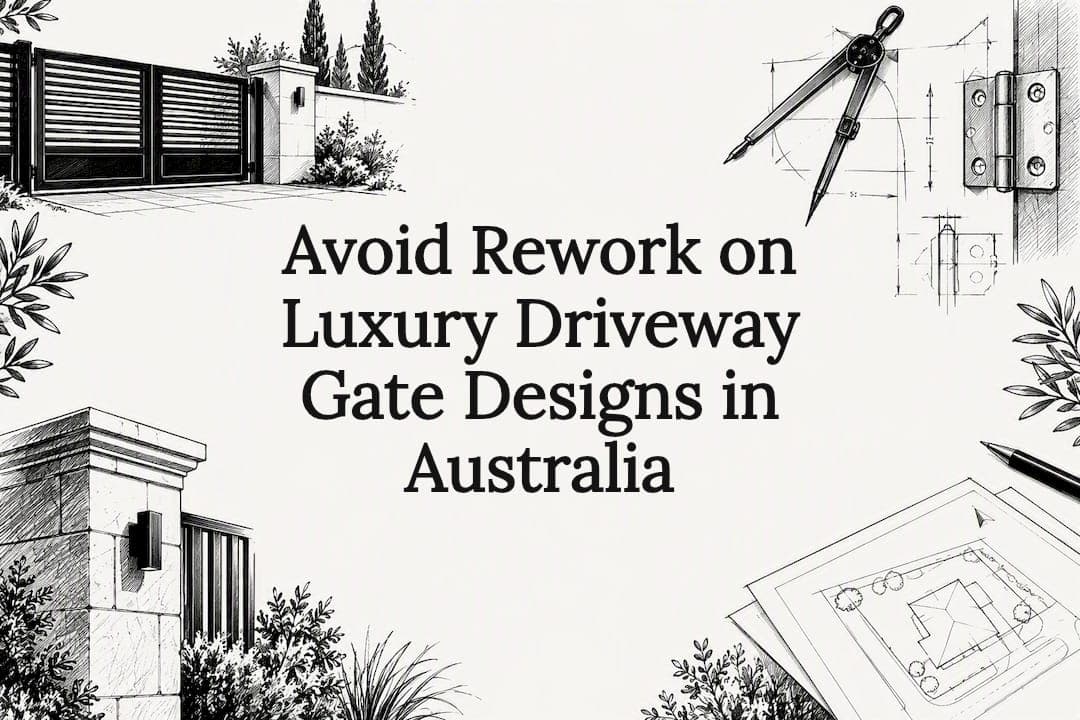
For a true luxury driveway gate, a bespoke, designer-led solution that balances proportion, material, and engineering delivers the best long-term result. Three style directions consistently deliver that quiet, high-end look: modern horizontal slats, refined vertical bars, and sculptural Corten or laser-cut panels. Which one is right depends on your site's slope and clearance, your automation and security needs, and how much your driveway approach already dictates the answer.
TL;DR:
- Steel, Corten steel, and aluminum are the most durable finishes, with aluminum resisting corrosion well, particularly in coastal locations.
- Swing gates are ideal for flat, wide driveways with enough clearance, while sliding or cantilever gates suit sloped or restricted sites.
- Automation systems should be concealed, with solar backup and low-energy motors to improve energy efficiency and reliability during power outages.
- Design should prioritize proportion and engineering details over ornament, ensuring longevity and aesthetic balance for up to decades of use.
- Most bespoke gate projects take several weeks to months, with early site survey and CAD review crucial to avoid costly redesigns and permit issues.
Table of Contents
- What Are the Best Luxury Driveway Gate Designs Right Now?
- Which Materials and Finishes Hold Up Best?
- Swing, Sliding, or Cantilever: What Fits Your Driveway?
- What Automation and Security Features Do Luxury Homeowners Expect?
- How Does the Design and Fabrication Process Actually Work?
- What Actually Drives the Cost and the Ongoing Maintenance?
- Do You Need a Permit for a Luxury Driveway Gate?
- Are Luxury Gates Getting More Energy Efficient?
- The Priorities That Separate a Nice Gate From an Exceptional One
- Bring Your Vision to Gatecon: Bespoke Gates, Fencing, and Full Packages
- Sources
- FAQ
What Are the Best Luxury Driveway Gate Designs Right Now?
Luxury gate design has moved away from ornament for ornament's sake. The strongest results today come from restraint: a limited material palette, disciplined proportions, and one or two deliberate design gestures rather than a dozen decorative flourishes.
Several style families dominate high-end driveway projects right now, each suited to a different kind of home and site.
- Modern minimalist slats. Horizontal timber-look aluminum or steel slats with matte black or dark bronze frames read as quiet luxury. This style suits contemporary and mid-century homes, and it tends to photograph beautifully against rendered or brick facades.
- Vertical-bar and refined grill designs. Slim vertical bars framed by rendered pillars preserve sightlines into the property while still signaling security and permanence. A well-documented example of this proportion play, a modern double driveway gate with slender bars and clean pillar framing, shows how spacing and scale do more visual work than density of material.
- Classic ornamental and wrought iron. For heritage homes, period properties, or anyone restoring a character facade, detailed scrollwork and traditional pickets still make sense, but they need to match the era of the house rather than sit as a generic add-on.
- Corten and laser-cut sculptural panels. Oxidized steel panels with cut patterns make a genuine statement entrance and develop a low-maintenance patina over time.
- Mixed-material gates. Pairing steel frames with timber inserts adds warmth to an otherwise industrial palette, particularly on homes with existing timber cladding or landscaping.
Trend analysis of high-end estate entrances confirms this shift toward horizontal slats, matte black frames, and privacy-first panels paired with quiet automation, rather than the heavier, more decorative gates that dominated a decade ago. Whatever direction you lean, ask your designer to show sightline studies and pillar proportions before committing. A gate that looks right on a rendering can feel oversized or undersized once it's standing at your actual driveway width.
Which Materials and Finishes Hold Up Best?
Material choice determines both how your gate looks in ten years and how much you'll spend keeping it that way. Galvanized and powder-coated steel gives you the strongest structural option and the widest color range, but it's the heaviest material, which affects motor sizing. Aluminum is lighter, resists corrosion well, and suits coastal properties, though it can flex more on very wide spans. Corten steel develops a rust-toned patina that many designers use deliberately as a design feature. It needs almost no maintenance once the patina stabilizes, but that stabilization period can stain adjacent paving if drainage isn't planned for.
Timber accents add warmth but need sealing every one to two years depending on sun exposure, and timber expands and contracts with humidity, which matters for tight-fitting slat gates.
- Coastal or high-salt-air properties do best with marine-grade powder coating or anodized aluminum.
- High-sun exposures fade darker finishes faster; matte and textured coatings hide fade better than gloss.
- Heavier finishes and materials mean your motor needs more torque, which affects both cost and cycle speed.
Pro Tip: Ask your fabricator for the actual gate weight before finalizing your motor spec. Undersized motors on heavy steel or sculptural panels are the single most common cause of early automation failures.
Swing, Sliding, or Cantilever: What Fits Your Driveway?
Your site's topography decides more of this choice than your style preference does. A flat, wide approach with room for the gate to arc open gives you the most design freedom, since swing gates showcase detailing on both faces. Slopes and tight side clearances change the equation entirely.
- Choose swing gates when your driveway is flat at the entry point and there's enough setback for the leaves to clear without scraping.
- Choose sliding gates when you have a slope, limited flat ground, or a driveway that curves right at the entrance, since a swinging arc simply won't clear.
- Choose cantilever sliding gates on steeper or uneven sites; because they don't run on a ground track, they avoid the debris and ice problems that plague standard sliders on inclines.
- Brief your designer with hard numbers: drive width, slope percentage at the gate line, and setback distance from the property boundary. Guessing at these figures is how gates end up misaligned after installation.
Foundation design and motor torque both depend on which family you land on, so this decision needs to happen early, not after you've already picked a style.
What Automation and Security Features Do Luxury Homeowners Expect?
Automation on a luxury gate should feel invisible until the moment you need it. Concealed motors built into pillars or gate posts keep the mechanics out of sight, while cabinet-style motors are easier to service but sit more visibly at the base of the gate.
- Battery backup or solar-assisted systems keep the gate operational during a power outage, a feature increasingly standard on high-end installations.
- Quiet, fast-cycling motors matter more than most buyers expect. A gate that grinds or takes twenty seconds to open feels cheap no matter how good it looks.
- Access control, from keypad and remote to intercom and smartphone app integration, should tie into your existing home system rather than run as a separate network.
- House-name plaques and integrated lighting need internal steel framing and sealed backing panels built in at the CAD stage, not bolted on afterward.
Pro Tip: If you want illuminated house numbers or a lit crest on the gate, tell your designer during the CAD review, not after fabrication starts. Retrofitting wiring into a finished panel usually means rebuilding part of it.
Ask about service contracts up front too. Motors, sensors, and hinges all wear differently depending on cycle count, and a maintenance agreement is far cheaper than an emergency callout.
How Does the Design and Fabrication Process Actually Work?
A typical bespoke gate process typically follows four stages, and each one exists to catch problems before they become expensive mistakes.
- Site survey and brief. This establishes drive width, slope, power access, and your design preferences.
- Digital template and CAD review. You see the actual proportions, pillar spacing, and detailing before anything is cut, and this is the point to lock in lighting, house-name panels, or monogram details.
- Fabrication. Panels, frames, and any ornamental elements are built to the approved template.
- Installation and automation commissioning. The gate is fitted, motors and access controls are wired in, and the whole system is tested under real-world cycling before handover.
Practitioners across the bespoke gate industry lean heavily on that digital template stage for good reason: it lets clients refine the visual concept before a single piece of steel is cut, catching proportion issues while changes still cost nothing. That collaborative front end matters even more on heavy or sculptural pieces. Fabrication case studies of monumental bronze gates show that large ornamental elements often need concealed anchoring and load-bearing adaptations worked out between designer and fabricator well before installation day, not improvised on site.
Most bespoke residential projects run from initial survey to final commissioning across several weeks to a few months, depending on design complexity and fabrication queue. If your gate ties into an existing masonry wall or retaining structure, it's also worth understanding how structural loads get managed when a new installation meets an older foundation.
What Actually Drives the Cost and the Ongoing Maintenance?
Detail complexity, material choice, and automation grade are the three biggest cost levers on a bespoke gate. Industry sources on custom metal gate fabrication consistently point to design complexity, size, and automation grade as the factors that move both price and lead time the most, more than the base material itself in many cases.
- Intricate laser-cut detailing or sculptural panels take longer to fabricate than clean slat or bar designs.
- Site prep and foundation work add cost on sloped or difficult-access sites.
- Higher automation grades (concealed motors, solar backup, integrated access control) cost more up front but reduce service calls later.
- Standardized hardware and modular detailing can trim both budget and lead time without sacrificing the bespoke look.
For upkeep, plan on an annual check of hinges, motor mounts, and electrical connections, plus finish touch-ups every few years depending on your exposure.
Do You Need a Permit for a Luxury Driveway Gate?
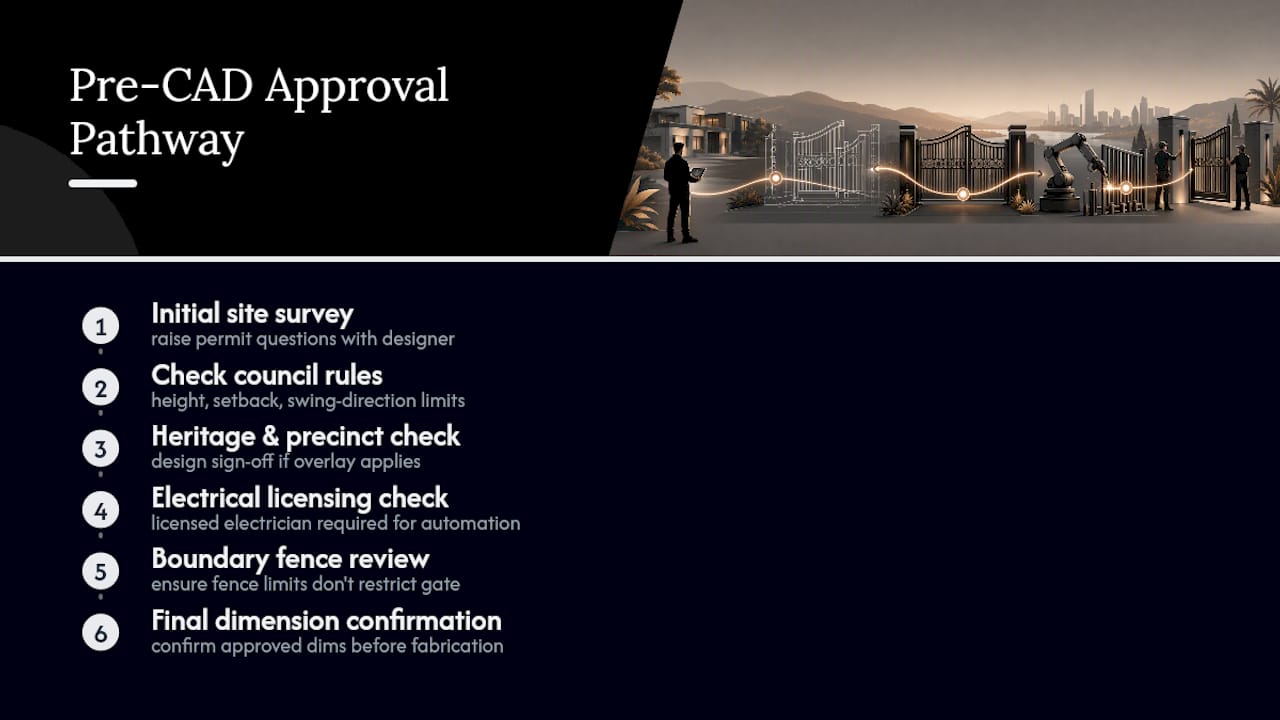
Most councils across Australia require some form of approval for a new driveway gate, particularly when the gate is automated, exceeds a certain height, or sits near a boundary or public footpath. Requirements vary by council area, so the specific height limits, setback rules, and swing-direction requirements that apply to your property depend on your local planning scheme.
A few things tend to come up across most jurisdictions. Automated gates usually need to open inward or be set back far enough that the swing arc never crosses the property line into a road reserve or footpath, since a gate swinging into a public path is a common safety objection. Height restrictions near street frontages are common too, especially on corner blocks where sightlines for passing traffic matter. If your property sits on a heritage overlay or within a specific character precinct, the design itself, not just the mechanics, may need council sign-off.
Electrical work for gate automation typically requires a licensed electrician regardless of council permit status, since it involves mains wiring and outdoor circuits. Boundary fencing height limits can also interact with your gate design if the gate is part of a continuous fence line rather than a standalone feature.
The practical move is to raise permit questions with your designer during the initial site survey, before the CAD stage locks in dimensions. A gate designed to a height or setback that later gets rejected means redesign costs that a five-minute council inquiry upfront would have avoided.
Are Luxury Gates Getting More Energy Efficient?
Automation is where most of the sustainability conversation in gate design actually happens, more than the metal or timber itself. Solar-assisted motor systems, now common on higher-end installations, let the gate run on battery power topped up by a small panel rather than drawing continuously from mains power, and they keep working during outages when a standard mains-only system would fail.
Motor efficiency matters too. Slower, older motor designs draw more current per cycle than modern brushless motors, which means a gate that opens and closes dozens of times a day (as many driveway gates do) has a real cumulative power draw over a year. Choosing a motor rated for lower standby consumption is a small spec detail that adds up.
On the materials side, Corten steel's low-maintenance patina reduces the lifecycle impact of repainting and recoating that powder-coated finishes eventually need. Aluminum is also highly recyclable at end of life compared to composite materials. Timber accents, if sourced from certified sustainable plantations, add a renewable element to an otherwise mineral-heavy material palette.
None of this requires sacrificing the design language you want. A solar-backed motor sits invisibly inside a pillar or cabinet, and a Corten panel looks identical whether or not you've thought about its maintenance footprint. The sustainability gains here come from spec choices made at the CAD stage, which is one more reason that early planning conversation with your designer matters more than it seems.
The Priorities That Separate a Nice Gate From an Exceptional One
Ornament gets the attention, but proportion and engineering are what actually make a gate feel expensive. A slightly wider pillar, a corrected sightline, a motor sized for the real weight of the panel. These decisions happen at the CAD stage or they don't happen at all.
Longevity matters more than most homeowners plan for. Choose automation you can actually get serviced locally, not a system that locks you into a single obscure supplier. If you're weighing options, ask your designer to walk you through proportion studies before finish samples. It's a smaller conversation than picking a color, but it decides whether the gate looks right in five years.
— Rhys
Bring Your Vision to Gatecon: Bespoke Gates, Fencing, and Full Packages
Bespoke gates are built through a process that starts with a CAD-based template review, so clients see the real proportions, pillar spacing, and detailing before any steel is cut, and every installation ends with the automation and access controls tested under real cycling before handover.
Gatecon's core services cover architectural gates for standalone entrance statements, designer fencing for homeowners planning a full boundary treatment, and custom packages that combine both into a single coordinated project. An initial consultation walks through your site survey, a rough timeline estimate, and early style direction, so you have a clear picture of what fabrication and installation will involve before committing to a design. If you want to see how these design principles look built and installed, book a design consultation through Gatecon's architectural gates page and start with a site assessment.
Sources
- Modern double driveway gate | Hoog Design
- The Gates of Eden — BELT Metal Art+Design
- Behind the gates: driveway entrance styles that define LA's estates — Omni Home Ideas
FAQ
What Makes a Driveway Gate "Luxury" Rather Than Just Custom?
A luxury driveway gate is defined less by ornament and more by proportion, material quality, and how well the design matches the home's architecture. Restraint, disciplined sightlines, and quality automation typically read as more expensive than heavy decoration.
Should I Choose a Swing Gate or a Sliding Gate?
Swing gates work best on flat, wide approaches with room for the leaves to arc open without obstruction. Sliding or cantilever gates suit sloped sites or driveways with limited clearance, since a swinging arc simply can't clear a slope or a tight setback.
How Long Does a Bespoke Gate Project Take?
Timelines depend on design complexity, material choice, and automation grade, with fabrication lead times varying based on how intricate the detailing and automation is. Most bespoke residential projects run from an initial site survey through installation across several weeks to a few months.
Do I Need Council Approval for an Automated Gate?
Most councils require some form of approval, especially for automated gates near boundaries or public footpaths, but exact height and setback rules vary by local planning scheme. Raise this with your designer during the initial site survey so any restrictions get built into the CAD design from the start.
What Does Gatecon Include in a Design Consultation?
A consultation with Gatecon covers your site survey, a CAD-based template review, and an early timeline estimate before any fabrication begins. Pricing for architectural gates, designer fencing, and custom packages is available on request through Gatecon's site.