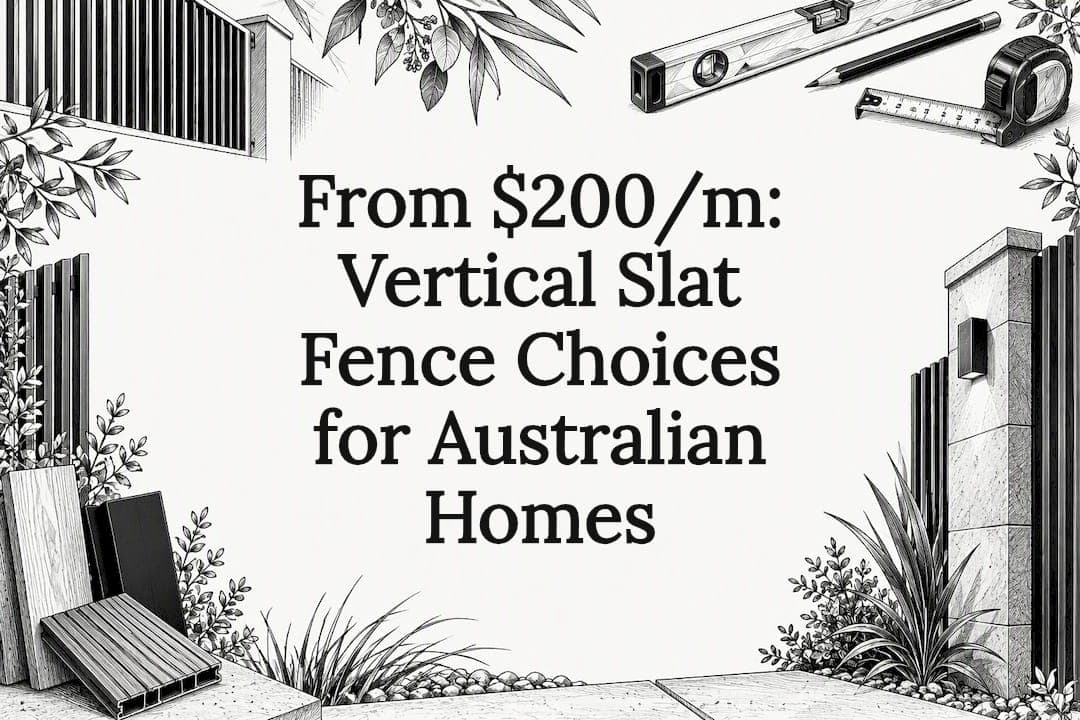
For most homeowners chasing low-maintenance privacy, powder-coated aluminium vertical slats are the safest default choice. Timber wins on warmth if you're willing to maintain it, and composite splits the difference. DIY works for a short, flat run; hire an installer for pool boundaries, slopes, or anything touching AS 1926.1:2024 compliance.
TL;DR:
- Aluminium slats are ideal for coastal or pool areas due to their corrosion resistance and low maintenance, but timber provides more warmth with regular sealing.
- Proper gap-to-slat ratio and viewing angle influence privacy, with stricter standards for pool barriers requiring gaps no larger than 10mm.
- Installation costs range from $200 to $500 per meter depending on materials, gate hardware, and site preparation, so comparing detailed quotes is essential.
- DIY is feasible for short, flat fences, but complex sites or longer runs benefit from professional installation to ensure precision and compliance.
- Designing a custom fence with piers, matching hardware, and thoughtful lighting enhances appearance and aligns with environmental considerations without extra cost.
Table of Contents
- What Materials And Styles Work Best For A Vertical Slat Fence?
- How Does Slat Spacing Affect Privacy And Compliance?
- How Much Does A Vertical Slat Fence Cost?
- Should You DIY Or Hire A Professional Installer?
- How Can You Design A Slat Fence That Looks Custom?
- Is A Vertical Slat Fence An Environmentally Sound Choice?
- Why Precision Matters More Than Most Homeowners Expect
- Get A Custom Vertical Slat Fence Built Right The First Time
- Sources
- FAQ
What Materials And Styles Work Best For A Vertical Slat Fence?
Aluminium, timber, and composite each solve a different problem, and the right pick usually comes down to how much upkeep you're prepared to do over the next decade.
Aluminium is dimensionally stable and resists corrosion, which is why it's the go-to choice for coastal properties and pool surrounds where salt air and constant moisture wreck timber over time. It won't warp, crack, or need repainting for years, and a powder-coat finish holds its color through direct sun exposure. Timber brings texture and warmth that aluminium can't fake, but it demands sealing or oiling every one or two years depending on exposure, and it moves with humidity.

Composite sits in between: a wood-look finish over a more stable core, with less maintenance than raw timber but a softer aesthetic than metal, as detailed in this plantation shutters comparison guide on material performance and finishes.
Style choice matters as much as material:
- Straight vertical battens in narrow widths (around 40 to 70mm) suit tight courtyard screens and modern facades.
- Wide slats (100mm or more) give a bolder, more architectural street presence with fewer fixings per meter.
- Angled or louvered blades improve airflow and add a sense of movement, useful when you want privacy without a solid wall feel.
- Pre-finished timber or factory powder-coat saves a maintenance step compared with site-applied stains or paints.
How Does Slat Spacing Affect Privacy And Compliance?
Spacing is really a ratio problem, not a millimeter problem. Think in gap-to-slat proportions rather than fixed numbers, because the same gap reads completely differently against a narrow batten than a wide one. A 20mm gap next to a 40mm slat feels open; the same 20mm gap next to a 150mm slat feels almost solid.
Privacy also changes with viewing angle. Looking straight at a slat fence you'll see daylight through every gap, but from an oblique angle the slats overlap visually and block the sightline almost entirely, which is why fences that look permeable head-on often feel private in daily use.
AS 1926.1:2024 compliance for pool boundaries: the revised pool safety standard sets a minimum barrier height of 1,200mm, caps vertical gaps at 100mm, and requires a 900mm non-climbable zone around the barrier. Horizontal slat designs are held to a stricter 10mm gap limit in that zone, which is a big reason vertical orientation is the more practical pick around pools.pdf).
Street-facing fences carry their own rules. Many councils cap solid fence height and require visual permeability above 1.2 meters on front boundaries, with gap-to-slat ratios written into local planning policy. Check yours before you order materials.
How Much Does A Vertical Slat Fence Cost?
Aluminium slat fencing typically runs in three bands. Basic setups start around $200 per meter, mid-range jobs land between $250 and $350, and premium custom work with heavier profiles, engineered footings, and integrated gates can push $300 to $500 or more per meter. Timber tends to sit lower upfront but adds recurring maintenance costs that aluminium avoids.
What actually moves a quote between bands:
- Gates and automation hardware, especially sliding or swing driveway gates wired into access control.
- Engineered footings for retaining, wind exposure, or council sign-off.
- Powder-coating in a custom color versus a standard stock finish.
- Site prep: demolition of an old fence, excavation, or leveling on sloped ground.
Before you compare quotes, standardize the specs across every supplier: fence height, slat width and gap, post spacing, and footing depth. Two quotes with the same per-meter price can hide very different post spacing or shallower footings, so ask each supplier to itemize those four numbers before you compare totals.
Should You DIY Or Hire A Professional Installer?
A short, flat, low-stakes run is a reasonable DIY project if you're comfortable with a drill, a level, and patience. Anything involving a pool boundary, a slope, a long unbroken run, or a gate with automation is where hiring a professional starts paying for itself. Installers commonly finish a 20-meter run, automation included, in about two days, a timeline that stretches considerably for a first-time DIYer working evenings and weekends.

Sloped sites need a specific decision: stepped panels or tapered posts, not a continuous raked gap that looks uneven once the sun hits it sideways. Wind-exposed sites need deeper footings than a sheltered backyard, regardless of how the fence looks above ground.
If you're building it yourself, four habits separate a clean result from an obviously amateur one:
- Let timber acclimatize on site for a few days before fixing it, so it doesn't shrink and gap unevenly later.
- Coat all four faces and both ends of every timber slat before installation, which cuts down on moisture cycling and keeps gaps consistent for years instead of months.
- Use a spacer jig and check plumb every one to two meters rather than eyeballing it down the whole run.
- Cut aluminium with proper metalworking tools. A rough or angled cut is obvious on a long run even from the street.
Pro Tip: Buy or make one spacer jig sized to your exact gap before you fix a single slat. Eyeballing spacing by eye almost always drifts over a 10 meter run, and by the time you notice, you've already fixed twenty slats you have to pull back out.
How Can You Design A Slat Fence That Looks Custom?
Piers spaced along a slat run break up long stretches visually and give you a place to mount house numbers or lighting without drilling into the fence itself. If your frontage is subject to a visual permeability rule, alternating solid pier sections with slat infill can help you hit the required openness without sacrificing the look.

Match your driveway gate to the fence profile rather than treating it as an afterthought. A sliding gate needs a clear running track, while a swing gate needs pier clearance and swept-area room, so decide on the gate type before you finalize post spacing along the frontage.
A few finishing touches lift the whole result:
- Recessed strip lighting along piers or the base of the fence for a clean nighttime silhouette.
- Planter boxes or hedging in front of narrower-gap sections to add a second privacy layer.
- A matte or textured powder-coat finish rather than gloss, which hides dust and fingerprints on gate hardware.
- Consistent hardware finish across gate, fence, and any adjoining screens, so the whole frontage reads as one design rather than three separate purchases.
Is A Vertical Slat Fence An Environmentally Sound Choice?
Material choice here has real environmental weight, and it's not the same trade-off for every material. Aluminium is energy-intensive to produce but highly recyclable at end of life, and a well-made aluminium fence can outlast several timber replacements, which lowers its lifetime footprint even with a heavier manufacturing cost upfront.
Timber has a lower embodied energy footprint if it's sustainably sourced, but shorter service life and repeated recoating over the years add up in both cost and resource use. Composite sits in the middle again: it often uses recycled content in its core, but it's harder to recycle at end of life than pure aluminium.

Vertical orientation itself has a small but real sustainability edge over horizontal slats: it sheds water more effectively, which reduces rot risk and the maintenance products used over the fence's life. If sustainability is a genuine priority, ask any supplier where their aluminium is sourced and whether their timber carries forestry certification. Not every supplier will have a good answer, and that's worth knowing before you sign a contract.
Why Precision Matters More Than Most Homeowners Expect
A slat fence lives or dies on straight lines. A single post out of plumb, or a gap that drifts 5mm over ten meters, shows up immediately from the street in a way a solid paling fence hides. Gatecon builds fencing to coordinate with the driveway gate, not as a separate afterthought, because a mismatched profile or automation hardware bolted on later almost always looks like exactly that. Precision on-site is what turns a good design into a fence that still looks intentional five years from now, particularly where a gate has to swing, slide, and lock without fighting the fence line around it.
— Rhys
Get A Custom Vertical Slat Fence Built Right The First Time
Custom vertical slat fencing can be designed and installed to match your driveway gate rather than as an unrelated add on. That means one team handling material selection, slat profile, automation integration, and pool-safety compliance from the start, instead of coordinating three separate trades yourself.
If you're weighing aluminium against timber, or trying to work out how a gate will interact with your slat spacing, Designer Fencing covers the fencing side and Architectural Gates covers coordinated entry design. Request a site consultation and get a quote scoped to your actual frontage, slope, and pool boundary, not a generic per-meter estimate that ignores what your property actually needs.
Sources
- Safeguarding Our Young Swimmers: Standards Australia Announces Release of Revised Swimming Pool Standard
- Local Planning Policy 2.8 — Fences (Fremantle WA)
- The Complete Guide to Vertical Slat Fencing
- Aluminium Slat Fence Installation Cost in Melbourne: A Guide for 2026 | Outstanding Fencing Blog
FAQ
What Are Vertical Slats On A Fence Called?
They're most commonly called vertical slats or vertical battens, and angled versions are often called vertical blades or louvers. All three terms describe the same basic idea: individual boards or panels fixed upright with a gap between them.
How Much Does A Slat Fence Cost?
Aluminium slat fencing typically costs $200 to $500 or more per meter installed, depending on slat profile, gates, and site prep. Timber usually starts lower per meter but adds ongoing maintenance costs that aluminium doesn't carry.
What Are Vertical Fence Panels Called?
Vertical fence panels are usually called slat panels or batten panels, built from individual vertical boards fixed to horizontal rails. The term applies whether the panels are aluminium, timber, or composite.
Are Slat Fences Good For Privacy?
Yes, when the gap-to-slat ratio is chosen well. Slats that look partly open when viewed straight on tend to block the sightline almost completely from an angle, since the boards overlap visually as you move past them.
Do I Need A Professional For A Pool-Side Slat Fence?
Pool boundaries fall under AS 1926.1:2024, which sets exact height, gap, and non-climbable zone requirements. Hiring an experienced installer, such as Gatecon, reduces the risk of a compliance failure that has to be torn out and rebuilt.