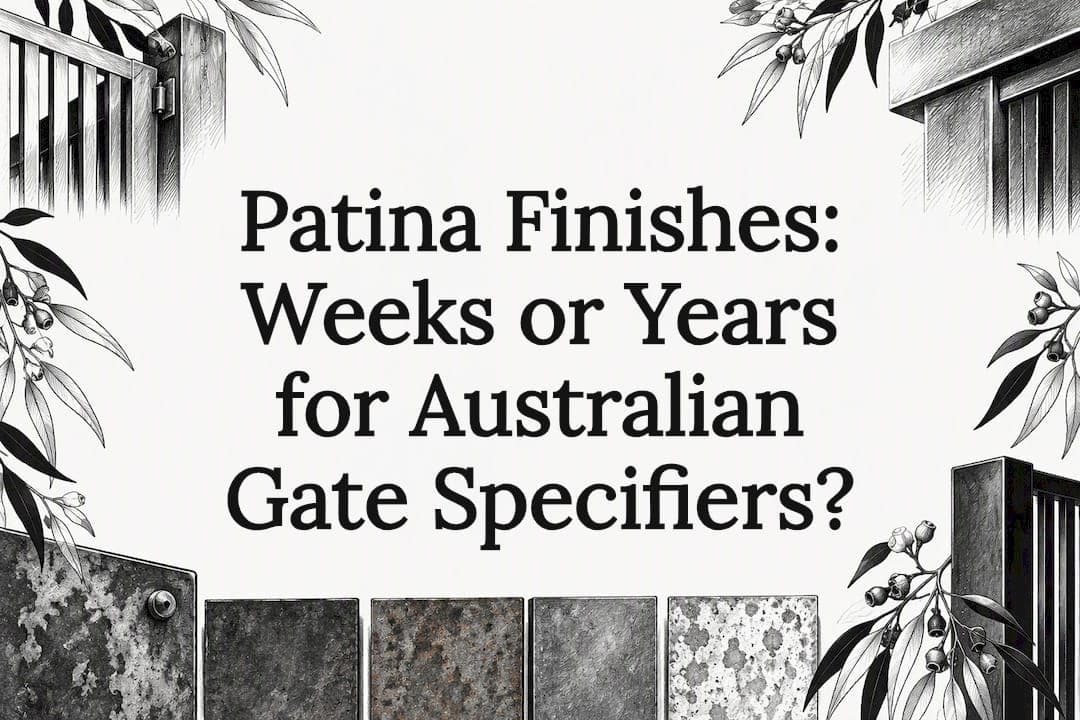
A patina finish is a chemically altered surface layer, often attractive and protective, that forms on metals like copper, bronze, brass, and weathering steel. For a gate, this layer delivers an aged, architectural look while offering a degree of surface protection. The main choice you face is whether to let that layer develop naturally over years or to specify an engineered finish that delivers the look immediately.
TL;DR:
- Marine and industrial sites develop color within a year, while stable green may take 5 to 7 years; rural sites need 10 to 14 years.
- Weathering steel needs airflow and drainage, since trapped moisture in tight joints causes pitting; coastal salts can destabilize copper alloy patinas faster than inland exposure.
- Forced patination delivers an aged look within weeks, but corrosive chemicals require trained handling; factory panels can show uneven color, poor adhesion, or staining.
- Clean patinated surfaces with mild soap and water, avoid abrasives and strong alkaline cleaners, and treat powdery green or white deposits as possible active corrosion.
- Because copper and bronze are softer than steel, gates may use steel frames with cladding; pigment coatings imitate patina without forming its protective mineral layer.
Table of Contents
- What Patina Is and Which Metals Develop It
- Natural Patina vs Forced Patina: Methods, Results, and Safety
- Material Choices for Gates: Matching Finish to Performance
- How Environment and Location Change Patina Timelines
- Protecting and Maintaining a Patina Finish
- Artisan Techniques and Product Options for Patina Effects
- Commissioning a Patina-Finished Gate: What We Check
- Balancing Aesthetics and Performance in Patina Choices
- Getting a Patina Finish Right on Your Gate
- FAQ
- Sources
What Patina Is and Which Metals Develop It
Patina is the product of oxidation: metal reacts with oxygen, moisture, and airborne compounds to form a new mineral layer on its surface. On copper, this process typically produces cuprite (a reddish-brown oxide) first, then brochantite or other copper sulfates that give the familiar blue-green finish. The chemistry matters because not every oxide layer behaves the same way. Some protect the metal underneath; others keep eating into it.
A handful of metals are chosen specifically because they patina well:
- Copper develops the classic blue-green patina prized on roofs, cladding, and gate accents.
- Bronze and brass (copper alloys) form darker brown, amber, or green patinas depending on their zinc and tin content.
- Weathering steel, sold under trade names like Corten, forms a dense rust-colored oxide layer that slows further corrosion once stabilized.
Stainless steel and galvanized steel behave differently. Stainless resists oxidation by design, so it rarely develops a visible patina unless deliberately treated. Galvanized steel's zinc coating forms its own protective layer, but it is a sacrificial barrier rather than a decorative patina.
One caution applies to bronze and copper alloys in particular: not every green surface growth is benign. "Bronze disease," a powdery, chloride-driven corrosion, actively destroys the metal rather than protecting it, which is why distinguishing a stable patina from active corrosion matters for anything you plan to keep outdoors for decades.

Natural Patina vs Forced Patina: Methods, Results, and Safety
Natural patina develops on its own timeline, shaped by humidity, pollution, and salt exposure. Forced, or artificial, patina uses chemical treatments to replicate that look in weeks rather than years, which appeals to anyone who wants a finished, aged gate from day one rather than waiting for the weather to do the work.
Workshops and specialist finishers commonly use:
- Liver of sulfur for browning copper and bronze quickly.
- Hydrochloric acid solutions to accelerate oxide formation on copper surfaces.
- Ammonium chloride mixed with other agents to produce green or blue-green tones.
These accelerants carry real handling requirements. Hydrochloric acid and ammonium chloride are classified as Class 8 corrosives under Australian dangerous-goods regulations, which govern how they are stored, transported, and handled. This is one reason forced patination is typically left to professionals with the right equipment and training rather than attempted as a weekend project.
Factory pre-patinated panels solve the waiting problem but introduce their own issues. According to technical guidance from Austral Wright Metals, pre-patinated copper products can show uneven coloration, poor adhesion, and staining of adjacent materials, because reproducing a naturally formed, environment-driven patina inside a factory is difficult to control consistently. If you are specifying a pre-patinated panel for a gate, ask your fabricator how they manage these variables before the material reaches site.
Material Choices for Gates: Matching Finish to Performance
Choosing a base metal for a patina-finished gate means balancing the look you want against how that material performs outdoors for the next several decades.
- Copper, brass, or bronze cladding suits formal, heritage, or coastal-adjacent designs where a warm, evolving color is part of the appeal.
- Weathering steel (Corten) fits rustic or industrial gate designs, producing a rich rust-red surface that darkens over time.
- Stainless or galvanized steel with a faux patina coating offers the aesthetic without relying on the base metal's own chemistry, useful where budget or maintenance simplicity outweighs authenticity.
Each option carries trade-offs. Copper and bronze are soft relative to steel, so structural gate components are often steel with copper or bronze detailing rather than solid copper construction. Weathering steel needs airflow to form its protective layer correctly; trapped moisture in tight joints can cause pitting instead of a stable patina, so design details like drainage and ventilation matter as much as the metal choice itself. In heavy salt-spray locations, chloride buildup can destabilize patinas on copper alloys faster than inland sites, which is worth discussing with your fabricator before committing to a material for an exposed coastal driveway.
How Environment and Location Change Patina Timelines
Patina does not form at a single predictable rate. It depends heavily on where the gate sits and what the air around it carries.
Industrial and marine atmospheres accelerate the process because of higher pollution and salt content. Austral Wright Metals reports that copper typically reaches a stable blue-green patina in several years under these conditions. Clean rural air slows things down considerably, with the same stable patina taking more time to form in cleaner rural air. In very dry or arid climates, a green patina may never fully develop at all, because the chemical reactions that produce it depend on sustained moisture.
- Marine and industrial sites: expect visible color change within the first year, moving toward a stabilized blue-green surface within 5 to 7 years.
- Clean rural settings: expect a slower, more even progression through brown and dark tones before reaching a stable patina around the 10 to 14 year mark.
- Arid or very dry regions: expect the metal to stall at a brown or black oxide stage indefinitely, without reaching the green patina associated with wetter climates.
Humidity and atmospheric chlorides do more than speed things up. They shape which minerals form, which is why two gates installed a few kilometers apart, one near the coast and one further inland, can end up looking noticeably different after the same number of years. A "stabilized" patina is one where the color and texture have stopped changing meaningfully year to year, which is the point at which the layer is doing its protective job rather than still evolving.
Protecting and Maintaining a Patina Finish
A patina finish still needs care, even though part of its appeal is looking weathered. Gentle maintenance preserves the layer you want; the wrong cleaning approach can strip it back to bare metal.
- Rinse with mild soap and water on a regular schedule rather than letting grime accumulate.
- Avoid abrasive pads, wire brushes, or strong alkaline cleaners, which can scratch or dissolve the patina layer.
- Inspect for powdery green or white deposits, a sign of active chloride-driven corrosion rather than stable patina.
- Apply a clear protective coating where recommended, understanding it will slightly alter sheen and can require reapplication over time.
- Call in a specialist when active corrosion appears, since treating bronze disease or advancing rust early prevents structural damage later.
If you notice surface grime or mild oxidation on adjacent aluminum or painted components rather than the patinated metal itself, a simple palm test for oxidation before reaching for any cleaning product helps you judge whether gentle washing is enough or whether professional attention is warranted.
Pro Tip: Ask your fabricator for a written maintenance plan at handover, including which cleaners are safe and how often inspection is recommended, so the finish you approved is the finish you keep.
Artisan Techniques and Product Options for Patina Effects
Metal finishers use a range of hand-applied techniques to achieve patina looks on commission, each suited to different budgets and timelines.
- Brush-on chemical washes let a finisher control color variation by hand, useful for custom gates where uniformity is not the goal.
- Factory pre-patinated panels offer speed and consistency on paper, though as noted above they can suffer uneven adhesion and staining.
- Paint or pigment-based patina-effect coatings, such as Dulux Copper Patina Effect, change the appearance of metallic paint but do not form the durable mineral film a true patina does, which makes them a visual option rather than a substitute for genuine protection.
Setting realistic expectations for what each method can and cannot deliver avoids disappointment once the gate is installed.
Commissioning a Patina-Finished Gate: What We Check
When we design a gate intended to carry a patina finish, substrate preparation comes first: the base metal needs to be clean and correctly profiled before any natural or forced patina process can take hold evenly. We also plan for metal movement across seasonal temperature swings, coordinate the patina material with adjacent surfaces like render, stone, or timber to avoid staining, and specify hot-dip galvanizing underneath where a steel substrate needs long-term corrosion resistance beneath a decorative layer.
For your own brief to a fabricator, we recommend including:
- Reference photos of the exact patina tone and texture you want.
- A maintenance plan covering cleaning frequency and products.
- Clear warranty terms on both the finish and the underlying structure.
For related finish decisions, our guides on powder coat versus paint and hot-dip galvanizing cover protective options that often pair with a patina-finished gate.
Balancing Aesthetics and Performance in Patina Choices
A patina finish rewards patience and punishes shortcuts. The gates that age best are the ones where the base metal, the environment, and the maintenance plan were all considered together before fabrication started, not treated as separate decisions. We lean toward lifecycle-aware choices: picking a material and finish combination that still looks intentional ten years in, with a maintenance plan built around the specific conditions at the gate's address. A specialist's input early in the design, not after installation, is what makes that possible.
— Rhys
Getting a Patina Finish Right on Your Gate
We design, fabricate, and install bespoke gates where the patina finish is planned from the first sketch. That means substrate prep, coordination with adjacent materials, and a maintenance plan are part of the quote, not an afterthought once the gate arrives on site.
When you request a quote, ask for finish mockups, a clear breakdown of substrate preparation, and a maintenance plan specific to your property's exposure. Browse our Architectural Gates and Designer Fencing pages to see how we approach custom finishes, or get in touch to start your bespoke package.
FAQ
Which metals develop a true patina?
Copper, bronze, and brass develop a true patina because their oxidation products form stable, often colorful mineral layers on the surface. Weathering steel forms a similar protective rust layer, while stainless and galvanized steel largely resist the process by design.
Which metal should I choose for a patina-finish gate?
Copper, bronze, or brass cladding suits a formal or heritage look with a naturally evolving color, while weathering steel like Corten gives a rustic, industrial rust-red finish. The right choice depends on your design intent and the gate's exposure to salt, humidity, and pollution.
How is a patina forced onto brass?
Forced patina on brass typically uses chemical agents such as liver of sulfur or ammonium chloride solutions to accelerate oxide formation within days or weeks. Because some of these agents are classified as Class 8 corrosives, the process is best handled by a trained metal finisher rather than attempted without proper equipment.
What is a patina finish?
A patina finish is a naturally or chemically formed oxide layer on a metal surface that changes its color and texture over time. On metals like copper and bronze, this layer can also slow further corrosion, which is why it is valued for both appearance and durability on exterior gates.
Sources
- What Is Factory Patina Copper? | Austral Wright Metals
- Dangerous goods class 8: Corrosives (Freight Assist Australia)
- 690-D0101 DULUX COPPER PATINA EFFECT (GHS / product data)