For new metalwork meant to last decades, powder coating wins on durability, and by a wide margin. It resists chipping, fading, and corrosion better than liquid paint over the long run. Paint still earns its place when a piece is too large for an oven, has heat-sensitive parts, needs on-site finishing, or just needs a quick, low-cost fix. Beyond that, the real variable isn't the category at all. It's surface prep, coating grade, and whether the warranty actually backs the claim.
TL;DR:
- Powder coating offers a lifespan of 15 to 20 years for outdoor metalwork, significantly longer than the 5 to 7 years typically needed for repainting with liquid paint.
- The upfront cost of powder coating is roughly 40 to 60% higher than liquid paint, but it often results in lower total lifecycle costs over 15-20 years due to fewer repaint cycles.
- Proper surface preparation and adherence to standards like AAMA 2604 or 2605 are critical for achieving the durability claimed by powder coating; poor pretreatment can cause rust or failure faster than quality paint.
- Powder coating is limited to factory application with oven curing, making it unsuitable for oversized or heat-sensitive parts, whereas paint can be applied on-site using various methods such as spraying, brushing, or dipping.
- Repaints or touch-ups are easier to perform with liquid paint for DIY maintenance, but repairs on powder-coated parts typically require stripping and recoating, which can be more costly once damage occurs.
Table of Contents
- Powder Coat vs Paint: Comparing Durability, Cost, and Repair
- How Do Powder Coating and Liquid Paint Processes Differ?
- How Long Does Each Finish Actually Last?
- Powder Coat vs Paint: What Does Each Actually Cost?
- How to Choose Between Powder Coating and Paint for Your Project
- Maintaining and Repairing Powder-Coated and Painted Metalwork
- Environmental and Safety Differences Worth Knowing
- Gatecon's Perspective: Specifying Finishes for Bespoke Driveway Gates
- The Take: Specification Beats Category Every Time
- Sources
- FAQ
Powder Coat vs Paint: Comparing Durability, Cost, and Repair
Put the two finishes side by side and the trade-offs get obvious fast. Powder coating dominates on lifespan and material efficiency. Paint wins on flexibility, repairability, and where it can physically be applied.
| Factor | Powder Coating | Liquid Paint |
|---|---|---|
| Durability / lifespan | Often 15 to 20 years outdoors | Typically needs recoating every 5 to 7 years |
| Upfront cost | Roughly 40 to 60% higher than professional painting | Lower initial quote, more frequent repeat cost |
| Lifecycle cost | Often lower over 15 to 20 years due to fewer redo cycles | Can exceed powder coating cost once repaint labor is factored in |
| Repairability | Small chips need matched liquid touch-up; larger damage needs strip and recoat | Easy to blend and touch up on site with the right primer |
| Application location | Factory only (oven cure required) | Factory or on-site; also used via CED dipping for immersion parts |
| Environmental impact | Near-zero VOCs, reclaimable overspray | Solvent-borne systems emit VOCs; waterborne options reduce but don't eliminate them |
A few patterns show up once you start comparing quotes against this table:
- Powder coating's higher sticker price front-loads cost that paint spreads out over several repaint cycles.
- Large gates, oversized fence panels, and anything with heat-sensitive hardware (solenoids, electronic locks, seals) often rule out oven curing entirely, which makes the durability argument moot.
- Repairability cuts the other way from durability: paint is the easier finish to touch up without specialized equipment, which matters for anyone who wants to do their own maintenance.
- Environmentally, powder coating's dry-process advantage is real, but a well-specified waterborne paint system closes some of that gap for on-site work.
The table settles the broad strokes. The scenario details decide which column actually applies to your project.
How Do Powder Coating and Liquid Paint Processes Differ?
Powder coating works by charging dry powder particles electrostatically and spraying them onto a grounded metal part. The powder clings to the surface because of that electrical charge, then the part goes into an oven where heat melts the powder into a continuous, cross-linked film. That cure step is why powder coating happens almost exclusively at a factory or dedicated coating facility. You need an oven big enough for the part and a substrate that can conduct electricity for the powder to stick in the first place.
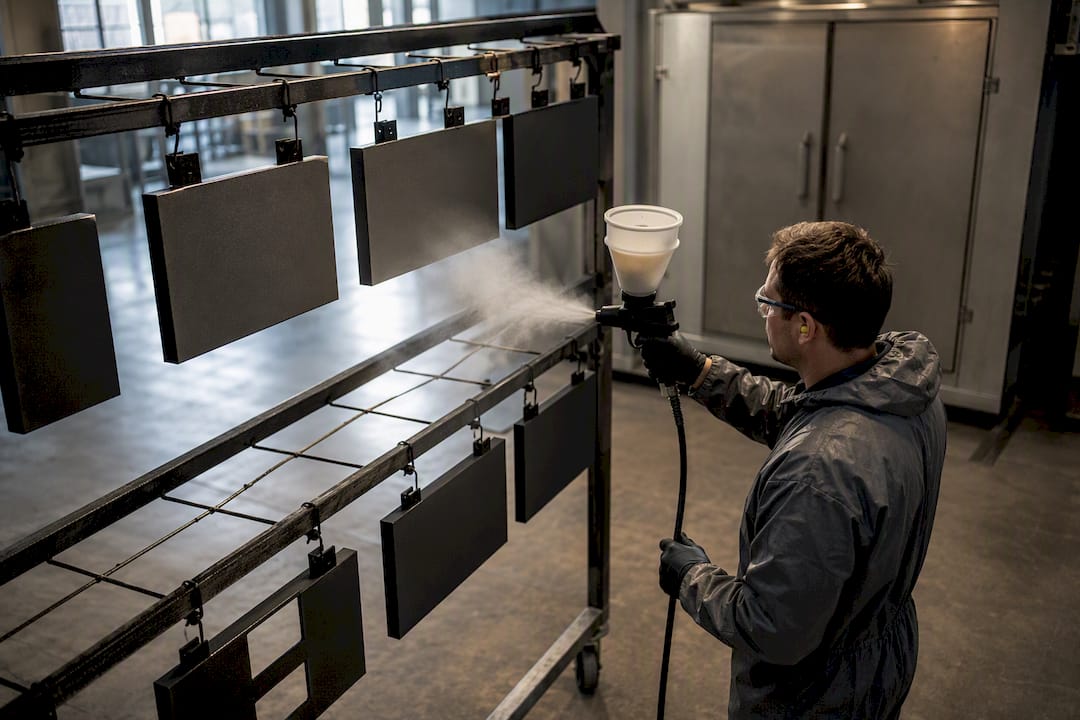
Liquid paint has more ways to get onto a surface: spray gun, roller, brush, or full immersion through cathodic electrodeposition (CED dipping), which pulls paint into every crevice using an electrical charge in a liquid bath. That versatility is the whole appeal. Paint cures at ambient or moderately elevated temperature, so it works on gates already installed, oversized fabrications that won't fit in any oven, and components with plastic or electronic parts that would warp or fail under powder coating's bake cycle.
Both processes hit real physical limits:
- Faraday cage effect: powder coating struggles to reach deep internal cavities and recessed corners because the electrostatic charge can't wrap around tight geometry, leaving thin or bare spots that need CED dipping or specialized liquid processes to fix.
- Part size: if it doesn't fit in the oven, it doesn't get powder coated, full stop.
- Heat sensitivity: rubber seals, foam gaskets, and some hardware can't survive the cure temperature powder coating requires.
How Long Does Each Finish Actually Last?
Powder coating on exterior metalwork typically holds up for 15 to 20 years, while quality exterior paint usually needs recoating every 5 to 7 years. That gap compounds over a gate or fence's usable life. A powder-coated driveway gate might get recoated once in twenty years; a painted equivalent could need three or four repaints in the same span, each with its own labor bill and downtime.
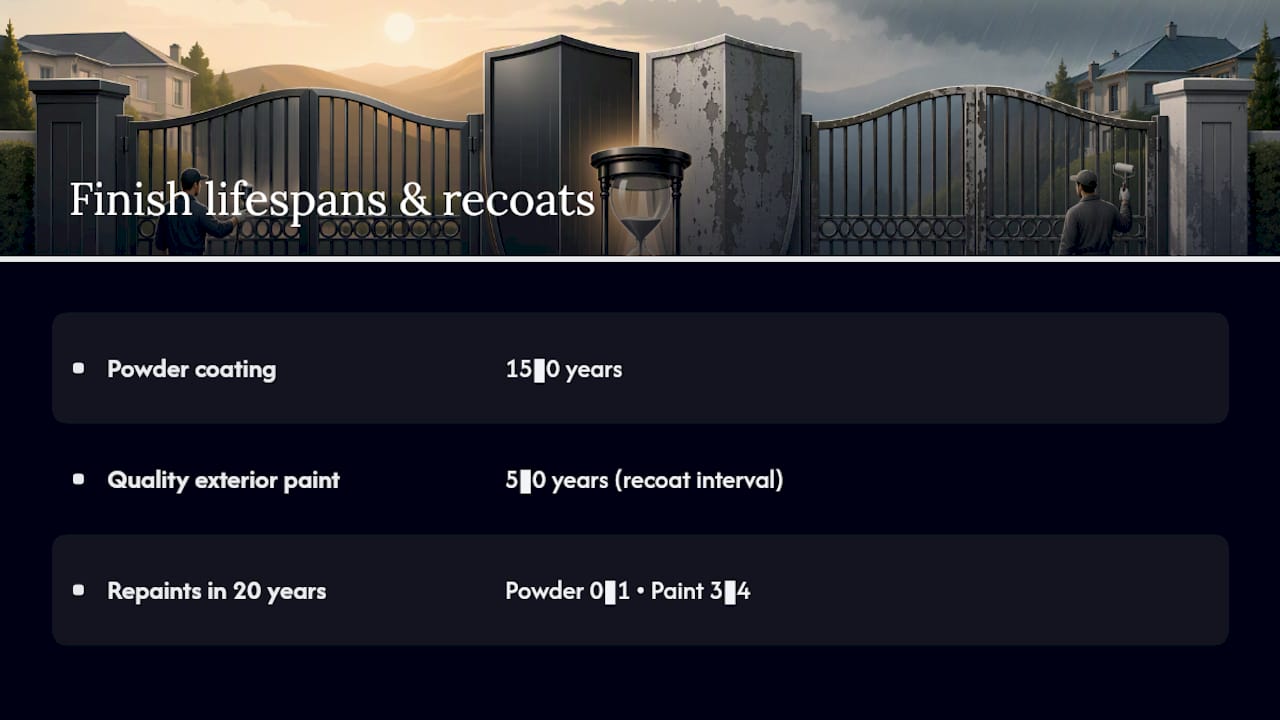
Failure shows up differently depending on the finish. Paint tends to chalk, fade, and eventually chip as UV exposure breaks down the resin binder, especially on south-facing or coastal installations. Powder coating fails less from UV degradation and more from impact damage or corrosion creeping in at an edge where the coating was thin or the substrate wasn't properly prepped.
That second point matters more than most buyers realize. Neither finish is inherently superior in isolation — performance comes down to surface preparation, pretreatment quality, and the coating system specified. A cheap powder coat job over poorly cleaned steel will rust from the inside out faster than a well-primed, properly applied paint system. This is exactly why architectural specifications like AAMA 2604 and AAMA 2605 exist: they set minimum standards for gloss retention, color fade, and chalk resistance so "powder coated" actually means something measurable rather than just a process label.
Pro Tip: Don't just ask if a finish is powder coated. Ask which AAMA grade it meets, because 2605 (the superfluoropolymer standard) holds color and gloss far longer than a generic 2604-rated polyester powder in direct sun.
Fabricating or welding after the coating goes on creates a separate failure risk entirely. It exposes bare metal at the cut or weld point, giving corrosion a foothold that spreads under the coating over time. Fabrication and pretreatment need to happen before the final finish, not after.
Powder Coat vs Paint: What Does Each Actually Cost?
Powder coating typically runs 40 to 60% more upfront than professional painting on comparable metalwork. That number surprises a lot of people shopping quotes for the first time, and it's the main reason paint still wins bids on tight budgets or short-term projects.
The lifecycle math tells a different story. Factor in labor for two or three repaint cycles over fifteen years, plus the scaffolding, masking, and downtime each repaint requires, and powder coating often comes out cheaper over the life of the installation, particularly for high-exposure pieces like driveway gates that face weather year-round without any wall or eave to shield them.
Material efficiency plays into this too. Powder coating's transfer efficiency runs roughly 70 to 90%, with reclaim systems pushing it above 95%, compared to liquid paint's 25 to 65%. Less wasted material per job is part of why powder coating's price gap narrows on larger production runs, even though the initial quote still looks higher line by line.
Before comparing quotes on price alone, confirm what's actually included:
- Pretreatment process (degreasing, etching, phosphate or chromate conversion coating)
- Primer system, if one is specified separately from the topcoat
- A touch-up kit matched to the exact color and finish
- Written warranty terms and what they actually cover
- Removal and reinstallation costs if the piece needs to travel to a coating facility
Two quotes with the same dollar figure can represent very different levels of protection once you strip out what's actually included.
How to Choose Between Powder Coating and Paint for Your Project
Work through this in order rather than jumping straight to a preference:
- Check part feasibility first. Can it fit in an oven, and is the substrate conductive enough for electrostatic application? If not, powder coating is off the table regardless of preference.
- Confirm the coating system and pretreatment. Ask specifically what pretreatment process precedes the topcoat, since this affects longevity more than the topcoat choice itself.
- Request the data sheet and warranty. A legitimate coating data sheet references a specification like AAMA 2604 or 2605, salt-spray test results, and specific warranty terms tied to that standard.
- Confirm the touch-up and removal plan. Ask how chips get repaired years down the line and what happens if the piece ever needs to come off site for recoating.
Run through a short mental checklist before you commit: can the piece be oven-cured, what's the expected UV and salt exposure, does the project need an exact color match down the road, and how will repairs get handled five or ten years out?
Pro Tip: Insist on a written warranty that names the specific coating standard, not just the word "powder coated." A supplier who can't produce a data sheet referencing AAMA 2604 or 2605 usually can't tell you what grade of powder they're actually using.
Maintaining and Repairing Powder-Coated and Painted Metalwork
Powder coating handles small chips well with a matched liquid touch-up product, but anything beyond a nick or scratch usually calls for stripping and recoating the whole piece rather than patching it. Cutting or welding a powder-coated part after the fact without a recoat plan just invites rust at the exposed edge.
Paint is friendlier to DIY repair. It blends more easily on site, and a homeowner with the right primer and matching color can touch up rust spots or scrapes without specialized equipment. That convenience comes at the cost of needing it more often, and skipping proper rust removal before repainting is the single most common reason a touch-up job fails within a year.
Routine care matters for both finishes:
- Inspect gates and railings twice a year, more often in coastal areas.
- Rinse salt spray off metalwork regularly in coastal or high-exposure zones to prevent early corrosion.
- Keep photos and dated notes of any damage or repair for warranty claims.
Pro Tip: Photograph any chip or scratch the day it happens, with a coin or ruler in frame for scale. Coating manufacturers often want this documentation before honoring a warranty claim.
Environmental and Safety Differences Worth Knowing
Powder coating is a dry, solvent-free process that emits virtually zero VOCs, while liquid paint relies on solvents that release VOCs as they evaporate. Overspray from powder coating is typically reclaimable and reused in the next batch, which cuts material waste well below what liquid spraying generates.
That doesn't make every liquid paint system a poor environmental choice. Waterborne formulations cut VOC output significantly compared to solvent-borne paint, even if they're not fully equivalent to powder coating on emissions or waste.
- Ask any supplier for the material safety data sheet on the specific product they're using, not a generic category claim.
- Ask how overspray and waste are handled and disposed of at their facility.
- Confirm their disposal process meets local requirements rather than taking "eco-friendly" at face value.
Gatecon's Perspective: Specifying Finishes for Bespoke Driveway Gates
Architectural powder coatings meeting AAMA 2604 or 2605 are often specified on bespoke driveway gates and fencing, because factory-cured finishes hold up to UV exposure and seasonal weather with minimal intervention over the piece's working life. That specification comes with a proper data sheet and warranty terms tied to the standard, not a vague promise of durability.
Liquid paint still has a place in the process, particularly for retrofits on existing gates, oversized custom assemblies that won't fit an oven, or pieces with heat-sensitive automation hardware already installed. In those cases, clients get a matched touch-up kit and written care instructions rather than being left to guess at maintenance.
Any bid worth signing should include a coating data sheet, a description of the pretreatment process, the cure schedule, a touch-up kit, and warranty terms in writing. Browse recent gate and fencing projects to see how these specifications play out on finished work.
The Take: Specification Beats Category Every Time
Most of the debate over powder coat versus paint misses the point. The category matters less than whether the fabricator actually followed a proper spec. A powder-coated gate with skipped pretreatment will rust before a well-primed painted one does, and I'd bet against the "premium" finish in that matchup every time.
Where conventional advice falls short is treating this as a binary choice you make once. It's really a series of smaller decisions: what pretreatment gets used, what AAMA grade gets specified, whether the warranty references an actual standard or just repeats marketing language. Homeowners who ask about coating data sheets before signing get dramatically better outcomes than those who just pick the finish with the better reputation.
If you take one thing from this, make it the paperwork. A data sheet and a warranty tied to a named standard tell you more about how long a finish will last than the word "powder coated" or "painted" ever will. For gates and fencing that need to look sharp for two decades, Gatecon's Melbourne service areas page outlines how that specification process works from design through installation.
— Rhys
Sources
- Powder coating vs painting for gates — practitioner guide
- Powder coating vs liquid painting — process constraints and fit
FAQ
Is Powder Coating Better Than Paint?
For most exterior metalwork that can be factory-finished, yes. Powder coating typically lasts 15 to 20 years versus a recoat cycle of 5 to 7 years for quality exterior paint. Paint remains the better choice for oversized, heat-sensitive, or on-site work where oven curing isn't possible.
What Are the Disadvantages of Powder Coating?
Powder coating can only be applied at a factory with oven access, ruling out on-site repairs and oversized parts. It also struggles to reach deep recesses or internal cavities due to the Faraday cage effect, and chip repairs require a matched liquid touch-up or a full strip and recoat for larger damage.
What Lasts Longer, Paint or Powder Coat?
Powder coating lasts longer in nearly every outdoor application, with typical lifespans of 15 to 20 years compared to paint's 5 to 7 year recoat cycle. High-performance liquid systems like two-part epoxies or CED can close some of that gap, but they add process complexity and typically cost more to apply correctly.
Which Is Cheaper, Painting or Powder Coating?
Painting is cheaper upfront, while powder coating runs roughly 40 to 60% higher in initial cost. Over a fifteen to twenty year lifespan, powder coating often ends up cheaper once you factor in the labor and material cost of repainting every 5 to 7 years.