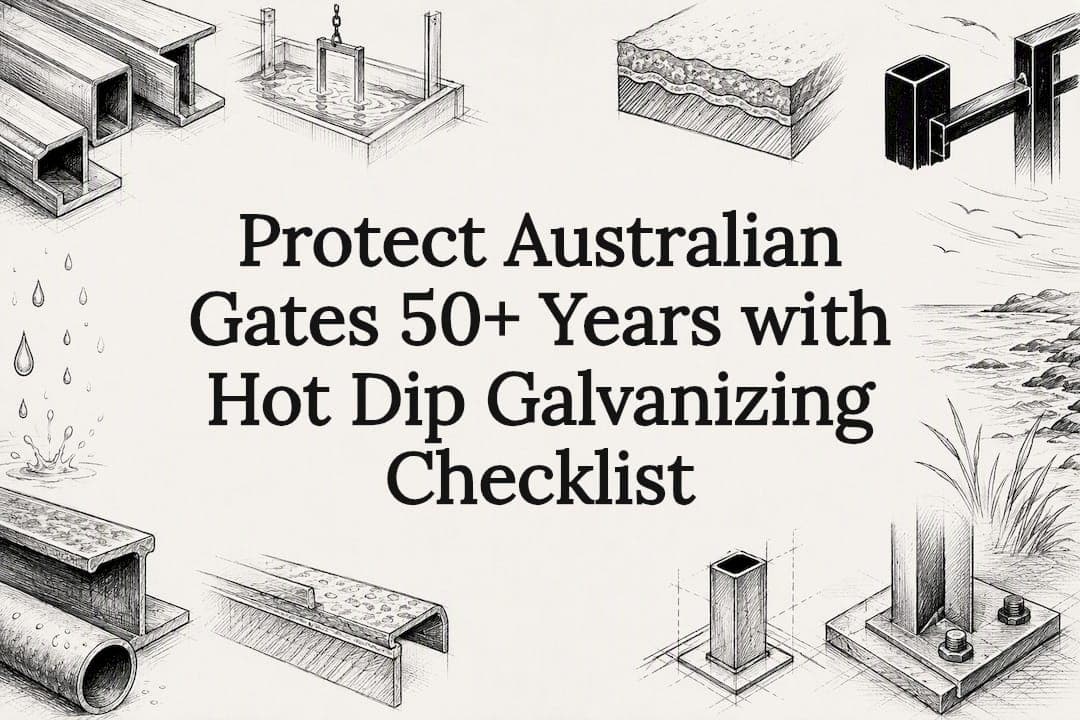
Hot-dip galvanizing is the recommended baseline protection for outdoor steel driveway and safety gates because it metallurgically bonds a zinc envelope to the steel, reducing corrosion risk and long-term upkeep. The relevant Australian standard, AS/NZS 4680, governs coating quality on fabricated steel. Where color or a specific architectural finish matters, pair galvanizing with a topcoat in a duplex system.
TL;DR:
- Proper venting, draining, and lifting point placement during design prevent coating defects and facilitate smooth galvanizing, especially for hollow or complex shapes.
- Galvanized steel gates can last over 50 years near calm seas and more than 30 years within 200 meters of surf beaches, depending on exposure conditions.
- Costs largely depend on surface area, batch size, and whether double-dipping is necessary, with intricate or small parts typically costing more per kilogram.
- Adding a topcoat is recommended only for architectural or coastal-specific needs, ensuring compatibility with galvanized surfaces to avoid peeling or damage.
- Coordination with the galvanizer from the design phase reduces delays, ensures compliance with standards, and provides predictable results for custom gate projects.
Table of Contents
- What Happens During the Galvanizing Process
- Why Galvanized Gates Last Longer With Less Upkeep
- When to Add a Topcoat: Duplex Systems Explained
- Design Rules That Prevent Galvanizing Defects
- How Galvanizing Is Priced
- How Long Galvanized Gates Actually Last
- Your Pre-Build Checklist Before Galvanizing a Gate
- How a Gate Specialist Manages the Galvanizing Process
- How Gatecon Handles Galvanizing and Finishing for You
- Standards and Guidance Worth Keeping on File
- Sources
- FAQ
What Happens During the Galvanizing Process
Hot-dip galvanizing follows a fixed sequence. The steel gate is cleaned and pickled to strip rust, mill scale and oils, then dipped in a flux solution that prepares the surface for bonding. From there it goes into a bath of molten zinc, typically held between 445°C and 465°C, and is withdrawn and quenched once the reaction is complete. Small brackets or hardware are often spun in a centrifuge to shed excess zinc and stay smooth.
The immersion itself is where the coating forms. Molten zinc reacts with the iron in the steel to build a series of zinc and zinc-iron alloy layers, which is why the coating is bonded into the steel rather than sitting on top of it like paint.
- Cleaning and pickling remove rust, scale and grease before any coating can form.
- Fluxing prepares the surface chemically so zinc adheres evenly.
- Bath temperature and immersion time both influence how thick and uniform the final coating is, a detail the galvanizing process guide ties directly to coating quality.
Why Galvanized Gates Last Longer With Less Upkeep
The zinc-iron layers created during immersion give galvanized steel two forms of protection at once. Zinc acts as a physical barrier that keeps moisture and oxygen off the steel, and it also provides cathodic protection, meaning that if the coating is scratched or chipped, the surrounding zinc still sacrifices itself to protect the exposed steel underneath. Paint alone offers only the barrier effect, so a scratch through a painted gate becomes a rust starting point almost immediately.
This matters most at welds, edges and recessed brackets, the exact spots where brush or spray paint tends to run thin. Galvanizing coats these areas as thoroughly as flat surfaces because the steel is fully immersed, not sprayed from one angle.
Galvanizing can protect steel gates for well over 50 years close to calm seas and beyond 30 years even within roughly 200 meters of surf beaches, according to advisory guidance from the galvanizing industry, though actual corrosion rates shift with exposure. That kind of service life reframes the maintenance conversation for a property owner:
- Fewer inspection cycles are needed compared with painted steel, which typically needs recoating well before a galvanized gate needs attention.
- Repair work is limited to isolated damage rather than full recoating, since the zinc envelope covers the whole gate uniformly.
- The first major maintenance decision on a galvanized gate is often decades away rather than years away.
When to Add a Topcoat: Duplex Systems Explained
A duplex system pairs hot-dip galvanizing with a paint or powder coat topcoat. The zinc layer still does the structural corrosion protection, while the topcoat carries the color and the visible finish, which means scuffs and fading show up on a layer that is far easier and cheaper to touch up than bare zinc.
Duplex makes sense in a few clear situations:
- Ornamental or architecturally detailed gates where a specific color is part of the design brief.
- Coastal-adjacent properties where the extra paint layer adds a further buffer against airborne salt.
- Any project where an architect or designer has specified a particular finish that plain galvanizing cannot deliver on its own.
Not every topcoat bonds well to zinc, so the paint or powder system needs to be compatible with galvanized substrates, and any later repairs or repaints should use products designed for that combination rather than a generic exterior paint.
Pro Tip: Ask your fabricator whether the topcoat is rated for galvanized steel before approving color samples, since an incompatible product can peel within a year regardless of how well the zinc underneath is performing.
Design Rules That Prevent Galvanizing Defects
Gates are rarely simple flat plates. Hollow rails, boxed frames and welded assemblies all trap air and moisture unless the fabricator plans for galvanizing from the drawing stage. Getting this wrong causes trapped gas, uneven coating, or in worst cases a dangerous explosion when molten zinc meets sealed, moisture-filled cavities.
- Vent and drain every hollow section. Design guidance on venting and draining for hot-dip galvanizing calls for holes sized to the enclosed volume and positioned near corners and connection points so zinc and air can move freely through the part.
- Plan hanging and lifting points before fabrication. Gates are typically suspended at roughly 45 degrees during dipping, and lifting lugs or existing structural points need to be placed so the piece drains cleanly on withdrawal.
- Snip or crop closed corners. Small cuts at box-section corners let trapped fluid escape and stop pooling that would otherwise leave a rough or thin patch.
- Strip weld slag and spatter before the gate goes to the galvanizer. Leftover slag stops zinc from bonding properly in that spot, and it is far cheaper to grind it off in the workshop than to have the galvanizer reject or re-run the piece.
- Plan for progressive or double dipping on long gates. Gates longer than the bath itself are dipped in two stages, and that adds handling time and cost, so it is worth confirming bath dimensions with the galvanizer before finalizing gate length.
How Galvanizing Is Priced
Galvanizers quote by finished weight, usually per kilogram for smaller jobs and per tonne for larger runs, and that number is driven by more than just how heavy the steel is. Surface area matters because more surface means more zinc pickup relative to weight, so a gate built from thin box section with lots of bracing can cost more per kilogram than a simple solid bar design of the same weight, a pattern explained in Galserv's pricing guidance.
Small, intricate parts also carry higher per-kilogram costs because the handling and dipping overhead for each piece stays fairly fixed regardless of size, so batching several components together tends to bring the effective rate down. Anything needing double-dipping for length, or a rushed turnaround, adds further cost on top of the base rate.
To get an accurate quote rather than a rough estimate, give the galvanizer:
- An estimated uncoated weight for the gate and any matching hardware.
- The largest single component's dimensions, since that determines whether double-dipping applies.
- Fabrication drawings showing vent and drain holes and lifting points.
- Your desired turnaround time and whether the job can be batched with other work.
How Long Galvanized Gates Actually Last
Service life depends heavily on how close the gate sits to the coast and how exposed it is to salt spray, a relationship sometimes referred to as the Sandelin curve when planning maintenance intervals for zinc coatings. In practice, hot-dip galvanized steel is often expected to protect gates for well over 50 years near calm coastal areas and more than 30 years even within around 200 meters of open surf beaches, per industry process guidance, with harsher surf exposure shortening that range.

A periodic visual check is still worth doing, particularly after any impact or heavy renovation work nearby. Look for mechanical damage such as scrapes down to bare steel, small uncoated patches missed during fabrication, and any buildup of zinc ash or drips left from the original dip.

Minor damage can usually be repaired with zinc-rich paint or mechanical smoothing rather than full recoating, and the model specification for hot-dip galvanizing sets renovation limits based on the percentage or area of damage, beyond which the galvanizer may need to re-dip the affected section.
Your Pre-Build Checklist Before Galvanizing a Gate
Getting a predictable result starts well before the gate reaches the galvanizing bath. A short checklist agreed between homeowner, fabricator and galvanizer avoids most of the common surprises.
- Put the specification in writing. Reference AS/NZS 4680 and AS/NZS 1214 explicitly, and note any special thickness requirement, such as a heavier HDG900-style specification, if the project calls for it.
- Confirm the design accounts for venting, draining and lifting. Every hollow section needs vent and drain holes, snipped corners where needed, and clear lifting lugs identified on the drawing.
- Send the galvanizer full documentation early. Drawings showing vent and drain locations, an estimated uncoated weight, the largest component's dimensions and the current surface condition all help produce an accurate quote and a smooth booking.
- Ask direct questions before committing. Confirm the galvanizer's bath size, whether your gate will need double-dipping, expected turnaround, their renovation limits for minor defects, and their warranty or repair policy.
Pro Tip: Send drawings to the galvanizer before the gate is fully welded, since design issues are far cheaper to fix on paper than after fabrication is finished.
How a Gate Specialist Manages the Galvanizing Process
Coordinating galvanizing well takes planning that starts at the design table, not after fabrication. A gate fabricator builds galvanizing requirements into gate drawings from the outset, confirming vent placement, lifting points and bath capacity with the galvanizer before cutting steel, which avoids the redesign delays that come from discovering a clearance issue late.
For projects where bath size limits a single piece, staged batching and agreed double-dip handling keep the schedule predictable rather than reactive. When a project calls for a specific color or architectural finish, duplex coating can be chosen and agreed at the design stage so the appearance expected on day one matches what gets delivered, rather than being negotiated after the gate comes out of the bath.
— Rhys
How Gatecon Handles Galvanizing and Finishing for You
If you want a gate that is engineered for galvanizing from the first drawing rather than patched together after the fact, a gate fabricator can manage that coordination directly, from specification through duplex finishing where color matters.
An enquiry typically starts with a site visit, followed by an agreed specification covering standards, coating and finish, and a clear timeline before fabrication begins. Explore Architectural Gates or get in touch through Gatecon's custom packages to start that conversation.
Standards and Guidance Worth Keeping on File
Keep AS/NZS 4680 and AS/NZS 1214 and the associated model specification on hand when briefing a fabricator or galvanizer for a gate project.
Sources
FAQ
What are the disadvantages of hot-dip galvanizing?
Galvanizing adds thickness and a distinct spangled or matte gray appearance that some homeowners prefer to hide under a topcoat, which means a duplex system and extra cost if a specific color is required. Complex hollow assemblies also need careful venting and draining design, and getting that wrong can cause coating defects or delays at the galvanizing stage.
How much does hot dip galvanizing cost?
Galvanizing is quoted by finished weight, generally per kilogram for smaller jobs and per tonne for larger batches, with the final rate shaped by surface area, batch size and whether double-dipping is required. Small, intricate gates often cost more per kilogram than simpler designs of similar weight because handling overhead stays fixed regardless of size.
How long will hot-dip galvanizing last?
Service life depends on how close the gate is to the coast and how exposed it is to salt spray. Guidance from the galvanizing industry points to protection beyond 50 years near calm seas and over 30 years even within roughly 200 meters of surf beaches, with harsher surf conditions shortening that range.
What is the standard for hot-dip galvanizing?
The applicable standard for hot-dip galvanized coatings on fabricated steel gates is AS/NZS 4680, which covers coating thickness, appearance and venting and draining requirements. AS/NZS 1214 applies alongside it for threaded fasteners and hardware used on the same gate.
Does Gatecon handle galvanizing for custom gates?
Gatecon coordinates galvanizing and, where needed, duplex finishing as part of its architectural gate and custom fencing projects, managing the specification and finish from the design stage through installation. Details on current offerings are available through Architectural Gates and Designer Fencing.