Stainless steel wins on longevity, especially near salt water or in high-hygiene settings; hot-dip galvanized steel wins on upfront cost for sheltered, low-salinity structural work. The right call comes down to lifecycle costing, not sticker price. Bodies like ASSDA and the Galvanizers Association of Australia both back that logic. The sections below break down where each material actually earns its keep.
TL;DR:
- Stainless steel often proves more cost-effective over its lifespan in coastal or high-hygiene environments due to its corrosion resistance and recyclability.
- Galvanized steel requires periodic inspections and touch-ups, especially in chloride-heavy conditions, which can escalate maintenance costs over time.
- Steel grade choice is critical: 316 stainless resists salt spray better than 304, making it essential within a few hundred meters of the coast.
- Welding stainless steel demands skilled labor and careful process control to maintain corrosion resistance, unlike galvanized steel which involves handling zinc fumes.
- For sheltered inland applications with shorter lifespan expectations, galvanized steel with powder coating offers a budget-friendly and recyclable alternative.
Table of Contents
- What Is Galvanized Steel and How Does It Protect Against Rust?
- What Is Stainless Steel and How Does the Passive Layer Work?
- Alloy vs Coating: Why the Manufacturing Difference Changes Everything
- Corrosion Resistance by Environment: Coastal, Industrial, Rural, and Indoor
- Strength, Ductility, and What That Means for Design
- Fabrication and Welding: What It Actually Takes on Site
- Appearance, Finishes, and Long-Term Maintenance
- Cost and Lifecycle: Upfront Price vs Total Ownership
- Common Uses: Matching Material to Application
- How to Choose: A Practical Checklist
- Gatecon's Perspective: Applying This to Custom Gates and Fencing
- The Real Trade-Off Nobody States Plainly
- Sources
What Is Galvanized Steel and How Does It Protect Against Rust?
Hot-dip galvanizing coats structural steel with molten zinc, applied by dipping fabricated parts into a bath at roughly 450°C, under standards like ASTM A123. The zinc layer works as sacrificial protection: it corrodes first, shielding the steel underneath even where the coating gets scratched.
That mechanism has a limit. Once zinc wears through at an edge or a deep scratch, the exposed steel starts rusting unless someone touches it up.
A few things drive how long a galvanized coating actually lasts:
- Coating thickness, usually measured in microns, sets the baseline service life.
- Local atmospheric corrosivity (industrial, coastal, rural) speeds up or slows down zinc loss.
- Mechanical damage during installation or use accelerates failure at exposed points.
What Is Stainless Steel and How Does the Passive Layer Work?
Stainless steel is not coated. It is a homogeneous alloy, and the chromium mixed through it reacts with oxygen to form a thin, self-healing oxide film across the entire surface, according to ASSDA. Scratch it, and the chromium exposed underneath repassivates on its own.
Grade selection matters more than people expect:
- 304 handles most general outdoor and architectural uses reasonably well.
- 316 adds molybdenum, which resists chloride pitting, making it the standard choice near salt spray or in marine air.
- Cut edges stay corrosion-resistant because the chromium runs through the whole cross-section, not just the surface.
That last point separates stainless from galvanized steel more than any other single fact.
Alloy vs Coating: Why the Manufacturing Difference Changes Everything
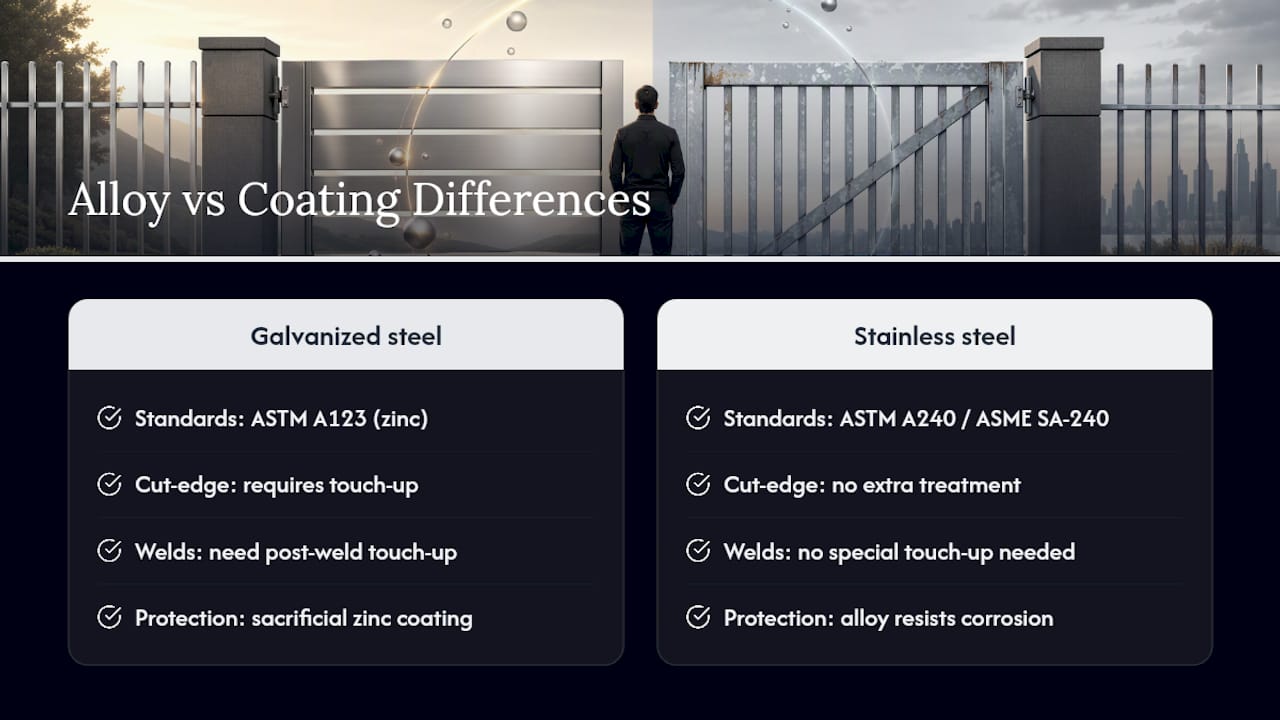
Galvanized steel is a coated substrate. Stainless steel is a solid alloy. That distinction cascades into every downstream decision. ASTM A123 governs zinc coating quality and thickness, while stainless plate and sheet fall under standards like ASTM A240 or ASME SA-240, which regulate chemical composition and mechanical properties rather than coating performance.
The practical fallout: a cut, drilled, or welded edge on galvanized steel needs field touch-up (cold-galvanizing spray or zinc-rich paint) to avoid a rust starting point. A cut edge on stainless needs nothing extra. Stainless also carries higher scrap value and gets recycled more extensively than carbon-based galvanized steel, which matters for end-of-life value on larger projects.
Corrosion Resistance by Environment: Coastal, Industrial, Rural, and Indoor
Chloride is the variable that decides this argument. Salt air drives pitting corrosion, and galvanized coatings lose zinc faster in chloride-heavy environments than they do inland. That is why 316 stainless is the standard specification within a few hundred meters of open coastline or on structures exposed to direct salt spray.
Pro Tip: If you're within sight of the ocean or on a bayside property, budget for 316 stainless from the start. Retrofitting a corroded gate frame costs more than specifying the right grade the first time.
Galvanized steel remains a sound, economical choice for sheltered, low-salinity structural work such as fencing frames, rural gates, and inland infrastructure, provided someone inspects it periodically. ISO 9223 corrosivity categories, ranging from C1 (very low, indoor) to C5 (very high, coastal/industrial), give a useful shorthand for how quickly a given environment will eat through a zinc coating and roughly how often inspection or touch-up should happen.
Strength, Ductility, and What That Means for Design
Mechanical properties push the decision in a different direction than corrosion resistance alone. Galvanized steel is typically mild or structural carbon steel underneath, which offers good ductility and is comparatively easy to form, bend, and weld into complex shapes without exotic tooling.
Stainless steel, particularly in the austenitic grades like 304 and 316, tends to have higher tensile strength but work-hardens faster during cold forming, which means bends and cuts need more careful planning. Designers often compensate by adjusting section thickness or geometry rather than treating the two materials as drop-in substitutes. For load-bearing structural members, engineers size sections around the specific grade's yield strength rather than assuming stainless and galvanized steel perform identically at equal thickness.
Fabrication and Welding: What It Actually Takes on Site
Welding stainless demands real skill. It needs matched filler rods, controlled heat input, and careful post-weld cleanup, because sloppy welding can wreck the very corrosion resistance you paid for by leaving heat-tinted or contaminated zones. Galvanizers Association of Australia guidance notes this specialist control requirement as a real cost and schedule factor on bespoke jobs.
Welding galvanized steel brings a different hazard: zinc fumes. Welders need ventilation and, on repairs, the coating around the weld gets damaged and must be restored with a zinc-rich touch-up.
Pro Tip: Moving parts, like hinges and rollers on automatic gates, are where stainless fails in an unexpected way: galling, a form of surface seizure where two stainless parts rub and cold-weld together. Specify lubrication, a hardened bushing, or a dissimilar-material contact point to avoid it.
Appearance, Finishes, and Long-Term Maintenance
Stainless offers a genuine range of finish options, from mirror-polished to brushed to bead-blasted, and holds that appearance for decades with minimal upkeep beyond occasional cleaning. That durability of finish is a big reason GAA notes it as the premium aesthetic choice.
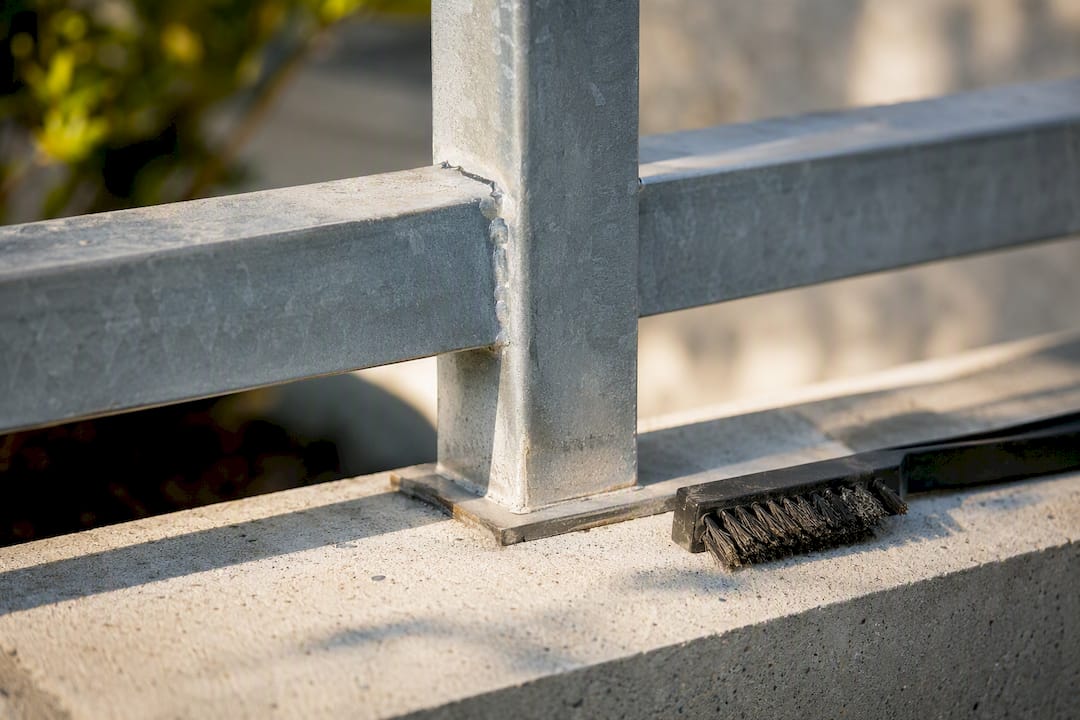
Galvanized steel starts with a distinctive spangled, metallic surface that dulls to a flat grey over time and can leave zinc runoff staining on adjacent masonry or paving during the first few rains after installation. A simple maintenance rhythm covers most needs: rinse debris periodically, inspect cut edges and welds annually for exposed steel, and recoat or touch up any spot where base metal shows through.
Cost and Lifecycle: Upfront Price vs Total Ownership
Stainless steel commonly costs three to five times more than galvanized steel per unit mass, driven by alloy content and more demanding fabrication. That gap is real, and it's why galvanized dominates budget-driven structural work.
But raw material price isn't the whole story. Three factors drive true lifecycle cost:
- Maintenance frequency, since galvanized coatings need periodic inspection and occasional touch-up while stainless mostly needs cleaning.
- Replacement cycles, since a corroded galvanized structure in a harsh coastal environment may need replacing well before a stainless equivalent.
- Fabrication labor, since stainless welding and finishing run higher per hour but avoid recoating costs later.
ASSDA's lifecycle costing guidance argues for comparing total cost over a 20 to 50 year horizon rather than initial quotes. On a coastal gate or fence expected to last decades, stainless often comes out cheaper once you account for avoided replacement and repainting cycles. On a sheltered rural fence with a shorter expected life, galvanized usually wins outright.
Common Uses: Matching Material to Application
Stainless dominates where hygiene, aesthetics, or chloride exposure rule out anything else: food processing equipment, medical facilities, marine hardware, and architectural features on premium homes. Galvanized steel remains the default for infrastructure, ducting, chain-link and rural fencing, and general railings where budget and structural performance matter more than finish.
For gates and fencing specifically, premium stainless makes sense when the property sits near the coast, when the design calls for a high-end brushed or polished look, or when the gate is a visible focal point of the entrance. A hot-dip galvanized substrate with a powder-coat finish is a perfectly reasonable choice for sheltered inland properties where budget matters more than a decades-long finish guarantee, and it also keeps recycling simpler at end of life since the steel core is easily reclaimed.
How to Choose: A Practical Checklist
Before committing to a material, walk through these factors in order:
- Exposure: Is the site coastal, industrial, rural, or sheltered? Chloride exposure is the single biggest variable.
- Required lifespan: Are you planning for 15 years or 50?
- Appearance priority: Does the design demand a specific finish that has to last decades?
- Maintenance willingness: Will anyone actually inspect and touch up a coating every year or two?
- Fabrication capability: Does your fabricator have genuine stainless welding experience, or mostly mild steel experience?
- Budget: What's the acceptable range for upfront cost versus lifecycle cost?
As a rule of thumb, choose 316 stainless for salt-exposed or high-hygiene applications, and choose galvanized for sheltered, budget-driven structural uses. Ask any supplier directly what coating thickness they specify, what grade of stainless they recommend for your exposure category, and whether they've priced the project using lifecycle costing or just upfront material cost.
Gatecon's Perspective: Applying This to Custom Gates and Fencing
Stainless steel is often recommended for coastal properties in bayside areas and for architectural entrances where the gate serves as a design statement, not just a barrier. The finish holds up, and it holds up without the maintenance calls that galvanized structures eventually generate near salt air.
Fabrication is where the real craftsmanship shows. Careful weld heat control is needed to protect stainless's corrosion resistance, finishes should suit the property's architecture, and bushings or lubrication points on automatic gates help avoid galling on hinges and rollers.
For sheltered inland properties, a galvanized substrate with a powder-coat finish remains a sound, cost-effective option. If you're weighing materials for your own driveway gate or fence line, Gatecon's architectural gates team can assess your site and recommend the material that actually fits your exposure and budget.
The Real Trade-Off Nobody States Plainly
Most comparisons frame this as stainless versus galvanized, full stop. That framing misses the actual decision, which is exposure versus horizon. A galvanized fence in a sheltered rural yard with a 15-year expected life is not an inferior choice. It's the correct choice, and spending extra on stainless there is money that never comes back as value.
The mistake I see most often runs the other direction: property owners near the coast choosing galvanized because it's cheaper upfront, then facing a corroded frame and a full replacement inside a decade. ISO 9223 corrosivity categories exist precisely because "near the coast" isn't one condition. A property facing direct salt spray corrodes galvanized coatings far faster than one three streets back with buildings blocking the wind.
The other underrated factor is what happens to the material at the end of its life. Stainless commands real scrap value and gets recycled at high rates, which matters if you're thinking about a project's full environmental footprint, not just its installed cost. Galvanized steel recycles too, but the economics favor stainless once you're accounting for the whole picture, not just the invoice.
If there's one habit worth adopting from engineers who specify this material for a living, it's running the lifecycle numbers before the quote, not after the coating fails.
— Rhys
Sources
- Comparison of Stainless Steel and Galvanised Steel — ASSDA
- Galvanized Steel versus Stainless Steel — Galvanizers Association of Australia (GAA)