For most luxury driveway gates, modern ornamental steel with hot-dip galvanizing plus powder coat is the practical choice; it delivers the wrought-iron look with far less upkeep. True hand-forged wrought iron still has a place, but it belongs on heritage restorations or one-off artisan commissions where matching historical detail matters more than maintenance cost. The trade-off comes down to weight, corrosion resistance, and how much repainting you're willing to do over the next twenty years.
TL;DR:
- Galvanized steel with powder coating offers 20 to 50 years of corrosion resistance with minimal maintenance, making it the most practical choice for most driveway gates.
- Steel is stronger and more cost-effective than true wrought iron, with lighter tubular sections favored for large sliding gates and easy installation.
- Heavier gates require deeper footings, reinforced hinges, and appropriately sized motors to prevent sagging and premature failure, especially with forged designs.
- For properties near saltwater, ask fabricators to specify galvanizing thickness to ensure long-term durability against corrosion.
- Wrought iron remains a niche material, mainly used for heritage restorations or custom artisan projects, due to its higher cost, weight, and labor-intensive fabrication.
Table of Contents
- Wrought Iron vs Steel: Comparing Appearance, Strength, and Cost
- Which Corrosion Protection System Should You Choose?
- How Often Does a Driveway Gate Need Maintenance?
- How Does Gate Weight Affect Installation and Automation?
- Wrought Iron or Steel: A Quick Decision Checklist
- The History Behind Wrought Iron and Modern Steel Production
- Environmental Impact: Which Material Is More Sustainable?
- Where Each Material Shows Up Most in Real Projects
- How Do Wrought Iron and Steel Perform in Fire and Extreme Heat?
- Designing Gates That Work With Stone, Timber, and Masonry
- What Gatecon Sees on the Ground in Melbourne
- Get a Custom Gate Built Right the First Time
- Sources
Wrought Iron vs Steel: Comparing Appearance, Strength, and Cost
Most gates sold today as "wrought iron" are not wrought iron at all. They're mild steel, shaped to mimic the scrolls, twists, and hammered textures of hand-forged work from a century ago. That's not a downgrade. Modern mild steel is more available and cost-effective than true wrought iron, and it takes ornamental detail almost as well when a skilled fabricator is running the shop.
The visual difference shows up mostly in profile. Solid steel bar mimics the density of forged iron closely. Tubular steel sections are lighter, cheaper to produce, and better suited to large sliding gates where stiffness matters more than mass.
On strength, steel wins outright. It has higher tensile strength than traditional wrought iron, meaning thinner sections can carry the same structural load. Wrought-style forged pieces tend to be more ductile, bending rather than snapping under stress, but that ductility comes bundled with extra weight, since forged sections are usually thicker to achieve the same rigidity.
Cost splits the two approaches sharply:
- Stock steel panels: manufactured in standard runs, installed in days, and priced well below custom work.
- Custom forged gates: installed costs commonly run substantially higher per linear foot than factory steel panels, with timelines stretching to weeks or months instead of days.
- Hybrid designs: steel frames with forged decorative inserts, splitting the cost difference while keeping some hand-worked character.
Weight differences ripple into everything downstream. A heavier gate demands deeper footings, beefier hinges, and a stronger motor, which changes your installation budget even before the gate itself goes up.
Which Corrosion Protection System Should You Choose?
Corrosion protection is where the real long-term cost of a gate gets decided, not at the design stage. Hot-dip galvanizing paired with powder coat is the standard for durable steel gates, often delivering 20 to 50 years of service life when the coating is properly maintained. Galvanizing works by coating the steel in a zinc layer that corrodes sacrificially, protecting the base metal even where the surface gets scratched or chipped.
Powder coat sits on top of that zinc layer for color and finish. It's what gives a gate its matte black, bronze, or heritage green look, and it's also the layer that needs occasional attention.
- Hot-dip galvanized + powder coat: the default recommendation for most driveway gates, balancing cost, appearance, and longevity.
- Stainless steel: worth the premium for extreme coastal exposure or when zero visible rust is a hard requirement.
- Aluminum: a strong option for coastal properties, thanks to natural corrosion resistance and lighter weight that eases automation.
- Painted forged iron: possible but harder to protect, since true wrought iron's hollow sections and hand-forged shapes resist effective galvanizing, leaving paint as the main defense.
Pro Tip: If your property sits within a few miles of saltwater, ask your fabricator about galvanizing thickness before you sign off on the design. Standard coatings can wear faster in salt air, and it's cheaper to upgrade the spec now than to recoat a gate in five years.
How Often Does a Driveway Gate Need Maintenance?
A galvanized and powder-coated steel gate needs far less attention than a painted forged one, but "far less" doesn't mean "none." Skipping inspections is how small chips turn into structural rust.
- Inspect twice a year. Check for coating chips, hinge wear, and weld cracks. Keep a simple log of what you find.
- Treat surface rust immediately. Clean the spot, sand back to bare metal, apply a zinc-rich primer, then touch up with matching paint.
- Recoat on a schedule, not a whim. Galvanized and powder-coated steel typically needs full repainting only every several years, while painted, unprotected forged iron often needs it every few years.
- Adjust for exposure. Coastal air, sprinkler overspray, and heavy shade all shorten these intervals, sometimes significantly.
Pro Tip: Keep touch-up paint matched to your original batch number, not just the color name. Powder coat colors can shift slightly between production runs, and a mismatched patch is more noticeable than the rust it's covering.
How Does Gate Weight Affect Installation and Automation?
Weight is the variable that trips up more projects than any design decision. Heavier gates require deeper footings and higher-capacity motors, and skipping that recalculation is a common cause of post-sag and premature motor failure (exact time frames vary).
- Footings and posts: a heavy forged gate can require significantly deeper concrete footings and larger posts than an equivalent steel panel design.
- Automation sizing: motor torque has to match gate mass and how often the gate cycles per day. A motor sized for a light aluminum gate will burn out fast on a solid forged one.
- Hinge assemblies: heavier gates need reinforced hinges and often a secondary support bearing to prevent long-term sag.
- Onsite logistics: custom forged sections frequently need craning into place and substantial field welding and finish work on site, adding labor days that stock panels avoid.
- Terrain: sloped or uneven driveways favor rackable tubular steel panels that flex slightly, while fully custom forged sections need precise, one-time-fit fabrication.
Get the motor and footing specs wrong on a heavy gate and you're not looking at a minor fix. You're looking at re-pouring concrete.
Wrought Iron or Steel: A Quick Decision Checklist
Match your project to the material, not the other way around.
- Choose modern ornamental steel if you want the classic look, faster installation, and lower long-term maintenance. This covers most residential and boutique commercial driveway gates.
- Commission true hand-forged wrought iron only when a heritage overlay mandates it, you're matching existing antique ironwork, or the project is a genuine artisan commission where budget and timeline are secondary to authenticity.
- Consider aluminum for coastal homes or anywhere low maintenance is the top priority and a slightly different aesthetic is acceptable.
- Consider stainless steel when you need maximum corrosion resistance and a contemporary finish, and budget allows for the premium.
- Default to tubular steel framing for large automated sliding gates, since it offers the best combination of stiffness and motor compatibility among common gate materials.
If your project doesn't clearly hit one of the heritage or coastal triggers above, galvanized and powder-coated steel is the safer default.
The History Behind Wrought Iron and Modern Steel Production
Wrought iron earned its name from the process, not the material alone. Blacksmiths heated iron and hammered, or "wrought," it into shape by hand, working out impurities as they went. That process produced a fibrous, malleable metal that was forgiving under the hammer but slow and expensive to make at scale.
Steel production changed the economics entirely. The Bessemer process in the 19th century made mass steel production viable, and by the early 20th century, commercial wrought iron production had all but disappeared. What survived was the aesthetic, scrolls, twists, and hand-hammered textures, now recreated in mild steel using modern welding and CNC-assisted bending rather than a forge and anvil.
That history explains why "wrought iron" survives as a design term long after it stopped being a common material. When a client asks for a wrought iron gate today, they're almost always describing a look, not requesting the metallurgy behind it. Clarifying that distinction early saves confusion over budget and timeline, since a fabricator quoting genuine hand-forged work is pricing an entirely different process than one quoting steel fabricated to look the part.
Environmental Impact: Which Material Is More Sustainable?
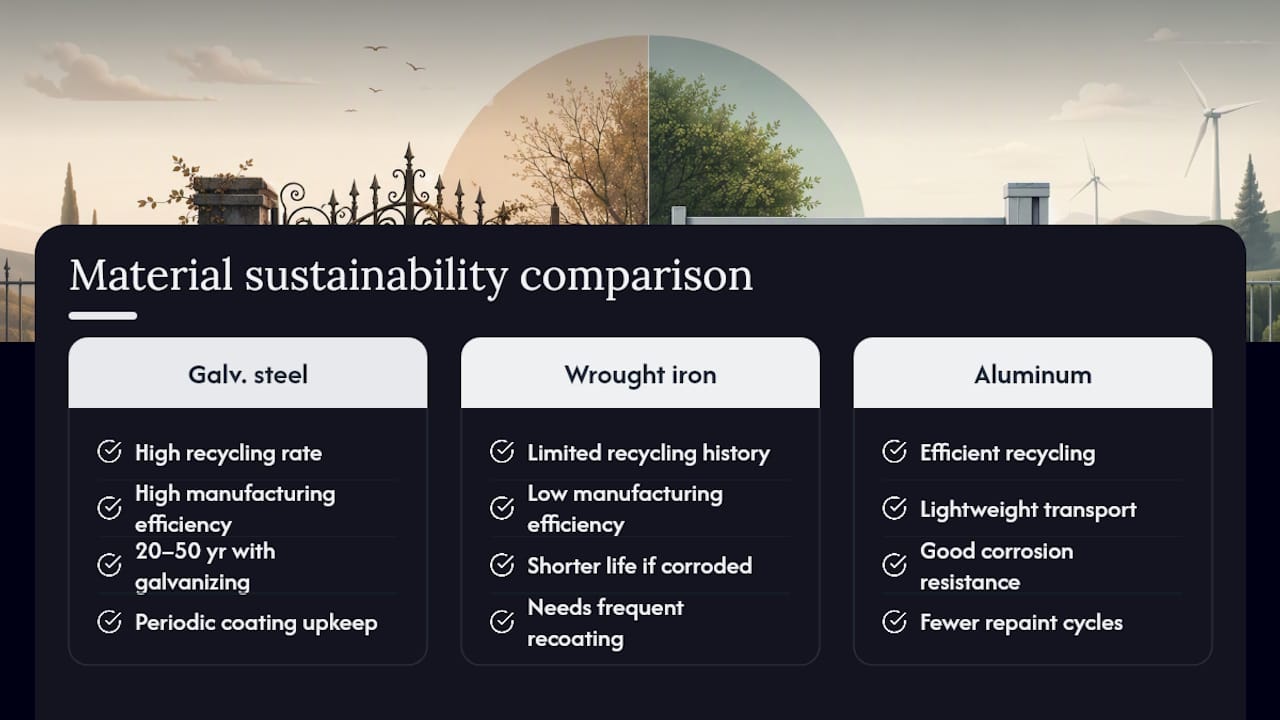
Steel has a clear sustainability edge for one simple reason: it's one of the most recycled materials in construction, with established scrap recovery and remelting infrastructure that historical wrought iron production never had. A mild steel gate reaching end of life gets recycled into new steel stock through standard industrial channels.
Manufacturing efficiency matters too. Modern steel mills produce structural sections with far less waste per unit than a hand-forging process, which by nature generates offcuts and requires more energy-intensive, labor-heavy heating cycles to shape each piece individually. Hand-forged work, while beautiful, simply isn't built for material efficiency at scale.
Longevity plays into the sustainability math as well. A gate that lasts 20 to 50 years with proper galvanizing and coating maintenance avoids the environmental cost of premature replacement, manufacturing, and disposal. A painted forged gate needing recoating every few years and eventual replacement due to unmanaged corrosion carries a heavier lifecycle footprint, even if the original material was durable.
Aluminum deserves a mention here too. It's lighter to transport, resists corrosion without heavy chemical coatings, and recycles efficiently, making it a reasonable sustainability pick for coastal projects where reduced maintenance also means fewer repaint cycles over the gate's life.
Where Each Material Shows Up Most in Real Projects
Steel dominates the driveway gate and architectural fencing market for good reason: it's flexible enough for ornamental scrollwork, strong enough for large automated sliding gates, and consistent enough for manufacturers to hold to standard sizing and tolerances. You'll find it in everything from simple picket-style fencing to elaborate estate entrances.
True forged wrought iron shows up almost exclusively in heritage restoration, museum-grade reproductions, and high-end custom commissions where a client specifically wants hand-hammered texture and irregularity that machine fabrication can't replicate. It's a niche application, not a mainstream one.
Industry standards for gate fabrication generally reference structural steel grades and coating specifications rather than historical ironworking methods, which underscores how completely steel has replaced wrought iron as the working material even where the finished product is still marketed under the old name. Stainless steel and aluminum fill specific niches: stainless for architectural statements demanding a contemporary finish with minimal upkeep, aluminum for coastal or weight-sensitive automated applications.
How Do Wrought Iron and Steel Perform in Fire and Extreme Heat?
Both materials are effectively non-combustible, which matters for bushfire-prone properties and commercial fire code compliance. Steel and iron won't ignite or fuel a fire the way timber fencing can.
Extreme heat does affect performance, though. Steel begins losing structural strength at high temperatures, which is why structural fire ratings exist for steel-framed buildings. A driveway gate isn't a load-bearing structural element in the same sense, so this rarely matters for gate selection specifically. Powder coat finishes can discolor or blister under sustained extreme heat exposure, such as direct proximity to a fire event, while galvanized zinc coatings can experience some surface changes at very high temperatures without compromising the underlying steel's basic integrity.
For most residential and commercial applications, fire behavior is a minor factor in the wrought iron versus steel decision. Corrosion resistance, weight, and maintenance carry far more weight in practice.
Designing Gates That Work With Stone, Timber, and Masonry
A gate rarely stands alone. It has to work visually and structurally with stone pillars, timber fencing, rendered walls, or masonry entry features, and steel's fabrication flexibility makes that integration easier than forged iron typically allows.
Steel welds cleanly to mounting brackets, accepts a wide range of finishes to match or contrast with surrounding materials, and can be fabricated in sections that bolt cleanly into stone or masonry piers without the improvisation that field-fitting forged iron often demands. Tubular steel frames also pair well with infill panels in timber, glass, or perforated metal for projects blending traditional gate silhouettes with a more contemporary material palette.
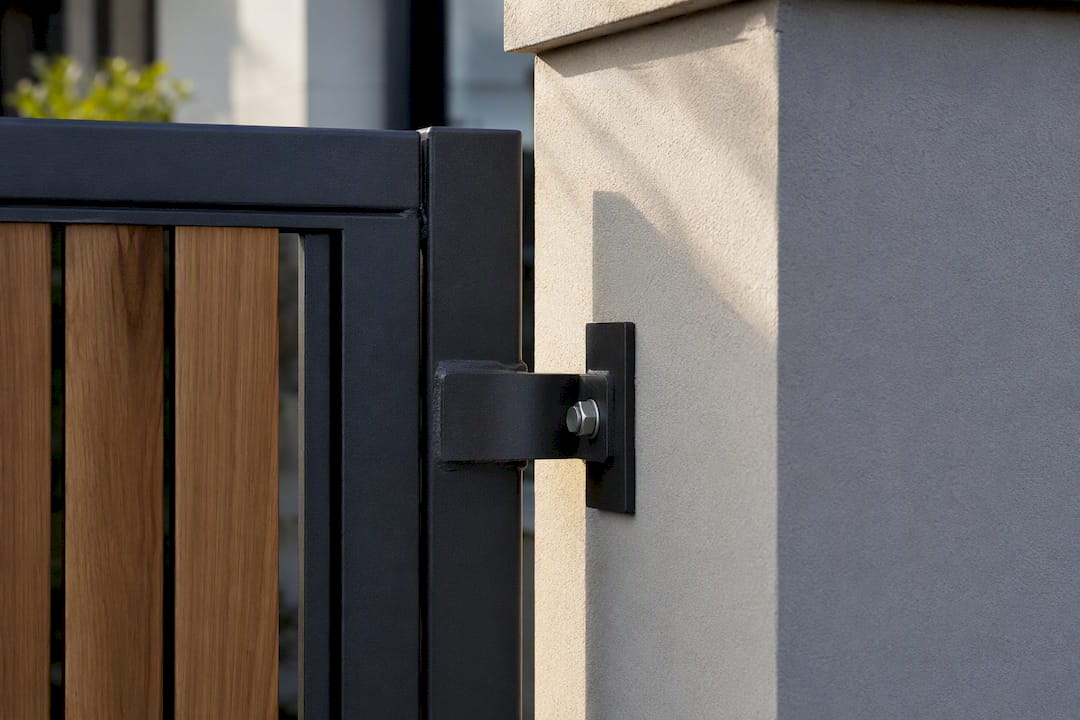
Forged iron can absolutely be integrated with stone and masonry too, and often looks stunning doing it, but the fitting tolerances are less forgiving. Hand-forged sections vary slightly piece to piece, which is part of their charm but also means more on-site adjustment when mating them to precisely cut stone piers or existing masonry openings. For projects mixing several materials and finishes, steel's dimensional consistency generally makes the integration process faster and more predictable.
What Gatecon Sees on the Ground in Melbourne
Most clients who call asking for a "wrought iron gate" actually want the look: scrolls, texture, a sense of weight and craftsmanship at the entrance. Once we walk through what that means in terms of budget and maintenance, most move toward galvanized and powder-coated steel without hesitation.
The adjustments we make most often on-site are footing depth and motor sizing, especially when a client's initial concept sketch is heavier than the automation budget accounts for. Our site assessment checklist covers exposure to salt air, gate mass against motor torque, hinge load, and how the design ties into existing stone or masonry. Getting that sequence right before fabrication starts is what keeps a bespoke gate performing for decades rather than needing early rework.
— Rhys
Get a Custom Gate Built Right the First Time
Choosing between wrought iron and steel is only half the decision. Getting the footing depth, motor sizing, and finish system right is what actually determines whether your gate looks sharp and operates smoothly ten years from now. Gatecon handles the whole process under one roof: custom design, fabrication, automation, and installation, so the motor is matched to the gate's real weight and the finish is specified for your property's actual exposure, not a generic template.
Working with a single team also means one point of accountability if a hinge needs adjusting or a coating needs attention down the line, rather than chasing separate suppliers for the frame, the motor, and the paint. If you're planning a driveway gate or architectural fencing project across Melbourne's inner and eastern suburbs, bayside area, or surrounding regions, request a site visit or estimate and we'll walk your property before recommending a material or finish.
Sources
For more on gate mechanics and design choices, see Gatecon's guide to sliding vs swing gates, luxury fencing design, and the full Gatecon blog for additional project guidance.
- Steel Fence vs Wrought Iron: Cost, Durability & Which to Install (2026) | FenceCalc
- Everything you need to know about wrought iron gates | Make Fencing
- Building a better gate: what to consider before your next DIY project | SHED Blog
- Best materials for iron gates: Wrought iron vs steel | Iron & Railings