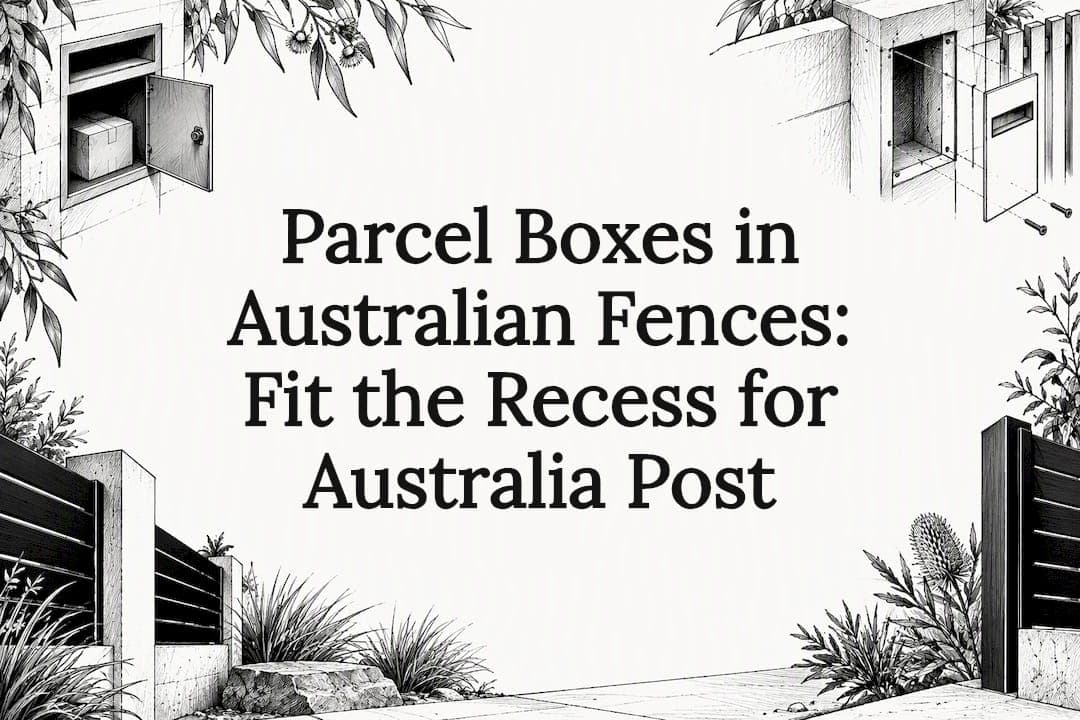
Yes, a parcel box built into a fence can securely accept unattended deliveries when it is sized and positioned for carrier access. The three things that matter most are generous internal clear dimensions, a boundary-facing aperture couriers can reach without entering the property, and a backup option like a Parcel Locker for anything oversized.
TL;DR:
- Medium sized parcels need 250 to 300 millimeters of internal depth and width; small satchels may fit with 50 to 80 millimeters of depth.
- Australia Post leaves parcels unattended only when the sender permits Safe Drop and the location is secure, discreet, and weatherproof; box size cannot guarantee delivery.
- Measure the exact fence cavity and follow the model’s cutout specifications; Chelsea offers recess depths of 40 millimeters or 115 millimeters.
- Rear retrieval from inside the boundary prevents street side access, while front access leaves parcels reachable until collection; check rear door clearance before installation.
Table of Contents
- Parcel box styles and design ideas for fence integration
- Installation checklist: what to measure and plan before you install
- Placement and delivery access: meeting carrier requirements
- Materials, weatherproofing and tamper-resistant features to specify
- [How a fencing specialist coordinates a built-in parcel box during fence or gate projects using job management software for fencing contractors to streamline coordination and project scheduling](#how-a-fencing-specialist-coordinates-a-built-in-parcel-box-during-fence-or-gate-projects-using-job-management-software-for-fencing-contractorshttpspipelineappcoukforfencing-contractors-to-streamline-coordination-and-project-scheduling)
- Perspective: balancing curb appeal with delivery practicality
- How Gatecon can help design and install a fence-integrated parcel solution
- FAQ
- Sources
Parcel box styles and design ideas for fence integration
Fence-integrated parcel boxes generally fall into three categories, and picking the right one depends on your fence material, parcel volume, and how much you want the box to disappear into the design.
Through-wall recessed boxes sit flush within the fence or gate panel, with a boundary-facing slot for the courier and a locked door on your side for retrieval. The Chelsea parcel box is a representative example: it comes in models with recess depths of either 40 millimeters or 115 millimeters, so the cavity you build into the fence has to match the specific model rather than a generic assumption. The Monaco built-in parcel letterbox follows a similar through-wall approach, with stated overall dimensions and a rear-access door designed for brick, rendered, or timber fence integration.

Fence-mounted surface boxes attach to the face of an existing fence rather than recessing into it, which suits retrofits where cutting into the panel isn't practical. These units trade some visual integration for a simpler, less invasive install.
Combined letterbox and parcel compartments merge daily mail with parcel capacity in one unit, often with a smaller slot up top for letters and a larger hinged or sliding door below for parcels. This style suits lower parcel volumes or households that want a single, tidy fixture rather than two separate openings.
Rear-only retrieval, where the courier can only access the front slot and you retrieve from inside your boundary, is the most secure arrangement because nobody on the street side can reach what's been delivered. Front-access models are easier to install but leave parcels reachable from the public side until collected, which matters if your fence sits close to a footpath.
A few practical sizing benchmarks help frame what "big enough" looks like:
- Standard letterbox parcels (small satchels, padded envelopes) need as little as 50 to 80 millimeters of internal depth.
- Mid-size parcels, including most shoebox-sized deliveries, typically need at least 250 to 300 millimeters of internal depth and width.
- Larger household deliveries often exceed what any fence-integrated box can hold, which is where a Parcel Locker becomes a sensible backup rather than a failure of the fence box.
Installation checklist: what to measure and plan before you install
Getting the cut-out right the first time saves you from reworking a fence panel after the fact. Work through these steps before you order a box or start fence fabrication:
- Measure the fence cavity depth at the exact point you plan to install, not an average across the panel, since timber and steel sections vary in thickness.
- Use the manufacturer's cut-out and recess-depth specifications, not the box's external width and height, since those numbers don't tell you what fits inside the fence itself.
- Confirm which side the rear door opens on and check that it clears any gate swing, narrow path, or adjoining structure.
- Check drainage provisions in the box design so rainwater doesn't pool inside during storms.
- Decide on a locking method, whether that's a key, combination, or keyed-alike system matching other property locks.
- Specify a reinforcement or backing plate if the box is heavy or the fence panel is lightweight, since an unsupported cut-out can sag over time.
- Choose corrosion-resistant fixings and finishes suited to outdoor exposure.
- Confirm the final mounting height, how it relates to street numbering, and any site access rules your installer flags before fabrication begins.
Pro Tip: Always measure the actual cavity depth on site and add clearance for trim, door swing, and any internal framing. Product "external" dimensions are not a reliable guide for planning your fence cut-out, as noted in installation specs for the Chelsea parcel box.
If your parcel box sits within a gate rather than a straight fence run, footing and structural requirements add another layer worth checking with your installer, similar to the considerations covered in Australian gate footing requirements.
Placement and delivery access: meeting carrier requirements
Where you put the box matters as much as how big it is. Australia Post's Safe Drop policy only applies when the sender has permitted it and the chosen location is secure, discreet, and weatherproof; couriers are not required to leave a parcel if the spot looks unsuitable. A well-built fence box increases your odds of a successful unattended delivery, but it can't override sender permission or a parcel that simply doesn't fit.
A box that accepts parcels up to the Parcel Locker limit of 16 kilograms and 35 × 44 × 61 centimeters covers most everyday deliveries, which makes that figure a useful sizing target even if your box isn't a Parcel Locker itself.
Placement guidance to keep in mind:
- Position the aperture facing the boundary so couriers can deliver without dismounting or entering the property.
- Avoid locations that force a courier to cross a driveway, open a gate, or walk around an obstruction to reach the slot.
- Keep the opening visible and unobstructed from the street, since a hidden or hard-to-find box is more likely to be skipped.
- For anything too large for your fence box, route deliveries to a Parcel Locker or PO Box instead of hoping it gets left on the ground.
A single residential mailbox should generally face the road or footpath so a postal officer can deliver without leaving their vehicle, which lines up directly with how fence-integrated parcel boxes should be oriented.
Materials, weatherproofing and tamper-resistant features to specify
A parcel box lives outdoors permanently, so the materials and hardware you specify determine how well it holds up and how hard it is to defeat.
Powder-coated steel is the common baseline finish for fence-integrated boxes, offering reasonable corrosion resistance at a moderate price point. Stainless steel and marine-grade finishes cost more but suit coastal or high-exposure sites where salt air accelerates rust. Match the finish to your fence material so the box reads as part of the structure rather than an add-on.
Weatherproofing comes down to seals around the door, a sloped or sealed roof section, and drainage holes positioned so water doesn't collect inside. A tight-fitting door with a rubber gasket keeps out driving rain far better than a simple hinged flap.
Features worth checking before you buy:
- Rear-only access, so retrieval happens from inside your boundary rather than the street side.
- Anti-reach baffles inside the chute that stop someone fishing out a parcel through the front slot.
- A robust lock, ideally a multi-point or cylinder lock rather than a basic latch.
- A hooded or sloped opening that sheds rain away from the slot itself.
For upkeep, check seals and hinges twice a year, clear any debris from drainage points, and touch up powder coating if it chips, since exposed steel corrodes quickly once the coating is broken.
How a fencing specialist coordinates a built-in parcel box during fence or gate projects using job management software for fencing contractors to streamline coordination and project scheduling
Bringing your fence contractor into the conversation early, before fabrication starts, is what keeps a parcel box from becoming an awkward retrofit. The details that matter most at this stage are the product's exact cut-out dimensions, the lock type, and how much clearance the rear door needs to swing freely.
From there, a contractor reconciles the box's final position with street numbering and any local site requirements that affect mailbox placement, the kind of check covered in guidance on driveway gate height and permits. Structural work typically includes:
- Framing a reinforced opening or backing plate so the panel doesn't sag around the cut-out.
- Planning drainage so water sheds away from the box rather than pooling against the fence.
- Matching the box finish to the fence's powder coat or timber stain so it reads as one build.
- Handing over keys or combination codes as part of project sign-off, with duplicates logged for the client.
Getting these checks right during fabrication, rather than after the fence is installed, avoids the cost and appearance compromises that come with cutting into a finished panel later.
Perspective: balancing curb appeal with delivery practicality
A parcel box that looks striking but sits where a courier can't reach it without leaving their vehicle will quietly reduce how many deliveries actually get left. It's a trade-off homeowners often discover only after the fact, once a string of "attempted delivery" notices piles up.
The fix is sequencing, not compromise. Settle the box's position and size against common parcel dimensions before the fence design is finalized, not after the panels are cut. A recess that's an inch too shallow or angled away from the street solves nothing, no matter how well it matches the gate hardware. Good design and good logistics aren't in tension here. They just have to be solved in the right order.
— Rhys
How Gatecon can help design and install a fence-integrated parcel solution
We design and install custom fencing and gates, coordinating the recess, reinforcement, and finish of a built-in parcel box so it integrates with the fence design.
- We confirm box dimensions, lock type, and rear clearance before fabrication starts to ensure proper installation.
- We coordinate finishes across the fence, gate, and parcel box for a cohesive appearance.
- We apply structural reinforcement to help maintain panel integrity around the cut-out.
If you're planning a new fence or gate and want a parcel box built in from the start, book a design consultation through our designer fencing page to confirm dimensions, materials, and installation sequencing.
FAQ
What size parcel box do I need for a fence?
Aim for internal clearance that covers most everyday parcels, which means at least 250 to 300 millimeters of depth and width for mid-size items. For anything near or above Parcel Locker limits of 16 kilograms and 35 × 44 × 61 centimeters, plan on a Parcel Locker or PO Box as backup rather than sizing the fence box around rare large deliveries.
Will Australia Post leave parcels in a fence-integrated box?
Australia Post's Safe Drop policy allows unattended delivery only when the sender has given permission and the location is secure, discreet, and weatherproof. A well-placed, boundary-facing parcel box improves your odds, but it can't guarantee delivery if the sender hasn't authorized Safe Drop or the parcel is too large.
What is the AS 4253 mailbox standard?
AS 4253 is the Standards Australia benchmark covering mailbox security and placement, updated in 2019 partly in response to rising mail theft concerns. It informs practical decisions like placement and access rather than mandating a single approved product.
How deep does the recess need to be for a through-wall parcel box?
Recess depth depends entirely on the model: the Chelsea parcel box comes in both 40 millimeter and 115 millimeter recess versions, so you need to confirm the exact figure for your chosen product rather than estimating from similar boxes. Always measure your actual fence cavity on site before finalizing the cut-out.
Can a parcel box be added to an existing fence or does it need a new build?
A fence-mounted surface box can often be retrofitted to an existing fence without major rebuilding, while a through-wall recessed box usually requires cutting into the panel and adding reinforcement. For a design that matches the surrounding fence and holds up structurally, it's worth having a fencing contractor assess the panel before committing to either approach.
Sources
These are the primary references worth checking for further detail on carrier policy, mailbox standards, and representative product specifications.
- Benefits of using parcel lockers — Australia Post
- Mailbox standard signed, sealed and delivered - Standards Australia
- Chelsea High Capacity Lockable Parcel Box - Pebble Grey