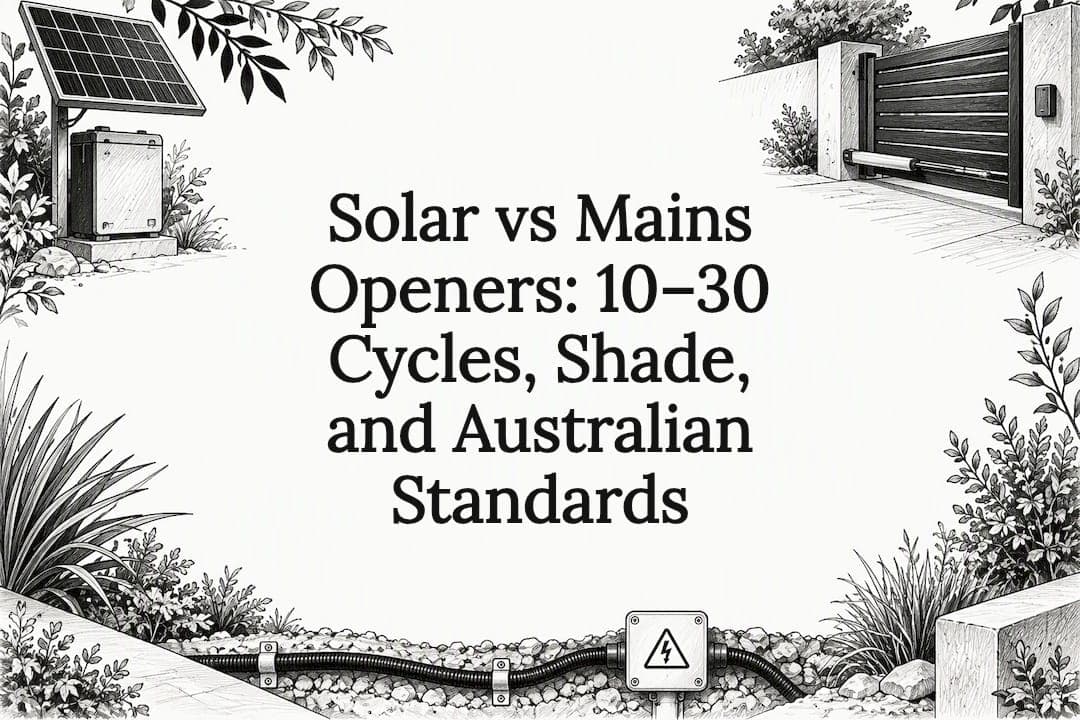
Choose solar if your gate sees low-to-medium daily use and trenching to a power source is impractical. Choose mains if you run a heavy gate, high cycle counts, or need uninterrupted reliability. Industry guidance puts solar's comfortable range at 10 to 30 cycles a day, with AS/NZS wiring rules and gate-drive safety standards setting the compliance baseline either way. We assess this site by site.
TL;DR:
- Solar generally suits 10 to 20 daily cycles; systems approaching 30 may need 20W to 60W panels and battery capacity matched to gate demand.
- Size both components for winter cloud cover; partial shade can cut panel output by more than half, and aging batteries worsen seasonal shortfalls.
- Choose mains for heavy gates, shared driveways, frequent deliveries, or added lighting and access equipment, all of which increase demand beyond typical solar use.
Table of Contents
- Solar vs Mains at a Glance
- Where Solar-Powered Openers Make Sense
- When Mains Power Is the Recommended Choice
- Sizing a Solar Gate Opener Correctly
- Standards and Safety for a Compliant Installation
- What to Check Before and After Installation
- How We Think About Power on Every Project
- Getting a Tailored Power Recommendation From Us
- FAQ
- Sources
Solar vs Mains at a Glance
Before you commit to a power source, it helps to see where each one actually wins and where it tends to fall short.
- Reliability: mains power delivers steady current regardless of weather or season; solar output depends on sunlight, panel angle, and battery charge state.
- Installation impact: mains typically means trenching or running conduit to the gate; solar needs a panel mount and a short cable run, often with no digging at all.
- Running costs: mains draws grid electricity but needs little ongoing hardware attention; solar has no power bill but carries battery replacement and occasional panel cleaning.
- Maintenance pattern: solar systems need periodic checks on battery health and panel exposure; mains systems mostly need electrical inspection at longer intervals.
Seasonal variability is the one caveat that catches solar owners off guard. A system sized for summer sun can struggle through a run of overcast winter days, and a battery nearing the end of its service life makes that gap worse.
Where Solar-Powered Openers Make Sense
Solar earns its place on sites where usage is light and running power to the gate is a genuine headache. Industry guidance treats 10 to 30 cycles a day as the practical ceiling for a well-specified solar setup, with 10 to 20 cycles being the comfortable zone for most residential gates. "Low-to-medium usage" in practice means a family driveway gate opening for daily arrivals and departures, not a shared access point cycling dozens of times an hour.
Solar suits sites where mains access is the real obstacle: long driveways far from the switchboard, heritage properties where trenching risks disturbing established landscaping or paving, short gate travel that keeps motor draw modest, and setups with minimal extra load from intercoms or lighting. Panel wattage and battery capacity vary with cycle count and gate requirements. Panel wattage commonly runs from 20W to 60W, paired with batteries in the 7Ah to 100Ah range.
Seasonal performance is the variable installers watch most closely. Winter daylight hours are shorter and weaker, so a panel and battery combination that comfortably handles summer use can fall behind once cloud cover sets in for several days running. The safer approach is to oversize both panel and battery for the worst month of the year, not the yearly average, so the gate keeps working through a stretch of gray weather rather than stalling halfway open.

When Mains Power Is the Recommended Choice
Mains power holds one advantage solar cannot fully match: it delivers the same current whether the sky is clear or socked in for a week. That makes it the recommended choice for high-traffic or commercial projects where downtime isn't an option.
A few practical signals point toward mains:
- Daily cycle counts that run well past the solar comfort zone, such as a shared driveway or a site with frequent deliveries.
- A heavy or long gate that demands a stronger motor and draws more current per cycle than a light residential swing gate.
- Integration with lighting, intercoms, cameras, or other security loads that add continuous draw beyond what a battery bank can sustain.
- A preference for avoiding periodic battery replacement altogether.
Mains installations are also where compliance stops being optional. Work must follow AS/NZS 3000 wiring rules, which set requirements for electrical installations. Consult the relevant regulatory authority about requirements for the work. For a project with a heavier gate or integrated access control, consider gate access control options when deciding on a power source.
Sizing a Solar Gate Opener Correctly
Getting the numbers right up front saves a callback six months later. Panel wattage and battery capacity work together: a 20W panel suits a light gate with a handful of daily cycles, while a 60W panel supports a busier residential setup closer to the 30-cycle ceiling. Battery capacity typically spans 7Ah to 100Ah, with larger batteries buying more buffer against cloudy stretches.
Battery chemistry matters as much as capacity. Repeated deep discharge below 50% state of charge shortens a lead-acid battery's working life, which is why installers often spec a larger-than-minimum battery rather than one sized to the daily average. A separate look at solar battery lifespan reinforces the same point: batteries that spend their life near full charge simply last longer than ones run down every day.
Shading is the quiet killer of solar gate systems. Partial shade can cut a panel's output by more than half, so a panel tucked under a tree canopy or mounted on the shaded side of a pillar rarely performs as advertised. Panels usually need a genuinely unobstructed sky view, even if that means running a cable from the gate to a sunnier post or fence line a few meters away.

Pro Tip: Size your panel and battery for your gate's worst week of weather, not its average day, so a run of cloudy winter mornings doesn't leave the gate stuck.
Standards and Safety for a Compliant Installation
Two standards govern a properly installed gate opener in this market. AS/NZS 3000 sets the wiring rules for any mains-connected electrical work, covering cable sizing, earthing, and overload protection. AS/NZS 60335.2.103 covers the gate drive itself, setting safety and construction requirements specific to automated gates, doors, and windows.
In practice, consult the relevant regulatory authority about who may carry out mains wiring work and what documentation the finished job requires. Ask any installer, solar or mains, to provide a compliance statement or certification referencing the relevant clauses. A reputable installer will have this ready without being asked twice.
What to Check Before and After Installation
A good quote starts with the site, not the hardware. Before signing off on either power type, work through these checks:
- Confirm gate geometry and the duty-cycle estimate, since a heavier gate or higher cycle count shifts the calculation toward mains.
- Check footing and foundation requirements, since post and footing depths need to suit the gate's weight and the automation hardware mounted on it.
- Account for installation differences: mains means trenching or conduit runs, while solar means a cable run to a well-lit panel location and secure, ventilated battery housing.
Once installed, the maintenance load differs by system. Solar setups need periodic battery health checks, panel cleaning, and sensor and hinge inspection, with battery replacement typically falling somewhere in the multi-year range depending on discharge habits. Mains systems need far less routine attention, mostly periodic electrical checks. Either way, a regular maintenance schedule catches small issues before they become a stuck gate.
How We Think About Power on Every Project
We start with the site, not the catalog. A gate's geometry, usage pattern, and distance from mains tell us more about the right power source than any general rule does, so we weigh aesthetics, reliability, and long-term upkeep together rather than bolting a power decision onto a finished design.
Automation choice is part of the gate design from day one in our process, not an afterthought fitted after the fact. If you want a recommendation built around your actual driveway and daily routine, we're glad to walk the site with you and talk through what fits.
— Rhys
Getting a Tailored Power Recommendation From Us
We design and install bespoke driveway gates with automation built in from the start, which means the solar or mains decision gets made alongside material, style, and security choices rather than as a separate afterthought.
Our Architectural Gates service covers custom design and installation, and we fold power source selection into the project rather than treating it as a bolt-on decision.
- Have photos of your driveway and gate location ready, including where the nearest mains point sits.
- Note your gate's rough measurements and material preference.
- Estimate your daily cycle count, even roughly, since that single figure drives most of the power decision.
Reach out through our Architectural Gates page to discuss a power recommendation that fits your gate, not a generic rule of thumb.
FAQ
Is solar or mains better for a daily-use driveway gate?
For a typical household gate cycling a handful of times a day, solar usually handles it fine, since industry guidance puts comfortable solar use at 10 to 30 cycles daily. Once usage climbs toward the high end of that range or the gate is heavy, mains becomes the steadier choice.
How many cycles a day can a solar gate opener handle?
A well-sized solar system typically supports 10 to 30 cycles a day, depending on panel wattage and battery capacity. Panels in the 20W to 60W range paired with larger batteries sit toward the higher end of that figure.
What happens to solar gate openers in winter or cloudy weather?
Shorter daylight hours and extended cloud cover reduce the energy a panel collects, which is why installers recommend oversizing both panel and battery rather than sizing for an average day. A battery that's already aging from repeated deep discharge makes this seasonal dip harder to ride out.
Do mains-powered gate openers need a backup for power outages?
Many mains-powered systems can be paired with a battery backup so the gate still opens during a blackout, similar in principle to the battery setups used on solar systems. Whether that's worth adding depends on how critical gate access is during an outage at your specific property.
Does a mains gate opener installation need an electrician?
Mains wiring work falls under AS/NZS 3000, which sets requirements for electrical installations. Consult the relevant regulatory authority about who may carry out the work and what documentation is required.
Sources
- Bmgi
- AS/NZS 3000:2018 | Standards Australia Store
- AS/NZS 60335.2.103:2016 Household and similar electrical appliances - Safety - Particular requirements for drives for gates, doors and windows
- Solarquotes
- Solazone