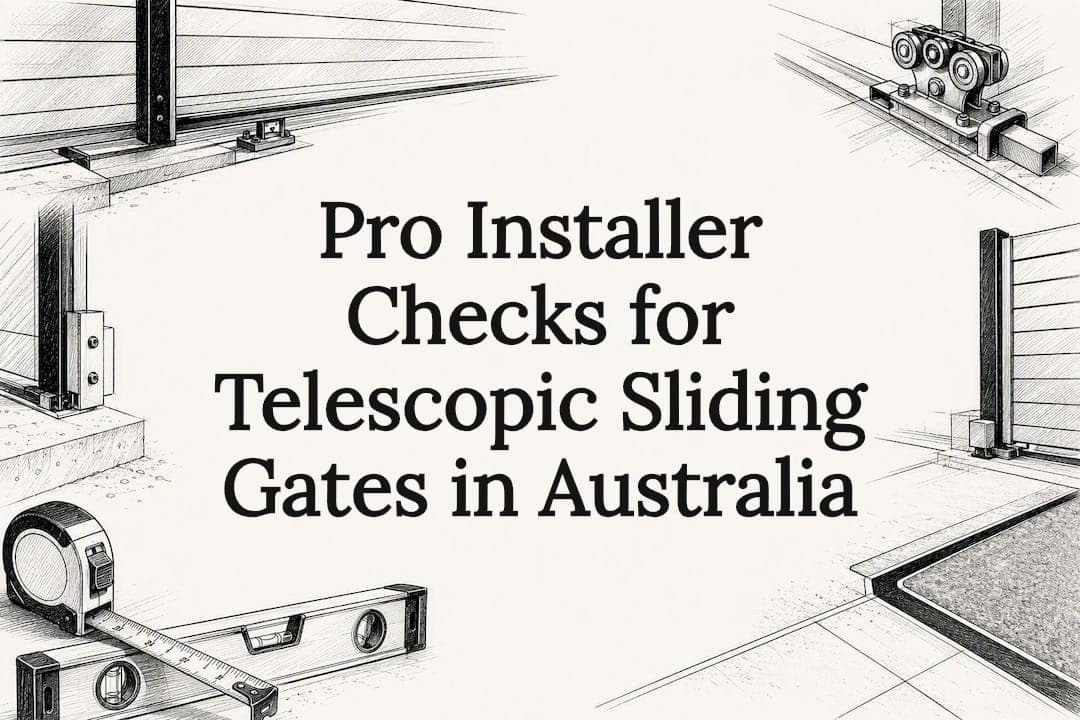
A telescopic sliding gate is the right call for almost any driveway that can't spare the run-back a standard single-leaf slider demands. Its overlapping panels cut the side clearance you need substantially, which makes it the default answer for narrow or awkward frontages. Measure your available run-back today, then book a professional site assessment before you commit to a design.
TL;DR:
- Telescopic sliding gates are ideal for narrow or awkward driveways because they fold into a smaller space than single-leaf sliders, reducing the needed run-back by roughly half.
- They require precise installation due to their mechanical complexity, with synchronized rollers and tensioned cables, making site measurements and ground conditions critical.
- Motor sizing must account for actual resistance from wind, slope, and debris, not just gate weight, with safety hardware like photocells and manual releases non-negotiable for compliance.
- Ground and slope conditions influence track choice, with top-hung or cantilever options better suited for uneven terrain or debris-prone sites.
- Regular maintenance, including sensor testing, track cleaning, and tension checks, is essential to prevent premature failures, especially on multi-panel systems.
Table of Contents
- What Is a Telescopic Sliding Gate and Why Choose One?
- Telescopic Gate Kits and Automation Options to Consider
- Site Suitability: Run-Back, Slope, and Materials
- Installation, Commissioning, and Maintenance Checklist
- Gatecon's Approach to Bespoke Telescopic Gate Projects
- Why Most Buyers Get Telescopic Gates Wrong
- Get a Custom Telescopic Gate Designed for Your Property
- Manuals and Guidance Worth Consulting
- Sources
- FAQ
What Is a Telescopic Sliding Gate and Why Choose One?
A telescopic sliding gate uses two or more overlapping leaves that retract in sequence along a track, rather than one long panel sliding past the opening. The smaller lead panel tucks behind the larger one, so the whole assembly folds into a fraction of the space a single-leaf slider would need beside the driveway.
Most residential setups use a two-panel telescopic layout. Wider commercial or estate entrances sometimes run three panels, letting each leaf shrink further and squeezing an even larger opening into a shorter side wall. Because telescopic sliding gates reduce the run-back needed compared to a single-leaf slider, a property that couldn't physically fit a conventional slider often can fit a telescopic one without touching the boundary fence or a retaining wall.
The trade-off is mechanical complexity. Two leaves moving at coordinated speeds need synchronized rollers, tensioned cables, and a drive system built to handle multiple contact points rather than one continuous track. That complexity is exactly why installation precision matters more here than on a basic slider: a misaligned track on a single-leaf gate is annoying, but on a telescopic system it compounds across every panel.
Here's where telescopic earns its keep over the alternatives:
- Narrow driveway gate ideas that actually work. Sites with under 3 meters of side clearance often can't run a single-leaf slider at all.
- Faster cycle times on wide openings. Two shorter leaves retract quicker than one long panel covering the same span.
- No swing arc required. Unlike hinged gates, nothing crosses the footpath or driveway apron mid cycle.
- Better fit for sloping driveway gate sites where a wide swing gate would scrape or bind on uneven ground.
The trade-off column is shorter but real: more rollers and cables mean more points that can wear, and a telescopic kit costs more upfront than an equivalent single-leaf setup.
Telescopic Gate Kits and Automation Options to Consider
Kits generally come in two mounting formats: side-mount, where the motor and rack sit beside the track, and bottom-mount, where the drive unit sits recessed at ground level. Side-mount suits most residential driveways since it's easier to service. Bottom-mount keeps the mechanism out of sight, which appeals to architectural projects where a visible motor box would clash with the design.
A standard telescopic kit typically includes a geared motor, a toothed rack or chain drive, guide rollers, top and bottom track guides for each leaf, and a control board. What it often doesn't include: mechanical stops, key-release hardware, floor anchors, and photocell posts. Those accessories are frequently sold separately from the base kit, so confirm exactly what's in the box before you compare prices between suppliers.
Motor sizing comes down to weight class and duty cycle:
- Light residential gates (roughly 400 to 600 kg combined leaf weight) run comfortably on standard domestic motors sized for daily household cycling.
- Heavier estate or commercial gates (1,200 kg and above) need a commercial-grade motor built for higher torque and more frequent cycling, the kind of capacity you'll see quoted on telescopic kits paired with heavier duty motor bundles.
- Always check the dataplate, not just the marketing copy, since actual travel resistance from wind load, track friction, and slope can push a gate outside a motor's rated limit even when the raw weight looks fine on paper.
Pro Tip: Don't size a motor off the gate's listed weight alone. Ground friction, wind exposure, and a slightly uneven track can add real resistance that a spec sheet never accounts for.
Non-negotiable safety hardware includes photocells, auto-reverse sensing, and edge protection on the leading panel, plus a mechanical release for manual operation during a power outage and a flashing light to warn approaching traffic. Australian installations must include these safety devices to protect anyone near the gate during a cycle. For access control, most owners choose a mix of remotes, a keypad for visitors, and increasingly an intercom or app that ties into a broader smart home setup. Battery backup or solar charging is worth adding if your property loses power often, since a telescopic gate stuck mid-cycle blocks the driveway completely.
Site Suitability: Run-Back, Slope, and Materials
Measuring run-back is simple in principle: it's the clear wall or fence length beside your opening, on the side the gate will retract toward. What trips people up is forgetting obstructions. Downpipes, meter boxes, garden beds, and even a slight boundary jog can eat into space you assumed was free. A telescopic system typically needs roughly half the run-back of a single-leaf slider covering the same opening width, but that number shifts with panel count and leaf proportions, so it's worth confirming against your actual gate design rather than a rule of thumb.
Slope changes your track choice. Ground-mounted tracks work fine on a gentle, consistent grade, but on a driveway with dips, gravel, or heavy leaf litter, a bottom track collects debris and drainage water fast. That's when a cantilever or top-hung telescopic system earns its cost premium, since it lifts the moving mechanism clear of the ground entirely. Sliding and telescopic gates are generally favored over swing gates on inclines because they avoid the ground-clearance problems a hinged gate runs into on uneven terrain.
Material choice feeds straight back into motor sizing. A few things to weigh:
- Aluminum keeps leaf weight down, which lets you run a lighter motor and reduces cable tension issues over time.
- Steel adds strength and a heavier, more substantial look, but pushes you into the higher motor weight class.
- Timber-look composite infills sit in between on weight but need periodic checks for warping in exposed positions.
- Dense or mesh infills reduce reach-through risk at pinch points, which matters more on a telescopic gate than a single-leaf one because it has more moving joints where fingers or clothing can catch.
Foundation work isn't optional here; proper structural support and anchoring are critical to ensure stability and durability, as detailed in the design of concrete structures for modern buildings With Integra. The gearmotor needs a properly anchored footing rated for the gate's full operational load, not just its static weight, and the track itself needs regular clearing to stay debris-free.
Installation, Commissioning, and Maintenance Checklist
Before any motor goes on, a proper installation starts with manual checks: does the gate slide freely by hand across its full travel, is friction consistent from one end to the other, and is the supporting structure rigid enough to carry a motor's repeated pulling force without flexing? Skipping this step is the single most common cause of early motor failure, since an automated system can't compensate for a structurally weak or misaligned gate no matter how well it's programmed.
Installation manuals are specific about placement for good reason:
- Anchor the gearmotor to a footing rated for the full pulling load, not the gate's resting weight.
- Mount the control unit where it's protected from weather but accessible for servicing.
- Position photocells at a height and sightline that catches both pedestrians and vehicles, with no obstruction across the beam path.
- Set mechanical stops at both travel extremes so the motor never relies on the control board alone to know where the gate should stop.
Commissioning should test auto-reverse under simulated obstruction, confirm the manual release disengages the motor cleanly, and verify the gate's actual dimensions and weight sit within the motor's declared limits rather than assuming the kit spec sheet covers your specific gate.
Ongoing maintenance is lighter than most owners expect but not something to skip. Clean the track every few months, lubricate rollers on a similar schedule, and test the safety sensors at least twice a year. Cable tension deserves particular attention on telescopic systems since uneven tension between panels causes jerky, unsynchronized movement and accelerates wear on whichever leaf is working harder than the other. A qualified technician should check tension and panel synchronization at each service visit, ideally annually for a residential gate and more often for a high-cycle commercial one.
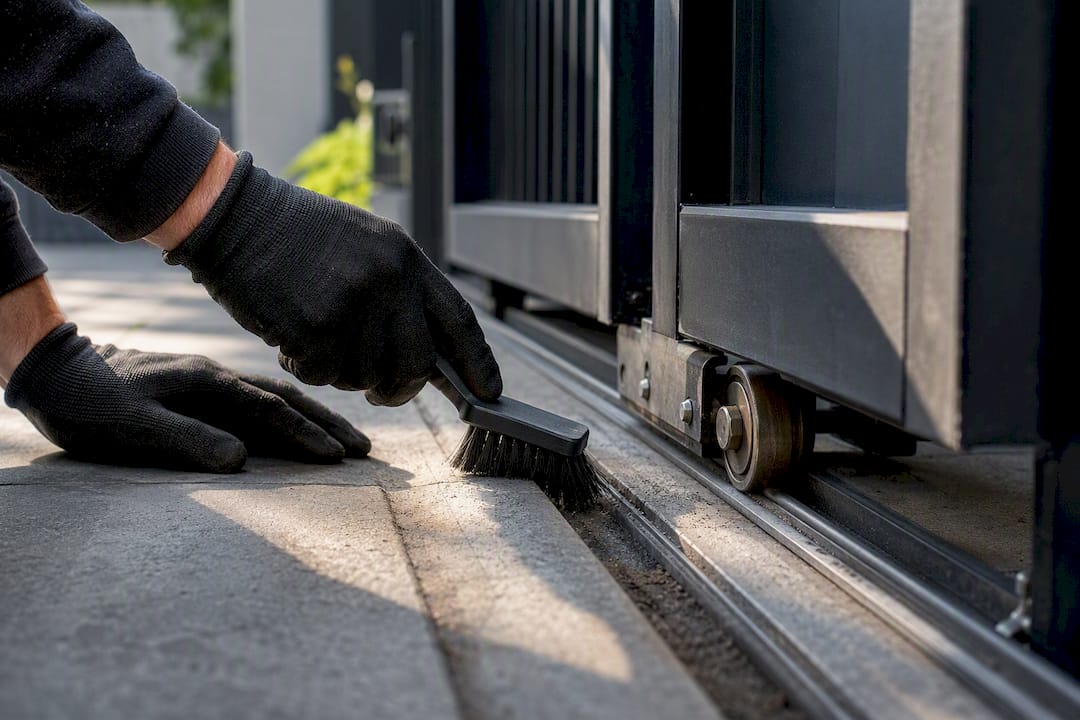
Watch for grinding sounds, a gate that hesitates or stutters mid-cycle, or visible daylight between a leaf and its guide track. Any of those signal a professional inspection is overdue, not a wait-and-see situation.
Gatecon's Approach to Bespoke Telescopic Gate Projects
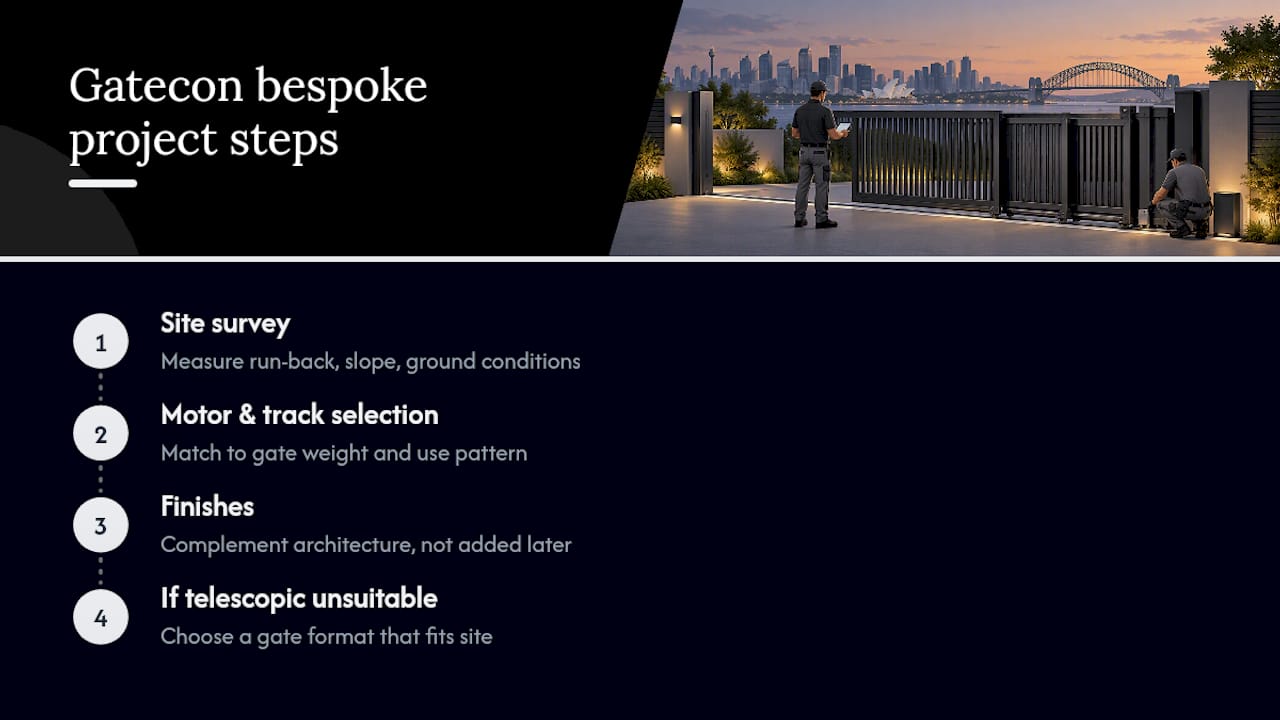
Some companies design and install custom driveway gates and architectural fencing across boutique residential and commercial properties, and telescopic systems come up often on sites where a standard slider simply won't fit. The approach starts with a site survey measuring actual run-back, slope, and ground conditions, not just the opening width on a plan.
From there, motor and track selection get matched to the gate's real weight and the property's daily use pattern, whether that's a family home cycling the gate a handful of times a day or a commercial site with constant traffic. Finishes are built to complement the architecture rather than sit on top of it as an afterthought, which is the difference between a gate that looks bolted on and one that looks designed in. You can see that design philosophy at work in Gatecon's luxury fencing projects across Melbourne.
Telescopic isn't the answer for every site. Where the structure or run-back doesn't support it cleanly, it is recommended to choose a gate format that suits the property rather than forcing a design that doesn't fit.
Why Most Buyers Get Telescopic Gates Wrong
The mistake I see most often isn't choosing telescopic when it's the wrong fit. It's choosing it correctly, then treating the motor spec sheet as the whole decision. A gate rated at 600 kg on paper can behave like an 800 kg gate once you factor in a slight grade, a stiff bottom guide, and Melbourne's wind gusts across an exposed frontage. That gap between rated capacity and real-world resistance is where most premature motor failures come from, and it's rarely the motor's fault.
Conventional advice leans hard on run-back math and stops there, as if fitting the space were the whole job. It's the easy half. The harder half is honest resistance testing before a motor gets specified, and cable tension discipline across the gate's working life afterward, since telescopic systems punish sloppy tensioning faster than single-leaf sliders do.
If you're weighing this for a tight or sloped driveway, prioritize the site survey over the catalog. A motor upgrade after installation costs far more than getting the sizing right the first time.
— Rhys
Get a Custom Telescopic Gate Designed for Your Property
Some providers build custom telescopic gates engineered around actual site surveys, not generic weight brackets. Where catalog kits require guessing motor sizing and hope the slope cooperates, some providers measure run-back, ground resistance, and structural load first, then specify automation and materials to match. That's the difference between a gate that fits on paper and one that runs smoothly for years.
The offering covers custom design, integrated automation, and premium materials, typically installed as a coordinated project rather than a kit assembled on site. Combine it with matching designer fencing for a unified entrance, or start with the gate alone through architectural gates. Either way, the process runs through a site survey, a tailored quote, and a design review before anything gets fabricated. Request a site assessment through Gatecon's custom packages page to get a quote moving on your project.
Manuals and Guidance Worth Consulting
For readers or installers who want the underlying technical detail, these sources cover motor selection, sloped-site automation, and installation standards referenced throughout this guide:
- Automatic sliding gate motor selection
- Sliding gate automation on sloped driveways
- Sliding gate installation and user instructions
- Residential gate automation Australia guide
Sources
- Automatic sliding gate motor selection | Digital Home Systems
- Automatic sliding gates for sloped driveways | Digital Home Systems
- SL1-SL10 Sliding gate install/user instructions (example installation manual)
- Residential gate automation Australia — complete guide | STGG
FAQ
How Much Run-Back Does a Telescopic Sliding Gate Need?
A telescopic gate typically needs roughly half the run-back of a single-leaf slider covering the same opening, since the overlapping panel design cuts the required side clearance. Exact clearance depends on panel count and leaf proportions, so measure your specific site rather than relying on a general estimate.
Is a Telescopic Gate Better Than a Single-Leaf Slider on a Slope?
Sliding gates in general handle slopes better than swing gates because they avoid the ground-clearance problems hinged gates face on uneven terrain, and telescopic variants add the benefit of needing less side space. On debris-heavy or steeply graded sites, a cantilever or top-mounted telescopic option often outperforms a ground-tracked one.
What Safety Devices Does an Automated Telescopic Gate Need?
At minimum, photocells, auto-reverse sensing, edge protection, and a manual mechanical release, since Australian automated sliding gate installations require these safety devices to protect people near the gate during operation. A flashing warning light for approaching vehicles is standard practice alongside them.
Does Gatecon Install Telescopic Sliding Gates?
Gatecon designs and installs custom telescopic gates as part of its architectural gates service, tailoring motor selection and finishes to the property's actual site conditions. Pricing is typically quoted per project after a site survey, with current details available directly from the provider rather than as a published rate.
How Often Should a Telescopic Gate Be Serviced?
A residential telescopic gate typically needs sensor testing and roller lubrication a couple of times a year, with a full technician inspection covering cable tension and panel synchronization at least annually. High-cycle commercial gates warrant more frequent checks, since uneven cable tension accelerates wear faster on multi-panel systems than on a single-leaf slider.