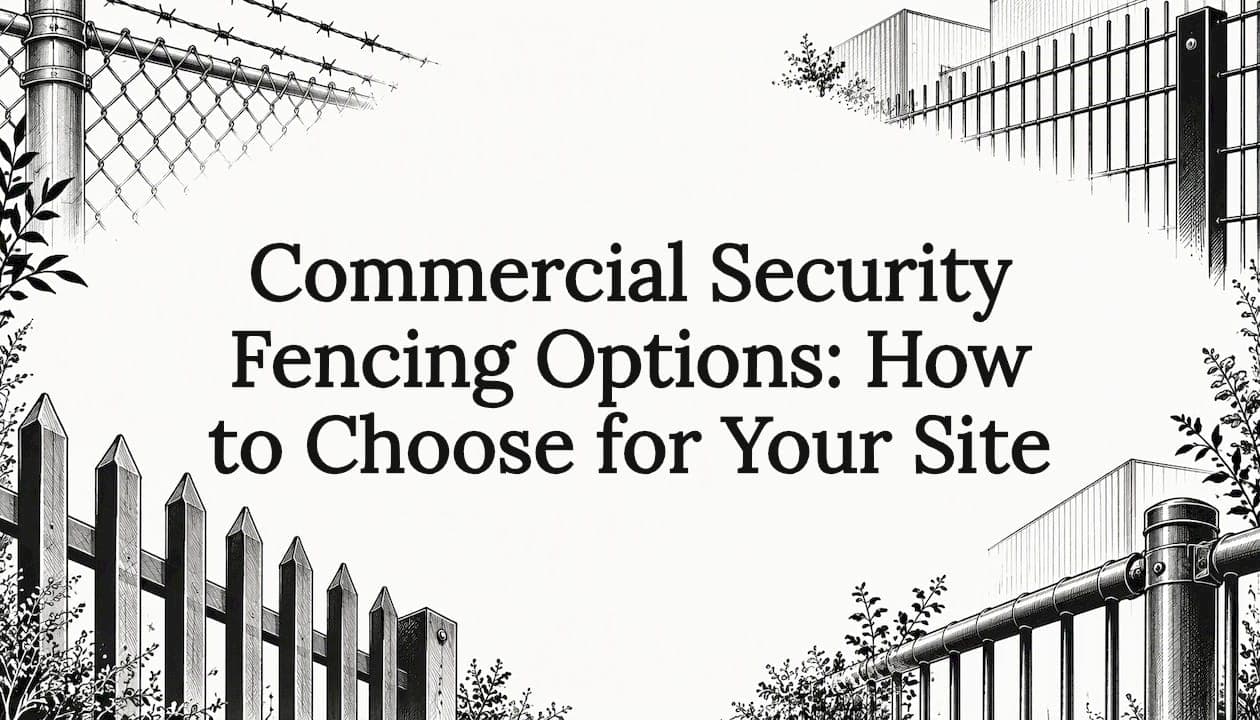
The main commercial security fencing options in Australia are chainmesh, welded anti-climb mesh, palisade and tubular steel. The right one depends on what you are protecting, who might try to get in and how the fence needs to look from the street. Chainmesh is the utilitarian baseline. Welded mesh and palisade add resistance to climbing and cutting. Tubular steel gives you security with a architectural finish, which matters on boutique commercial and high-end development sites. This guide explains how each type works, which sites suit it and what to check on height, gates, coatings and compliance before you commit.
TL;DR
- Start with a security risk assessment, not a fence catalogue. Utility operators such as TasNetworks use one to pick between weldmesh and chainmesh and to choose the gate type.
- Four types cover most commercial work: chainmesh, welded anti-climb mesh, palisade and tubular steel. They differ in climb resistance, visibility and appearance.
- Height is only part of the answer. The fence also has to resist climbing, stop access underneath and stay stable under load.
- Gates are usually the weakest point. Plan swing direction, self-closing pedestrian gates, automation and access control together with the fence line.
- Galvanized coatings, solid footings and a documented compliance trail decide how long the fence lasts.
Table of Contents
- The four main types of commercial security fencing
- How the options compare
- Match the fence to the site and the risk
- Height: why the number is not the whole story
- Gates and access control: the weak point to design first
- Materials, coatings and footings that decide durability
- Standards, compliance and paperwork
- Installation and upkeep
- Our perspective
- Bespoke gates and fencing for Melbourne projects
- FAQ
- Sources
The four main types of commercial security fencing
Most commercial fencing in Australia falls into four families. Each has a clear job, and mixing them across one site is common: a robust type on a rear boundary, a refined one at the entrance.
Chainmesh (chainwire)
Chainmesh is woven wire fabric stretched between posts. It is economical, lets you see through the fence and covers long runs quickly. Australian Standard AS 1725.1-2010 sets requirements for chain-link fabric security fences and gates where restricted access is desirable. That makes it the reference point for general-purpose perimeters such as yards, car parks and storage compounds.
It suits lower-risk sites and temporary works. It is the type most often paired with added deterrents when the risk rises.
Welded anti-climb mesh
Welded mesh is made from rigid wire panels with tight openings. The openings are small enough that fingers and boot toes struggle to find a grip, and the welded construction resists cutting better than woven wire. Heavier panels are often described in the trade as 358 mesh. It keeps good visibility, so cameras and passers-by can still see the site.

It suits sites where theft, trespass or vandalism is a real concern, including plant rooms, substations, data and logistics sites and the rear boundaries of commercial buildings. Our own guidance on anti-climb fence design explains why gap size matters so much for climb resistance.
Palisade
Palisade uses vertical steel pales fixed to horizontal rails, often with shaped tops. It looks imposing and is hard to cut or bend. The visual message is deterrence, which suits industrial estates, depots and infrastructure. It blocks less of the view than a solid wall but more than mesh, and it reads as a heavy-duty perimeter.
Tubular steel and architectural fencing
Tubular steel fencing uses vertical bars, usually in square or round section, welded or fixed between posts and rails. Bar spacing, top treatments and finishes can all be set to the design. It offers solid security and can be detailed to suit the building: slatted infill, curved runs, feature gates and powder-coated or artisan finishes.
This is where architectural fencing earns its place. For a boutique apartment building, a showroom, a clinic or a high-end commercial frontage, the fence is part of the facade. A steel perimeter that looks designed also tells visitors the property is cared for. Our designer fencing work sits in this category.
How the options compare
The table below gives a practical, general comparison. Actual performance depends on specification, panel gauge, post spacing and installation quality.
| Type | Climb and cut resistance | Visibility | Appearance | Typical commercial use |
|---|---|---|---|---|
| Chainmesh | Basic, improves with added deterrents | High | Utilitarian | Yards, car parks, temporary works |
| Welded anti-climb mesh | High | High | Clean, industrial | Plant, utilities, logistics, rear boundaries |
| Palisade | High | Moderate | Imposing | Depots, industrial estates, infrastructure |
| Tubular steel (architectural) | Good to high, set by design and bar spacing | Adjustable | Refined, customizable | Boutique commercial, developments, street frontages |
No single row wins everywhere. The better question is which combination matches each boundary of your site.
Match the fence to the site and the risk
The research on public and utility infrastructure points to the same method: assess first, then specify. TasNetworks, for example, requires a security vulnerability assessment to decide the fence fabric and gate type for its substation perimeters. You can borrow that approach for a business.
Ask these questions for each boundary:
- What is the target? Stock, vehicles, plant, data, people or the building itself.
- Who is the threat? Opportunistic trespassers, organized theft or deliberate vehicle attack.
- What can be seen from outside? A visible, well-lit perimeter works with cameras. A hidden compound might need more physical resistance.
- What does the street or neighbour expect? Planning conditions and design review often influence what is acceptable on a frontage.
- How do people and vehicles get in? The entry points decide the gate type, and the gate decides how much of the fence line matters.
A general pattern follows. Low-risk sites often use chainmesh or decorative security fencing. Higher-risk sites move to welded mesh or palisade. Customer-facing and design-led sites use tubular steel for the frontage and a tougher type behind it. If you are a developer working through frontages, our developer fencing guidelines for Melbourne cover how to coordinate this.
Height: why the number is not the whole story
Height is the first thing people ask about, and it matters. WorkSafe Victoria says construction-site security fencing should be at least 1.8 m high, well constructed, stable under the loads it is expected to carry, difficult to climb and built so nobody can get in underneath. Education department specifications in NSW describe 2,100 mm high temporary chainwire fencing built to AS 1725, which shows that heights above 1.8 m are common where the risk calls for it.
The more useful lesson comes from WorkSafe Tasmania. Its guidance treats effective fencing as performance-based. A fence has to deal with climbing, gaps underneath, joints, stability, wind and impact, not only a nominal height. A tall fence with loose panels or open ground beneath is weaker than a slightly lower one that is properly braced and grounded.
A few practical notes follow from that:
- Check the ground line. Uneven ground creates gaps that people use.
- Choose panels without footholds. WorkSafe Victoria says reinforcing mesh should not be used as site fencing, because it can give children hand and foot holds and its protruding ends can cause injury.
- Keep fixings and horizontal rails on the inside where you can, so there is nothing to step on from outside.
- For driveways and entries, height rules and permits differ by council. Our guide to driveway gate height and permit checks shows what to confirm before design is locked.
Gates and access control: the weak point to design first
A perimeter is only as strong as its entrances. Public standards show the kind of detail worth copying. The ACT Municipal Infrastructure Standard 10 requires gates on external boundaries to swing one way only and personnel gates to be self-closing. It also says heavy-duty vehicle gates should resist deliberate impact where a site is isolated or where standard gates have already been damaged.
That gives you a checklist for any commercial site:
- Swing direction. Gates opening outward onto a public footpath create both a safety and a security problem.
- Self-closing pedestrian gates. A gate left ajar defeats the fence.
- Impact resistance. If vehicles have hit your gates before, or the site is remote, specify accordingly.
- Gate type. Swing, sliding and pivot gates suit different sites. Sliding gates are often the answer where space is tight or traffic is heavy, and our commercial sliding gate design guide walks through the choices. For multi-level or residential-commercial parking, see our car park gate design guide for Melbourne.
- Automation and access control. Keypads, intercoms, card or app-based access and vehicle detection all need to be planned with the gate frame, not added afterwards. Integrated systems can give you security without bulky visible hardware.
If your plans go to a builder or council, specifying gates in architectural plans helps you set out clearly what is required, so the installed gate matches the intent.
Materials, coatings and footings that decide durability
Two fences that look the same on day one can age very differently. Local government specifications show what a durable build includes. The City of Wyndham specification (Section 707) calls for tubular steel posts with a minimum yield strength of 195 MPa, specified galvanized coatings, wire gauge and type shown on the drawings, and concrete footings for chain-wire and welded-mesh fences. It also requires galvanized tubular steel gate frames and hot-dipped galvanized gate fittings in accordance with AS 4680.
Translate that into questions for any supplier:
- What steel grade and wall thickness are the posts and rails?
- Is the coating hot-dip galvanizing, and are the fittings galvanized too? Fittings corrode first.
- What finish sits on top, such as powder coat, and how is it applied?
- How deep and wide are the footings, and are they concrete? Footing size depends on post size, soil and gate weight, and our Australian gate footing requirements article covers it in detail.
If you want a sense of how architectural metalwork specifications are written for rails and stairs, these architectural metal specifications show the level of detail that good steel documentation includes, from material to finish.
The coating and footing decisions are where cost is saved or lost over a decade. Cutting them rarely shows at handover and always shows later.
Standards, compliance and paperwork
Commercial fencing sits under several layers of rules, and which apply depends on the site and the client.
- Australian Standards. AS 1725.1-2010 covers chain-link security fences and gates. Gate fittings in public specifications reference AS 4680 for hot-dip galvanizing.
- Work health and safety. Temporary and construction fencing has its own expectations, as the WorkSafe guidance above shows.
- Material safety. The ACT standard prohibits highly flammable fences such as brush fencing, a reminder that fire performance matters near buildings.
- Council and project specifications. Wyndham, for instance, requires contractors to submit a Certificate of Compliance with test reports for fencing components at least 14 days before use. Not every site demands this, but a supplier who documents materials as a habit makes approvals easier.
- Planning permits and overlays. Heritage, design and frontage rules can limit height, materials and transparency. Confirm them with your local council before design is finalized.
Many of the figures above come from public authorities, not from rules that bind every private property. Treat them as reference points and confirm requirements for your own site, council and insurer.
Installation and upkeep
Good installation protects the security rating of the fence. The Wyndham specification requires logs, stumps, saplings and undergrowth within 1 m of the fence line to be cleared. The reasoning applies on any site: vegetation hides activity, gives climbing aids and loads the fence.
A simple routine keeps a fence effective:
- Walk the line regularly. Look for lifted panels, loose fixings, gaps at the base and signs of digging.
- Keep the line clear. Trim vegetation and remove stored materials that could be stacked to climb on.
- Treat coating damage early. Chips and scratches expose steel. Touching up promptly avoids rust spreading.
- Service gates and automation. Moving parts, safety sensors and access control should be checked on a schedule, particularly after impact.
- Review after incidents. An attempted break-in or vehicle strike is a signal to reassess the weak point, not just repair it.
Our perspective
Most security fencing conversations start with the cheapest way to enclose a boundary. On boutique commercial and high-end development sites, that is the wrong place to begin. The fence and gate are the first thing every client, resident and visitor meets, and they set the tone for the whole property.
We design for security and appearance together. Tubular steel and architectural fencing let us set bar spacing, heights and finishes to the architecture, so a perimeter can be tough without looking like a compound. Our approach is to start from the building and the risk, then choose the form, rather than pull a standard product off a shelf.
The entrance deserves the most thought. We aim to integrate automation and access control into the gate itself, so security works without bulky hardware spoiling the design. When the gate, the fence line and the footings are specified as one system, the result is more reliable and more elegant.
If you are an architect, builder or developer, bring us in early. A few decisions on gap size, gate type and finish at concept stage save rework at council and on site.
Rhys
Bespoke gates and fencing for Melbourne projects
Gatecon designs and installs luxury driveway gates, automatic gates and architectural fencing for boutique residential, high-end commercial and development projects across Melbourne. Our work covers custom design, premium materials, automation, security integration and artisan finishes, so the entrance and the perimeter are developed together.
If your project needs a perimeter that protects and also suits the architecture, explore our architectural gates and designer fencing, or talk to us about a custom package for your site. You can also check the Melbourne areas we serve.
FAQ
What is the most secure type of commercial fencing?
Welded anti-climb mesh and palisade are the usual choices where resistance to climbing and cutting is the priority. Tubular steel can also reach a high level when bar spacing, height and footings are specified for the risk. The best choice comes from a site risk assessment, not from the fence type alone.
How high should a commercial security fence be?
WorkSafe Victoria sets a minimum of 1.8 m for construction-site security fencing, and some public specifications use 2,100 mm. Height must work with climb resistance, no gaps underneath and a stable structure. Local council rules and permits can also affect what you may build on a frontage.
Can a security fence still look good?
Yes. Tubular steel and architectural fencing can be detailed with custom panels, curved runs and refined finishes, and still deliver real perimeter security. This suits boutique commercial buildings, developments and any site with a visible street frontage.
What should I check on the gates?
Check swing direction, self-closing pedestrian gates, impact resistance for vehicle gates, and how automation and access control are integrated. Public standards such as the ACT's MIS 10 set out these points. Plan them together with the fence line, not afterwards.
What affects how long a security fence lasts?
Steel grade, galvanized coatings on posts, frames and fittings, a quality finish and properly sized concrete footings matter most. Regular inspection, clear fence lines and prompt coating repairs extend life further.
Sources
- TasNetworks Security Fences and Gates Standard
- AS 1725.1-2010, Standards Australia Store
- WorkSafe Victoria: Construction site security fencing
- WorkSafe Tasmania: Security fencing for construction sites
- NSW Department of Education: 0242 Fences and Barriers
- ACT Municipal Infrastructure Standard 10: Fences, Guardrails and Barriers
- Wyndham City Council Technical Specification Section 707: Fencing
- Architectural metal specifications