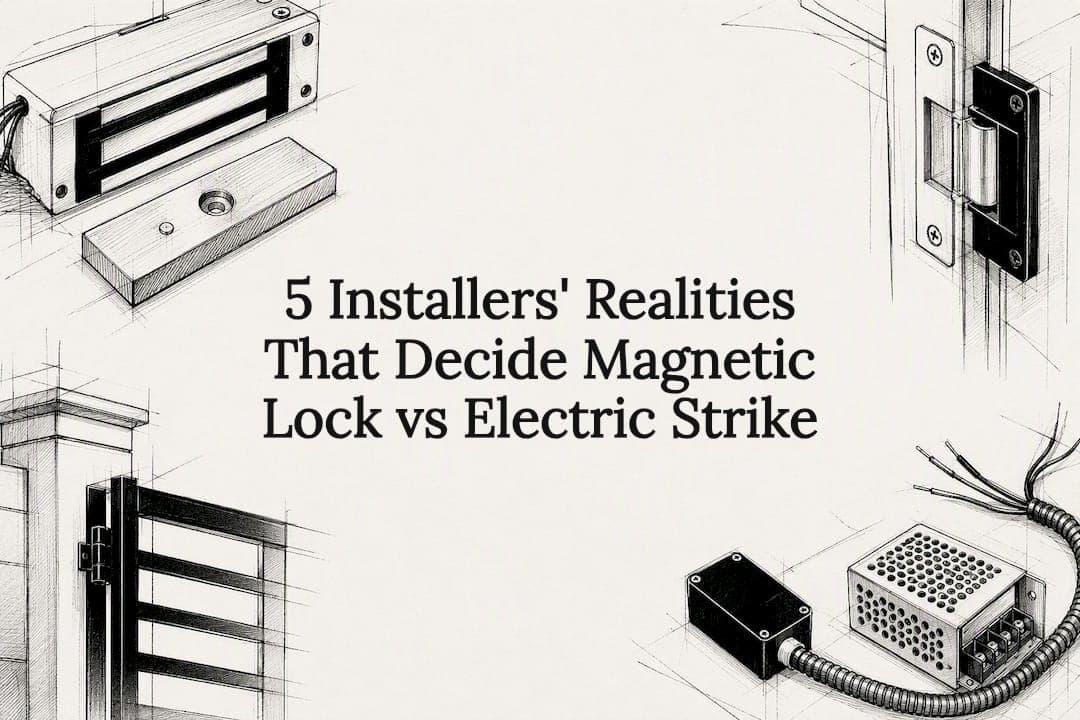
Electric strikes latch mechanically and let you choose fail-safe or fail-secure behavior, which is why they are the standard choice for hinged commercial and office doors. Magnetic locks hold electromagnetically and unlock the instant power cuts out, so they suit openings where egress can never be blocked or where a strike simply won't fit the frame. The right pick comes down to your door type, your local fire and egress code, and whether you need the door to stay secure when the power fails.
TL;DR:
- Magnetic locks are inherently fail-safe and will always unlock during a power outage, making them unsuitable for high-security or fire-rated doors without additional hardware.
- Electric strikes require proper frame depth, latch compatibility, and fire rating certification, with fail-secure wiring preferred for security and fail-safe for egress compliance.
- Installation of strikes depends heavily on precise frame preparation and latch alignment, while maglocks demand parallel mounting and accounting for door sag and weather conditions.
- For large external gates, specialized electromechanical or vertical lock options outperform maglocks by transferring load and resisting wind and push forces.
- Fire-rated doors require UL 10C listed strikes and proper fire-alarm interface testing to ensure code compliance and occupant safety during emergencies.
Table of Contents
- Magnetic Lock vs Electric Strike: How Each Device Actually Works
- How Do Magnetic Locks (Maglocks) Work?
- Key Differences at a Glance
- Which Doors and Applications Suit Each Lock?
- Egress, Fire Codes, and What Happens When Power Fails
- Installation, Alignment, and What to Budget For
- How to Choose Between a Maglock and an Electric Strike
- A Gate and Entrance Specialist's View on Lock Selection
- Sources
- FAQ
Magnetic Lock vs Electric Strike: How Each Device Actually Works
The two technologies solve the same problem, holding a door shut, through completely different mechanics. An electric strike replaces the fixed keeper plate in the door frame with a movable one. When the access control system sends power (or cuts it, depending on wiring), the keeper pivots to release the door's existing latch. The latch itself never changes. That matters because the door still feels and operates like a normal mechanical door to anyone walking through it.
Here's what determines whether a strike works on your door:
- Fail-secure vs fail-safe wiring: fail-secure strikes stay locked on power loss (common for exterior and high-security doors); fail-safe strikes release on power loss (required on most fire-rated egress paths).
- Latch type: deadlatch hardware needs a strike built for it; a plain spring-latch won't work with every strike model.
- Frame rabbet and preload: the frame needs enough depth for the keeper mechanism, and door closers must be adjusted so the latch doesn't bind against the strike face.
- Fire rating: strikes suit standard hinged commercial doors with good latch and frame fit, but a fire-rated opening needs a UL 10C listed strike, not a generic one.
Ask your installer to check frame rabbet depth and latch compatibility before ordering hardware. Guessing here is how you end up with a strike that binds or won't seat.
How Do Magnetic Locks (Maglocks) Work?
A maglock is an electromagnet mounted on the frame paired with a steel armature plate on the door. Energize the coil and the plate locks to it with no moving parts, no latch, and no mechanical engagement at all. Cut the power and the bond releases instantly. That's not a design choice you can wire around: maglocks are fail-safe by nature, full stop.
Mounting comes in three common styles: surface mount for straightforward header applications, Z-bracket mount for outswing doors where the magnet needs to clear the frame, and shear-lock variants for narrow-stile glass doors. Each changes labor and hardware cost.
Holding-force ratings vary by model and are typically specified by manufacturers, measured under ideal lab conditions with a flush, aligned armature plate. Real doors sag. Paint builds up. Weather warps frames slightly over time. Even a small gap or misalignment can cut effective holding force well below the rated number, which is why installers should record the initial air gap and holding-force test at commissioning, not guess at it later.
- Continuous power draw: maglocks stay energized the entire time the door is locked, with power consumption varying by model.
- Multiply that across a dozen doors and it starts to matter for backup power sizing and UPS planning.
Key Differences at a Glance
Five factors decide most maglock-vs-strike arguments in the real world, not marketing copy.
- Fail mode: maglocks always unlock on power loss (fail-safe only); strikes can go either way, giving you a security option strikes have that maglocks structurally don't.
- Door fit: strikes need a standard frame and functioning mechanical latch; maglocks handle glass, frameless, and awkward openings where a strike has nowhere to seat.
- Security character: a strike retains a physical latch bolt even unpowered in fail-secure mode; a maglock's holding force exists only while current flows, and that force drops with misalignment.
- Installation labor: strikes demand precise frame cutting and closer coordination; maglocks demand armature/magnet parallelism and clearance for mounting brackets.
- Operating cost: maglocks draw power continuously; many fail-secure strikes only draw current during the release moment, which shrinks backup battery requirements.
Neither wins across the board. The door in front of you decides.
Which Doors and Applications Suit Each Lock?
Matching hardware to the opening avoids most of the callback issues installers see.
- Office suites, payroll rooms, standard perimeter doors: electric strikes usually win here. You keep the mechanical latch, the door feels normal, and fail-secure wiring keeps sensitive rooms locked even during an outage.
- Glass storefronts, frameless doors, large lobby entries: maglocks often win because there's no frame depth for a strike mechanism. You'll still want a mechanical deadbolt or a hybrid setup for after-hours security since the maglock alone offers nothing once power drops.
- Perimeter and driveway gates: skip standard interior maglocks entirely. Electromechanical gate locks or vertical drop locks handle wind load and transfer stress away from the gate operator motor, something a flat-mounted maglock designed for a hinged door was never built to resist.
- Fire-rated doors on an egress path: this is a code decision more than a preference, covered next.
Egress, Fire Codes, and What Happens When Power Fails
Life-safety code shapes this decision more than any spec sheet. Building and fire officials care about one thing above all: can occupants get out during an emergency, every single time, without needing a key or a working network connection?
NFPA guidance on electrified egress hardware requires that locks release on fire alarm activation and use only listed components. A sensor-release system needs a power-loss unlock function, a labeled push-to-exit button, and UL 294 compliant hardware, no exceptions carved out for convenience.
- Maglocks on an egress path must integrate with fire-alarm relays and a request-to-exit (REX) device; battery-backing the maglock circuit to keep it locked during an outage typically violates the code intent, since it defeats the fail-safe release.
- Electric strikes chosen for fire-rated doors must carry a UL 10C fire rating; installing a standard commercial strike on a rated door can void the door's label entirely.
- Ask for documented evidence of listed components and a tested fire-alarm interface before sign-off, not a verbal assurance.
Pro Tip: Request the fire-alarm interface test in writing, not a verbal walkthrough. If the installer can't produce documentation showing the lock releases on alarm signal, that's a compliance gap you don't want discovered during an inspection.
Installation, Alignment, and What to Budget For
Labor costs diverge sharply between the two systems, and it's not where most people expect.
Strike installation is dominated by frame prep: cutting the mortise, aligning the keeper with the latch throw, and coordinating door closer tension so the latch doesn't slam against the strike face. Get the alignment off by a few millimeters and the door either won't latch or won't release cleanly.
Maglock installation is dominated by parallelism. The armature plate and magnet face need to sit flush, which means accounting for door sag, hinge wear, and frame square before final mounting. Power draw differs too: maglocks pull current the entire time they're locked, while many fail-secure strikes only draw during the release pulse, which meaningfully changes backup battery sizing.
- Check the air gap and record the holding-force test result at installation for future comparison.
- Inspect keeper wear on strikes and armature face wear on maglocks at every service visit.
- Weatherproofing matters more on exterior applications than either spec sheet usually mentions.
- Build a recurring inspection cadence into the contract, not a one-time install and walk-away.
How to Choose Between a Maglock and an Electric Strike
Run through this before you accept a quote:
- Identify your door and frame material. Metal, wood, glass, and aluminum storefront each rule certain hardware in or out before you even discuss brands.
- Confirm the fire rating. A rated door narrows your options to listed hardware only, and that's not negotiable.
- Decide who needs access during a power outage. If the answer is "everyone, always," you're leaning fail-safe. If it's "nobody, security matters more," you're leaning fail-secure.
- Ask the installer four direct questions: Will this keep the fire door's rating intact? How is REX being provided? What's the measured air gap or holding-force test result? What maintenance is included after installation?
- Get one quote covering hardware, labor, and code integration together, not a parts list with installation as a footnote.
Manufacturer and installer guidance consistently frames this as a site-specific decision made after inspecting the actual opening, not a blanket rule you can apply from a spec sheet alone.
A Gate and Entrance Specialist's View on Lock Selection
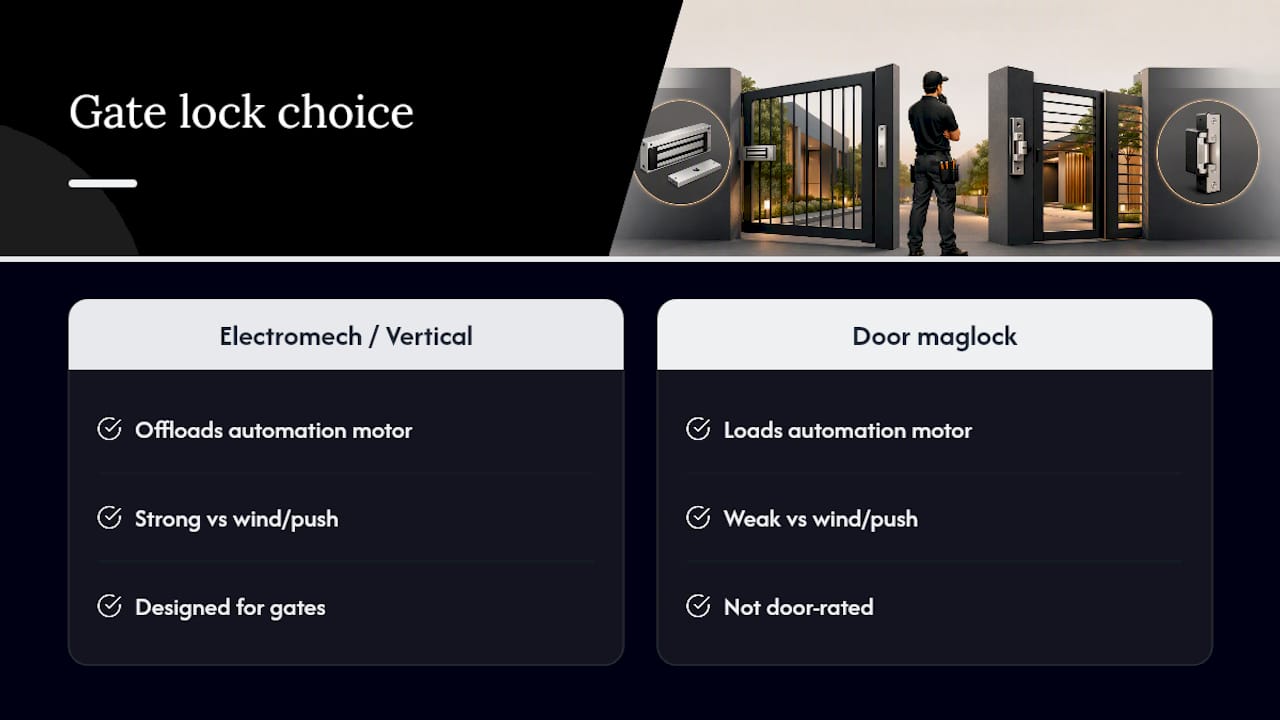
A gate and entrance specialist's perspective notes that lock selection is rarely the simple maglock-or-strike question homeowners expect. For large external gate leaves, we favor electromechanical or vertical gate locks over standard maglocks, since those transfer load off the automation motor and hold up against wind and push forces a door-rated maglock was never engineered for.
During site inspection, we document alignment tolerances, load transfer paths, and weatherproofing details, because those three items predict whether the hardware still performs correctly five years in, not just on installation day.
— Rhys
Sources
Before specifying hardware, check NFPA's egress locking guidance, manufacturer spec pages like the dormakaba KML-5000G for holding-force and current-draw figures, and heavy-gate hardware references such as Tomellini's gate product line for large-leaf applications.
If your project involves a driveway gate or architectural entrance rather than an interior door, a custom assessment catches load and weatherproofing issues a standard hardware quote misses. Gatecon's Melbourne service team can walk your specific opening before you commit to hardware.
- NFPA blog on permissible egress door locking arrangements
- Security Wholesalers maglock vs electric strike guide
- NGTECO access-control buying guide
FAQ
What Are the Downsides of a Magnetic Lock?
Maglocks lose all holding power instantly when energy is cut, offer zero security during an outage without added mechanical hardware, and their rated holding force drops noticeably if the armature plate isn't perfectly aligned with the magnet face.
What Locks Do Security Professionals Recommend for Doors?
There's no universal answer. Guidance from lock specialists points to electric strikes for high-traffic doors where a normal latch feel matters, and maglocks for openings, like glass or frameless doors, where a strike physically won't fit.
Can Magnetic Locks Be Configured as Fail-Secure?
No. Magnetic locks are inherently fail-safe by design and unlock whenever power is lost; they cannot be wired to stay locked without electricity the way a fail-secure strike can.
What Happens to a Maglock When the Power Goes Out?
The electromagnet loses its field instantly and the door unlocks immediately, which is why maglocks on egress paths must pair with a fire-alarm interface and a request-to-exit device rather than relying on battery backup to keep them locked.