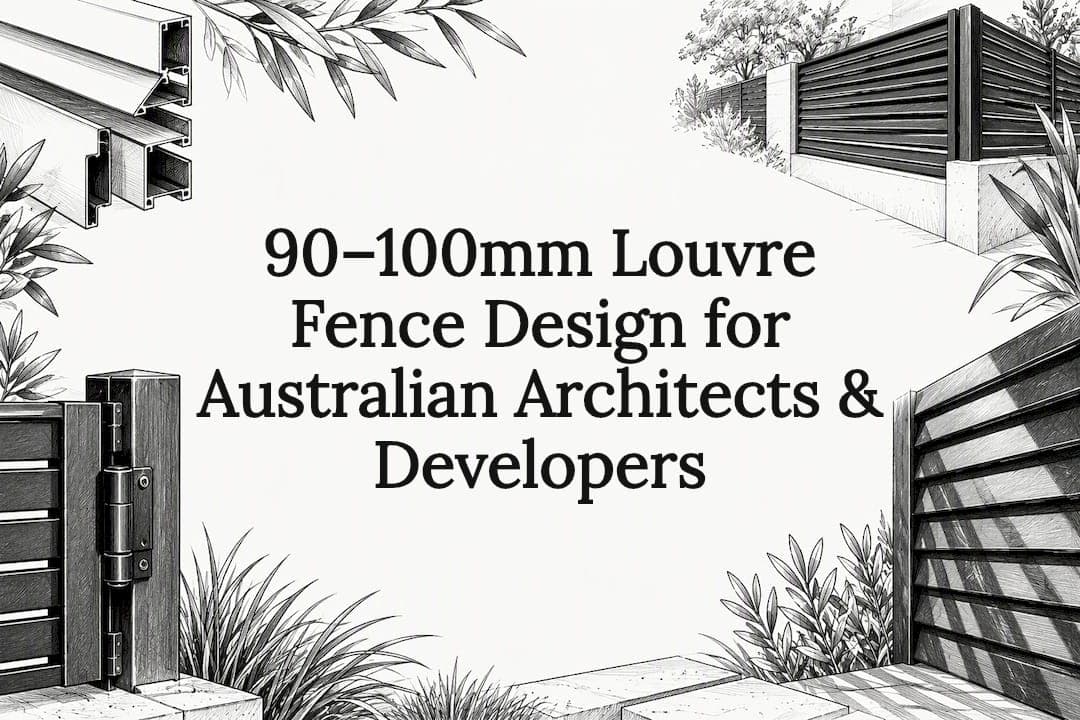
The best starting point for a contemporary, high-end project is an architectural aluminium louvre system with wider blade profiles, concealed fixings and a certified finish specification. This combination gives you a clean, modern look that holds its color and shape for decades when it's specified and installed correctly. If you're ready to commission a bespoke design, we outline what to ask for below, and how we approach the build.
TL;DR:
- Wider blade profiles in the 90 to 100 millimeter range offer a modern, substantial look that reduces the number of components needed in long runs.
- Powder-coating must include specific pre-treatment steps like cleaning and etching, with documented specifications to prevent failure and ensure durability.
- Fixing schedules should be calculated against site-specific wind pressures using AS/NZS 1170.2, especially in high-wind regions where verified test reports are critical.
- Privacy depends on blade spacing and angle, with steeper, tighter blades offering maximum privacy but less airflow, and adjustable louvres allowing seasonal or daily tuning.
- Matching fence and gate elements in blade width, color, and hardware, with concealed fixings and ongoing design coordination, enhances the integrated architectural appearance.
Table of Contents
- Which louvre styles suit your project
- Materials and finish specifications that prevent failure
- Structural design and fixing details you need to verify
- Balancing privacy, airflow and light with blade geometry
- Matching louvre fencing to gates and architectural hardware
- Cost drivers and realistic timelines for bespoke louvre fencing
- What a specialist design-to-install service adds to a louvre project
- Louvre fencing versus other options for commercial properties
- Common suppliers and manufacturers to consider
- A design priority checklist worth following
- Commissioning us: what to include in your enquiry
- FAQ
- Sources
Which louvre styles suit your project
Louvre fence design comes down to blade orientation and angle, and each choice changes both the look and the function of the fence. Horizontal slats give a clean, linear read that works well on street-facing boundaries and suits most contemporary facades. Vertical louvres create a strong upward rhythm, useful on narrow or tight sites, or where you want the fence to echo vertical lines already present on the building. Angled and adjustable blades let you control sightlines and light penetration without blocking airflow completely, which matters on pool fences, courtyards and anywhere you want privacy without a solid wall effect.
Blade width is one of the most overlooked design decisions. Wider profiles, generally in the 90 to 100 millimeter range, read as more substantial and modern, and tend to need fewer components across a long run when the blades are aligned precisely with the building's facade rhythm. Slimmer blades still work well on smaller sites or where a lighter, more delicate look suits the architecture.
- Horizontal slats: linear, streetscape-friendly, easy to align with low garden walls
- Vertical louvres: strong rhythm, good for narrow frontages
- Angled or adjustable blades: variable privacy and airflow control
- Wider blades (90 to 100mm): substantial, modern look with fewer joins per run
Materials and finish specifications that prevent failure
Aluminium extrusions are the standard choice for louvre fencing because the material resists corrosion, holds tight tolerances for blade alignment, and takes a powder-coat finish well. Alloy selection and finishing capability vary by supplier, so it's worth requesting specification sheets directly from your aluminium extrusion manufacturer rather than assuming all extrusions perform the same.
Many powder-coating failures trace back to inadequate pre-treatment rather than the coating itself, according to an industry bulletin on coating and corrosion covering carports and patios, which recommends documented coating specifications as part of building code compliance. That means dry film thickness, pre-treatment steps and coating type should all appear in writing before fabrication starts, not after a problem shows up.
- Aluminium extrusions: corrosion-resistant, dimensionally stable for tight blade alignment
- Powder-coat pre-treatment: specify cleaning, etching and primer steps in writing
- Steel framing (where used): requires galvanising plus a duplex coating system, referencing AS 2312 and AS 4506 guidance for surface preparation
Structural design and fixing details you need to verify
A louvre fence is only as strong as its weakest fixing, and every bracket, post and subframe in the system needs to be sized for the actual wind pressures at your site, not a generic assumption. Wind load design for fences and screens follows AS/NZS 1170.2, and a fence panel that looks identical to another can need very different fixing centers depending on height, exposure and terrain category.
- Confirm the fixing schedule and bracket sizing are calculated against your site's wind pressures under AS/NZS 1170.2, not a standard template.
- In cyclonic or high-wind regions, ask for independently verified test reports to AS 4040.3 from a NATA-accredited lab, matched to the exact panel configuration you're ordering.
- Check that welded joints on steel subframes are treated after galvanising, and that drainage details avoid water entrapment at post bases and bottom rails.
Pro Tip: Ask your installer for an engineer-signed fixing certificate before fabrication begins, especially on exposed boundary runs where wind exposure is higher than a sheltered courtyard.
Balancing privacy, airflow and light with blade geometry
Privacy in a louvre fence comes down to two variables: blade spacing and viewing angle. Tighter spacing and a steeper blade angle block more of the direct line of sight from a neighboring property, while wider spacing and a flatter angle let more light and air through at the cost of some visibility. Pool boundaries and fences close to a property line often call for tighter spacing or angled blades, though any pool fence still has to meet its own safety and climbing-resistance requirements regardless of the privacy geometry chosen.
- Tight spacing, steep angle: maximum privacy, reduced airflow, best for close boundaries
- Wide spacing, flat angle: more airflow and light, moderate privacy
- Adjustable louvres: let you tune the angle seasonally or by time of day
- Backing screens or infill panels: added where a design calls for near-total opacity in specific zones
Matching louvre fencing to gates and architectural hardware
A louvre fence reads as a single architectural statement when the fence panels and the gate share the same blade width, color and spacing rhythm. Specify the powder-coat color code once and apply it across fence, gate and any screening elements, and set out the blade alignment grid before fabrication so posts, panels and gate leaves all land on the same rhythm. Integrating louvre fencing with the broader architectural design of a property works best when this coordination happens at the design stage, not as a retrofit.
Concealed fixings and continuous top and bottom rails help the fence and gate read as one system rather than two separate products bolted together. When briefing a gate, include leaf width, motor clearance and how the louvre pattern should continue across the gate leaf, particularly for sliding versus swing gate choices, since clearance and travel path affect how the blades align when the gate is open.
- Match powder-coat color codes exactly across fence, gate and hardware
- Use concealed fixings and continuous rails for a single-system look
- Specify leaf width and motor clearance alongside louvre continuity in the gate brief
Cost drivers and realistic timelines for bespoke louvre fencing
Custom louvre fencing costs more than off-the-shelf paneling because several specification choices stack on top of each other. Custom extrusion profiles, high-performance powder coats, engineering for wind loads, and site conditions like sloped ground or limited access all add to the final price, and skipping any of them to save money is usually where problems start later.
Bespoke fabrication typically needs lead time for extrusion ordering, cutting and coating before installation can begin, and site installation windows depend on fence length and access. When comparing quotes, make sure every supplier is pricing the same blade width, coating specification and fixing detail, otherwise the numbers aren't comparable at all.
- Custom extrusion profiles and wider blades add cost over standard stock sizes
- High-performance powder coats and duplex systems cost more but reduce recoating risk
- Engineering sign-off for wind loads adds a fixed cost but protects against failure
- Site access and foundation work vary by site and should be quoted separately
What a specialist design-to-install service adds to a louvre project
A fence that looks simple on paper still needs correct alignment, fixing design and finish specification to perform over decades, and that's where a specialist installer earns the brief. Our team at Gatecon designs and installs architectural fencing and luxury driveway gates for boutique residential and high-end commercial projects, and we build tailored fencing solutions that blend security with a refined aesthetic rather than treating the fence as an afterthought to the gate.
We focus on craftsmanship that complements the architectural style of the building it sits on, which means a design brief gets translated into blade width, alignment and coating choices that suit the property rather than a generic design.
- We design fencing and gates together, so blade rhythm and hardware finish match
- We specify coatings and fixings to suit the site, not a one-size template
- Our full project portfolio shows how these choices play out across different architectural styles
Louvre fencing versus other options for commercial properties
Commercial properties weighing fence options usually compare louvre systems against palisade fencing, chain-link with slats, precast concrete panels and timber screening. Palisade fencing is strong and affordable but reads as industrial rather than architectural, which matters for a boutique retail frontage or a commercial development trying to signal quality. Chain-link with inserted slats is the cheapest option by far, but the slats degrade, shift and often look patchy within a few years.
Precast concrete panels offer excellent security and a long service life, and technical specifications for noise and boundary fencing note design lives in the range of 25 to 40 years for core construction materials, according to transport sector fencing specifications used for infrastructure fencing. Concrete panels are heavy, limit airflow entirely, and rarely suit a design-led commercial frontage where ventilation or a lighter visual presence matters. Timber screening looks warm initially but needs more frequent maintenance and doesn't hold up as well to coastal or high-exposure sites.
Louvre fencing sits in a middle ground that suits design-conscious commercial projects specifically: it delivers a security-grade boundary, allows airflow and light where timber or concrete block both, and reads as considered architecture rather than infrastructure. For a boutique retail strip, a mixed-use development frontage or a commercial property aiming for a premium presentation, louvre systems are usually the stronger fit despite a higher upfront cost than palisade or chain-link alternatives.

Common suppliers and manufacturers to consider
Specifying commercial-grade louvre fencing means sourcing from two different layers: the extrusion and finishing supplier who produces the raw aluminium profiles, and the fabrication and installation team who turns those profiles into a finished fence on site. Extrusion suppliers publish technical catalogues covering alloy selection and finishing capability, and it's worth requesting this documentation directly rather than relying on a fabricator's summary of what's available.
For panel products and broader building material sourcing, builders and developers often work with suppliers like The Panel and Paper Company's outdoor panel range, which covers panel products relevant to fabrication and cladding decisions alongside louvre fencing.
On the fabrication and installation side, the right partner depends on project scale and design ambition. For boutique residential and high-end commercial projects, we work directly with architects, builders and developers to take a louvre fence from initial design through fabrication and on-site installation, coordinating the fence with gates and automation as one system rather than separate purchases. Larger commercial developments with simpler, repeated fence runs may be better served by a volume fabricator, while projects with a strong architectural brief tend to benefit most from a specialist design-to-install relationship where blade alignment, finish and hardware integration are handled together.

A design priority checklist worth following
Three things separate a louvre fence that lasts from one that doesn't. First, confirm the load path and fixing schedule with an engineer rather than assuming a standard bracket will do. Second, get the pre-treatment and powder-coat specification in writing before fabrication starts. Third, insist on a sample panel or site mock-up before committing to a full run, since color and shadow lines read differently in person than on a spec sheet.
— Rhys
Commissioning us: what to include in your enquiry
Once you've settled on a style and specification, the next step is getting a firm design and price from a team that can deliver both the fence and the gate as one coordinated system. We offer Architectural Gates for bespoke entry design, Designer Fencing for louvre and other custom fence panels, and Custom Packages that combine both for a single project brief.
To get a useful first response, include site photos, your preferred blade style and width, total fence length, and your target timeline.
- Site photos showing boundary conditions and existing architecture
- Preferred blade style (horizontal, vertical or angled) and target width
- Total fence length and any gate integration you need quoted together
Reach out through our Custom Packages page to start a design conversation.
FAQ
What are the benefits of a louvre fence?
A louvre fence combines privacy with airflow and natural light, since angled blades block direct sightlines without sealing off a space entirely. It also offers a cleaner, more architectural look than solid paneling, and aluminium versions resist corrosion well when specified and coated correctly.
What is the cheapest style fence to build?
Chain-link fencing, including chain-link with inserted slats, is typically the lowest-cost option to install. It trades cost savings for a shorter service life and a less refined appearance compared to aluminium louvre or precast concrete systems.
What is the most attractive privacy fence?
Attractiveness depends on the architectural style of the property, but aluminium louvre fencing is widely favored for design-led projects because wider blade profiles create a substantial, modern look while still allowing airflow. We design and install louvre fencing as part of coordinated gate and fence packages for exactly this kind of project.
What fence color adds the most value?
There's no single color proven to add the most property value, since this depends heavily on the building's architectural style and the surrounding streetscape. Matching the fence and gate finish to the building's existing palette, rather than choosing an unrelated color, tends to support a stronger overall presentation.
Sources
- Industry Bulletin 139 – Coating and corrosion failure to carports and patios
- How to specify aluminium cladding for cyclonic regions | Valmond & Gibson
- ALUMINIUM PRODUCTS CATALOGUE (Capral)