The best gate lighting layers three things: architectural fixtures on the pillars, uplighting on texture and detail, and low, functional light along the approach. Solar fixtures work well for simple retrofits, while low-voltage systems suit gates already wired for automation. Start by measuring your pillar width and gate scale, then plan fixture placement before you buy a single bulb.
TL;DR:
- Solar fixtures are suitable for remote gates with ample sunlight, offering about 8 to 10 hours of runtime, but performance declines in shaded areas.
- Low-voltage 12V systems are safer and integrate well with automated gates, yet require a transformer and are more costly upfront than solar options.
- Mains power provides the highest output needed for security floods but always requires a licensed electrician for installation and maintenance.
- Proper fixture scaling, symmetric placement, and downward shielding are crucial to prevent glare and achieve balanced, residential-quality illumination.
- Incorporating lighting into the gate's design during fabrication results in a cleaner look and easier long-term maintenance compared to retrofitting fixtures later.
Table of Contents
- 8 Gate Lighting Ideas Worth Copying
- How to Choose Fixtures and Plan Placement
- Lighting Techniques That Change How a Gate Looks
- Solar, Low-Voltage, or Mains: Choosing Your Power Source
- Syncing Lights With Your Gate's Automation
- Installation and Maintenance That Actually Hold Up
- Matching Lighting to Your Gate's Material and Style
- What Gate Lighting Actually Costs
- Gatecon's Perspective: Design Lighting Into the Gate, Not Around It
- Get Gate Lighting Built Into Your Design From the Start
- Sources
- FAQ
8 Gate Lighting Ideas Worth Copying
Most driveway entrances fail for one of two reasons: too little light where it matters, or too much light scattered everywhere. The fixture types below solve that by giving each part of the gate a specific job. Post and pillar fixtures on gate columns remain the most common starting point, and for good reason: they frame the entrance and give visitors an obvious focal point at night, according to Tri State Gate.
- Post or pillar lanterns for classic entrances. A pair of matched lanterns on stone or brick pillars still reads as the gold standard for traditional properties.
- Integrated LED strip outlining for modern gates. Recessed channels along the gate frame produce a clean glow line without visible hardware, a favorite for minimalist steel and aluminum designs, per Landscape Lighting Guru.
- Uplighting aimed at columns, mature trees, or ornate ironwork to add depth after dark.
- In-ground well lights along a long driveway approach, spaced generously to avoid a runway look.
- Wall-mounted sconces for narrower gates or side pedestrian entries where a full pillar isn't practical.
- Solar pillar caps for remote gates or properties without easy access to mains power.
- Keypad and intercom downlighting so visitors can actually read the buttons at night.
- Seasonal color-changing LEDs for temporary accents, used sparingly and pointed inward to avoid bothering neighbors.
How to Choose Fixtures and Plan Placement
Fixture selection comes down to five decisions, and skipping any one of them is how gates end up either underlit or glaring.
- Scale the fixture to the pillar. A lantern on an 18 inch pillar should be roughly a third of that width, not a fraction the size of a mailbox lamp.
- Pick lumens by purpose. Accent lights in the 100 to 300 lumen range add glow without washing out detail; functional path lights can run higher.
- Choose a warm color temperature, generally 2700K to 3000K, for a residential feel rather than the cooler, bluish tones suited to commercial signage.
- Mirror your layout. Matched pairs on either side of the gate create the symmetry that makes an entrance look designed rather than assembled.
- Space path lights roughly 3 meters (10 feet) apart to avoid the strip-mall runway effect that plagues over-lit driveways.
- Shield and aim fixtures downward so oncoming drivers and neighbors aren't hit with direct glare.
Pro Tip: Walk the driveway at night with a flashlight before you commit to fixture positions. Wherever the beam catches an interesting texture, whether it's stone joints or ironwork scrollwork, that's usually where a light belongs.
Lighting Techniques That Change How a Gate Looks
The same gate can look flat or dramatic depending on which technique you use, and most properties benefit from mixing two or three rather than relying on one.
- Uplighting works best on textured materials. Aim a narrow beam angle up a stone pillar or tree trunk to bring out shadow and grain.
- Backlighting turns ornate ironwork into a silhouette against a glowing wall or hedge, a striking effect for wrought iron gates with detailed scrollwork.
- Outline lighting using integrated LED strips suits contemporary gates, tracing the frame itself instead of lighting what's behind it, as Landscape Lighting Guru notes for electric gate installs.
- Wash lighting floods a broader surface evenly, good for plain walls or fencing; spot lighting isolates a single feature like a house number or crest.
- Pairing an uplight with a path light gives layered depth: drama up top, safety down low.
Solar, Low-Voltage, or Mains: Choosing Your Power Source
Solar fixtures suit simple retrofits on pillars that get several hours of direct sun daily. Expect roughly 8 to 10 hours of runtime from a midrange unit, similar to the specs on a solar gate pillar light built around a 4W LED, 3000K color temperature, and a 6V 4.5W panel paired with an 18650 4000mAh battery. Low-voltage 12V systems cost more upfront but integrate cleanly with gate automation and are safer for DIY installation. Mains power becomes necessary once you need high-output flood lighting, and that always means hiring a licensed electrician.
- Solar: best for detached pillars, no trenching required, performance drops in shaded or overcast conditions.
- Low-voltage 12V: safer voltage, pairs naturally with automated gate systems, needs a transformer.
- Mains: highest output, required for heavy security floods, must go through a licensed electrician.
For any exposed fixture, look for an IP65 rating or higher. That standard, recommended by outdoor lighting specialists for driveway and gate installs, means the fixture resists dust and low-pressure water jets, which covers most weather a gate light will face.
Syncing Lights With Your Gate's Automation
A gate that lights up the moment it starts moving does more for safety than almost any fixture upgrade. Low-voltage trigger kits tied to the gate opener turn lights on with the motion itself, and a short program hold, often a minute or two after the cycle finishes, keeps the driveway lit while people are still walking to their car.
- Trigger lights from the gate's motion sensor or control board rather than a separate switch.
- Set motion sensors with moderate sensitivity to avoid false triggers from passing cars or pets.
- Keep the post cycle hold brief. Long enough to be useful, short enough to save power.
Pro Tip: If your gate already has an automation controller, ask your installer whether it has a spare relay output. That's often the cheapest way to add a light trigger without new wiring runs.
Anything touching the gate's electrical control system should go through a specialist familiar with both the automation and the lighting circuit.
Installation and Maintenance That Actually Hold Up
Good gate lighting fails less often from bad fixtures than from bad placement.
- Space path lights about 3 meters (10 feet) apart to keep the residential feel instead of a runway look.
- Set fixtures back 15 to 30 centimeters (6 to 12 inches) from pavement edges so mowers, cars, and delivery trucks don't clip them, a setback installers commonly recommend.
- Check seals, battery health, and panel cleanliness once a year, ideally before the darker season starts.
- Keep irrigation heads pointed away from fixtures, and avoid installing near where de-icing salt or pool chemicals could reach the housing.
- Bring in a licensed electrician for any mains work and for permanent low-voltage runs buried under paths or driveways.
Matching Lighting to Your Gate's Material and Style
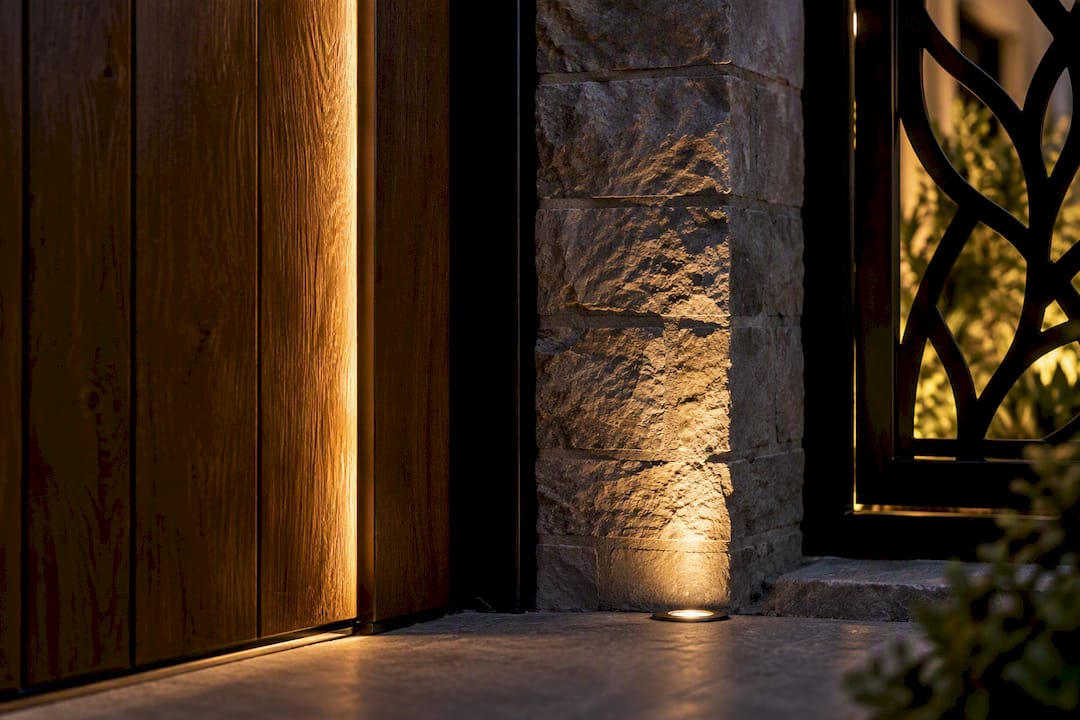
Timber gates take warm washes well. A soft glow from recessed strips at the base brings out grain without turning the wood into a stage prop. Ornamental ironwork rewards uplighting and backlit silhouettes, since the detail only really shows once shadows get involved. Stone pillars look best with pillar lanterns or recessed well lights that catch the texture of the surface rather than flattening it with a direct wash. Minimal contemporary gates, especially in steel or aluminum, do well with concealed LED strips and slim in-ground linear fixtures that disappear during the day and outline the gate cleanly at night. If you add seasonal or festive lighting, keep colors and brightness modest and angle fixtures inward. It keeps the display fun for you without becoming a nightly floodlight for the house next door.
What Gate Lighting Actually Costs
Budgets for gate lighting swing widely depending on fixture count, power source, and whether you're retrofitting an existing gate or building lighting into a new installation. Solar pillar caps sit at the low end since they need no trenching or wiring, which makes them the cheapest way to add light to an existing gate. Low-voltage kits cost more upfront, largely because of the transformer, cable runs, and labor, but they scale better if you're lighting a longer driveway with several fixtures working together.
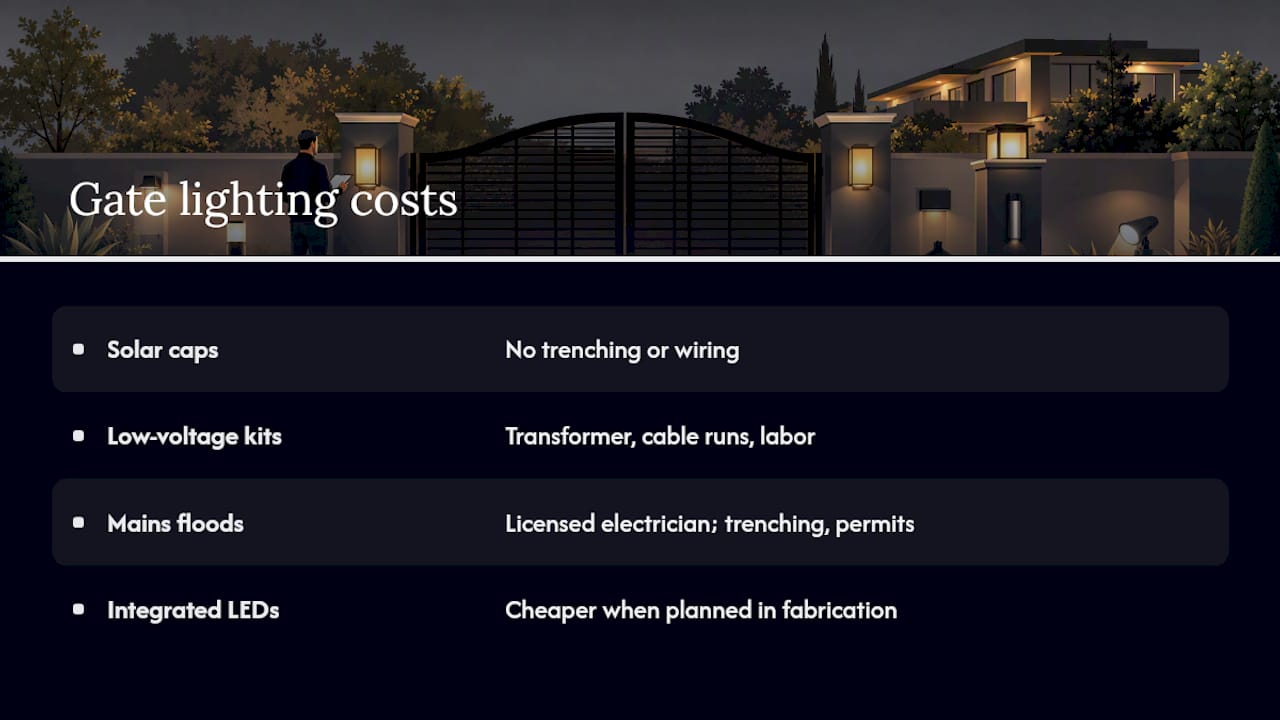
Mains-powered flood lighting and any project requiring a licensed electrician sits at the higher end of the range, particularly once trenching, permits, or panel upgrades enter the picture. Integrated LED strips built into a custom gate or pillar during fabrication often cost less in the long run than retrofitting the same effect later, since the wiring gets planned in from the start rather than routed around finished stonework.
A realistic budgeting approach: price out fixtures first, then add labor separately rather than assuming a quoted fixture price includes installation. Ask any installer whether the quote includes trenching, conduit, and a transformer, since those line items are where low-voltage projects often run over budget. For anyone weighing a full gate rebuild against a lighting retrofit, it's usually worth pricing both, since building lighting into new pillars can end up cheaper than adding it after the fact.
Gatecon's Perspective: Design Lighting Into the Gate, Not Around It
Lighting planned during the gate and pillar design lets wiring run inside the structure instead of being bolted on later. That's the difference between a fixture that looks integrated and one that looks added. Planning lighting alongside the gate itself also makes long-term maintenance simpler, since there's nothing exposed to snag or corrode. It's a detail worth budgeting for before the gate design is finalized, not after.
— Rhys
Get Gate Lighting Built Into Your Design From the Start
Retrofitting light onto an existing gate always means working around what's already there. Some gate manufacturers design the wiring path, mounting points, and fixture recesses into the gate itself, so the lighting looks like it was always part of the structure. That's the practical edge of building lighting in during fabrication rather than adding it afterward: no surface conduit, no visible boxes, no compromise on the finish you actually wanted.

Gatecon's Architectural Gates service covers custom design and installation with lighting and automation planned in from the first sketch, and Designer Fencing extends the same approach to the rest of the perimeter. If you're weighing a new gate against retrofitting lights onto an old one, request a consultation and get a design that treats lighting as part of the structure, not an accessory bolted on afterward.
Sources
For deeper detail on spacing, fixture types, and specs referenced in this guide: Tri State Gate's driveway lighting tips cover spacing and pillar fixture basics. Kings Outdoor Lighting's guide to driveway entrance lighting breaks down IP ratings and motion sensors. Landscape Lighting Guru's entrance gate lighting guide explains integrated LED strip techniques. Mr Bright Lighting's solar pillar light product page shows a real-world spec sheet for solar fixtures.
- Driveway Gate Lighting Tips | Tri State Gate Blog
- Outdoor lighting for driveway entrances: Gates, columns, and long approaches
- Light your entrance gate - Landscape Lighting Guru
- Outdoor Solar Gate Pillar Light GS391S | Mr Bright Lighting
FAQ
What are the different types of gate lights?
The main categories are pillar or post lanterns, wall-mounted sconces, in-ground well lights, uplights, and integrated LED strips built into the gate frame. Most well-designed entrances combine at least two types, typically a pillar fixture for structure and a path or well light for the approach, as outlined by Tri State Gate.
What are some creative ideas for a gate?
Backlighting ornamental ironwork to create a silhouette effect is one of the more striking options, along with outline lighting using LED strips recessed into a modern gate frame. Solar pillar caps also work well as a creative, low-effort upgrade for gates without easy access to power.
What are some creative ideas for driveway lighting?
Layering in-ground well lights along the approach with pillar lanterns at the entrance gives depth without over-lighting the space. Spacing path lights about 3 meters (10 feet) apart keeps the look residential rather than resembling an airport runway, a guideline echoed across driveway lighting installers.
What are the trends for outdoor lighting in 2026?
Integrated, low-glare fixtures such as recessed LED strips continue to replace bulky standalone lamps, giving gates a cleaner look that pairs naturally with automation, according to Landscape Lighting Guru. Warmer color temperatures and motion-triggered lighting tied to gate sensors are also becoming standard rather than optional add-ons.
Does Gatecon design lighting into custom gates?
Gatecon builds lighting considerations into its Architectural Gates and Designer Fencing projects from the design stage, which allows wiring and fixture mounts to be concealed within the structure. Pricing is specific to each project and available on request through a consultation.