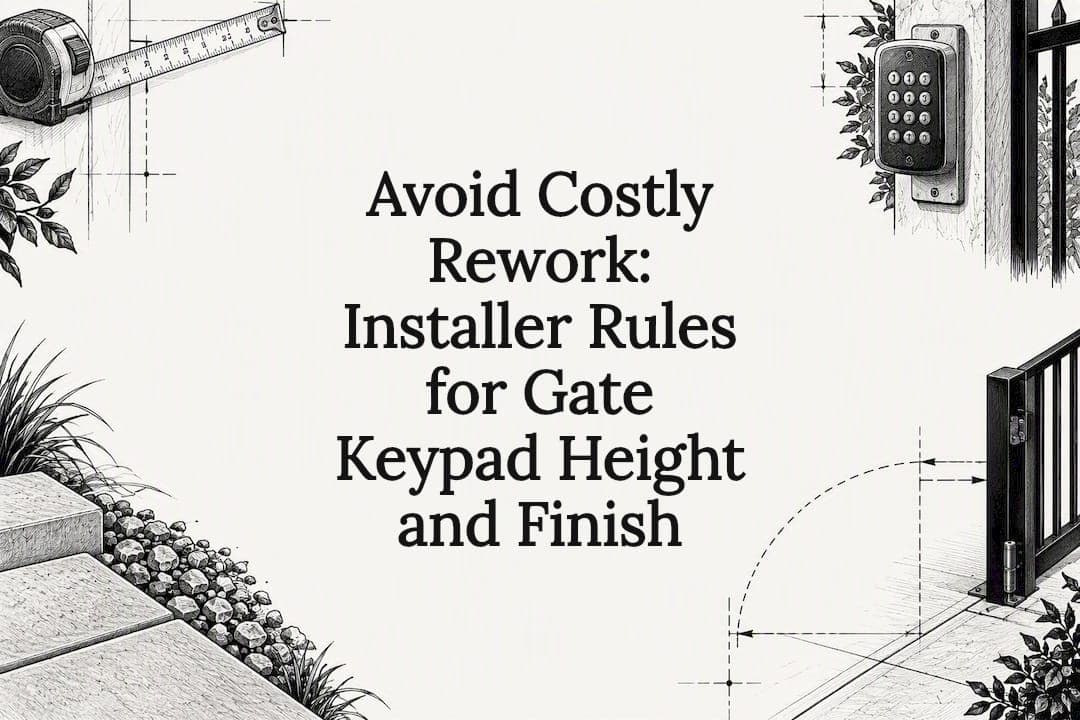
Mount a vehicle-access gate keypad at about 42 inches (1,067 mm) from grade to the center of the device, with 48 inches or 54 inches common on driveways serving trucks or mixed traffic. Pedestrian-only keypads sit closer to 40 to 44 inches for comfortable reach. Always measure from finished grade to the center of the unit, not the top of the housing, and adjust upward for wheelchair vans, delivery trucks, or sloped approaches.
TL;DR:
- Mount the keypad at 42 inches from finished grade for most residential vehicles, adjusting higher for trucks or commercial traffic up to 54 inches.
- Use gooseneck stands to curve the keypad toward the driver, keeping the post shorter and maintaining proper reach distance.
- Measure from a fixed reference point and consider actual user height and vehicle type to prevent future height and placement issues.
- Seal all wiring points and fasteners with weatherproof materials to ensure long-term durability in outdoor conditions.
- Plan keypad placement during the gate design phase to align with vehicle access, usability, and aesthetics, avoiding costly rework later.
Table of Contents
- Recommended Gate Keypad Height by Use Case
- Mounting Hardware: Gooseneck, Pedestal, and Post Options
- How to Measure and Position a Gate Keypad Correctly
- Accessibility: Designing for Different Users
- Installation Best Practices That Prevent Future Failures
- Materials and Finishes for Long-Term Weather Protection
- Why Incorrect Keypad Height Causes Real Problems
- Keeping Keypads Serviceable Over Time
- Gatecon's Installer Perspective on Height and Trade-Offs
- Get Your Keypad Height and Gate Design Right the First Time
- Sources
- FAQ
Recommended Gate Keypad Height by Use Case
The right gate keypad height depends on who's reaching for it and from what. A sedan driver's arm sits lower and closer to the vehicle body than a truck driver's, and a single fixed height rarely serves both well.
For standard residential driveways, 42 inches to center of device is the benchmark figure you'll see on most gooseneck pedestal specifications, and it works because it lines up with an average sedan or SUV window. Once you're dealing with commercial vans, box trucks, or a driveway that serves both family cars and trade vehicles, installers commonly push that up.
- 42 inches: the standard for passenger vehicles and most boutique residential gates
- 48 inches: a frequent choice on mixed-traffic or light commercial driveways
- 54 inches: used where truck cabs sit noticeably higher, a range some installers cite for larger commercial lanes
- 40 to 44 inches: the comfortable band for a pedestrian gate keypad reached on foot, not from a car window
If you're unsure which way to round, go higher rather than lower. A keypad that's slightly too tall is a minor stretch; one that's too low forces drivers to lean out of the window or open the door, which wears on both patience and paint.
Mounting Hardware: Gooseneck, Pedestal, and Post Options
The hardware you choose determines how much flexibility you have at gate keypad height and how the finished look reads against the rest of your fence line. A gooseneck stand curves the keypad toward the driver, which lets you keep the post itself shorter while still hitting the right reach distance for vehicle access. A straight pedestal is simpler and often cleaner-looking on architectural gates where the post is meant to disappear into the design rather than announce itself.
- Pad mount: bolts to a poured concrete pad, ideal where you want a permanent, vibration-resistant base
- Direct bury: the post goes straight into the ground in a concrete footing, common on longer driveways where a visible pad would look out of place
- Adjustable posts: typically range 33 to 45 inches and suit temporary setups or rental and multi-tenant sites
- Fixed heavy-duty pedestals: the standard for permanent, high-end installations where finish and stability matter more than adjustability
Pro Tip: If you're matching a custom gate finish, order the keypad post in the same powder-coat batch as your gate hardware. A slightly off match between post and gate is one of the most common finish complaints on otherwise well-built installations.
How to Measure and Position a Gate Keypad Correctly
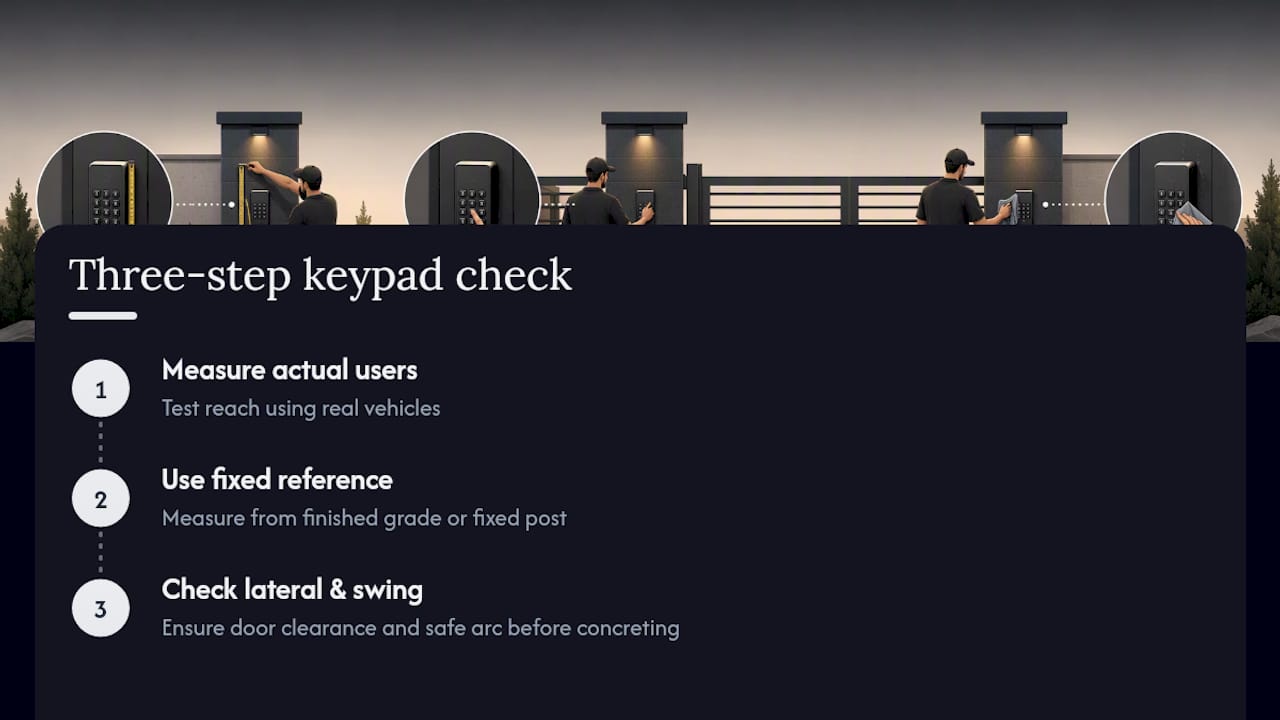
Getting gate keypad height right isn't about eyeballing a number. It's a short, specific sequence, and skipping a step is how you end up drilling a second hole six months later.
- Identify finished grade. Measure from the ground surface the vehicle will actually sit on, not the current dirt or gravel base if paving or asphalt is coming later.
- Mark the center point. Standard practice is 42 inches from grade to the center of the keypad face, adjusted for your vehicle mix.
- Check the eye-line and arm reach from a seated driver's position, ideally testing with the actual vehicle that will use the gate most often.
- Set the lateral offset so the keypad sits within comfortable arm's reach of the driver's window, typically 12 to 24 inches from the travel path of the vehicle, and never inside the gate's swing or slide zone.
- Add clearance for slope and curbs. A driveway with any grade change needs the mount height recalculated at the actual stopping point, not at the gate line.
One detail installers learn the hard way: mount relative to a fixed reference, not the current surface, since driveway resurfacing years later can quietly change your finished grade and throw off a height that was correct on installation day.
Accessibility: Designing for Different Users
A single keypad height rarely works for every person who needs to use the gate. Wheelchair users typically need a lower mount, often in the 36 to 40 inch range measured to center, which puts standard 42 inch vehicle keypads out of comfortable reach. Where both drivers and wheelchair users need access, a dual-mount pedestal with two devices at different heights solves the problem without forcing a compromise height that satisfies no one.
- Consider passenger-side placement if the household regularly has a passenger operating the gate, which also adds a layer of privacy for the driver
- For delivery drivers and couriers who don't have a fixed vehicle type, err toward the middle of the range rather than the top
- On sites with genuinely mixed users, an intercom or phone-based entry system may replace or supplement the keypad entirely, since visual verification solves the height and access problem at once
- Balance accessibility against street-facing security. A keypad mounted too low is also easier to shoulder-surf or tamper with from a parked car
Installation Best Practices That Prevent Future Failures
Height only matters if the mounting holds up. Route low-voltage cabling inside rigid conduit from the controller to the keypad, and seal every termination point against moisture before backfilling or pouring the pad. A loose or exposed splice at the base of a post is one of the most common causes of intermittent keypad failure on outdoor gates.
- Seal the mounting plate against the post with a weatherproof gasket before final fastening
- Use stainless or corrosion-resistant fasteners throughout, especially near coastal properties
- Select an IP-rated keypad appropriate for full outdoor exposure, not a unit rated only for covered entries
- Keep the mount at least 12 inches clear of any part of the gate's swing or slide path
- Check gaskets, weep holes, and keypad button wear on a seasonal schedule
- Update controller firmware when the manufacturer issues security patches
Pro Tip: Vibration from a heavy sliding gate can loosen pedestal bolts over time even when the post itself is solid. Torque-check the mounting hardware annually, not just after installation.
Materials and Finishes for Long-Term Weather Protection
Stainless steel resists corrosion best in coastal or high-moisture settings, while powder-coated steel gives you more finish and color options for matching an architectural gate. GRP or PVC posts cost less but rarely suit a premium installation where the post is part of the visible design.
- Look for keypads with a solid IP rating designed for direct weather exposure
- Use sacrificial anodes or corrosion-resistant sleeves on fasteners near salt air
- Luxury installations generally prioritize finish matching over the cheapest hardware option, which shapes material choice more than climate alone
Why Incorrect Keypad Height Causes Real Problems
Most keypad complaints trace back to a height decision made without thinking through who actually uses the gate. The most common mistake is mounting to fit the installer's own truck or a single test vehicle, then discovering the family's sedan sits noticeably lower. That mismatch turns a quick tap into an awkward stretch across the seat or a fully opened door every single time.
Another frequent error is measuring from an unfinished surface. A keypad set at 42 inches above compacted gravel can end up at 40 inches or less once a driveway gets paved, which sounds minor until you realize it now sits below comfortable reach for taller vehicles. The reverse happens too: measuring from a temporary high point during construction leaves the keypad too tall once final grading levels the site.
Lateral placement causes just as much frustration as height. A keypad mounted too far from the vehicle's stopping point forces drivers to open their door in traffic or on a slope, which is both inconvenient and a legitimate safety issue on busier streets. Placing it too close to the gate's swing arc creates a different risk entirely, putting fingers and hands near moving hardware during entry.
The fix for nearly all of these problems is the same: measure against the actual vehicles and users who will operate the gate, use a fixed reference point rather than a temporary surface, and confirm the swing or slide clearance before the post ever gets set in concrete.
Keeping Keypads Serviceable Over Time
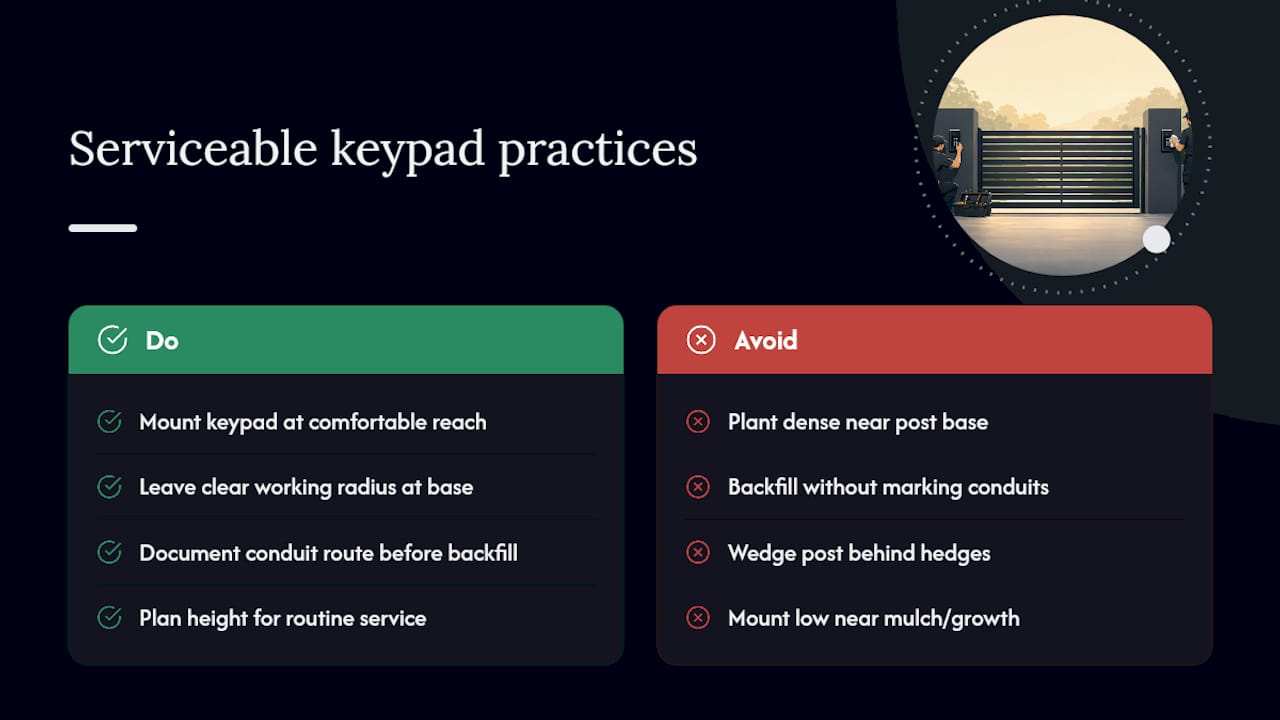
Gate keypad height affects more than daily use. It also determines how easily a technician can service the unit years later. A keypad mounted at a comfortable reach for drivers is usually just as accessible for a technician standing at ground level, but low-mounted units near garden beds or landscaping can end up partially buried by growth or mulch within a season or two.
Leave a clear working radius around the base of the post, free of dense planting or hardscaping that would block a ladder or a technician's stance during a controller swap or wiring repair. This matters most on pedestal and gooseneck mounts, where the control board sits inside the post itself rather than in a separate enclosure.
Access to the wiring chase matters as much as access to the keypad face. If conduit runs underground to a controller box elsewhere on the property, mark that route on an as-built drawing or photograph before backfilling, since a buried conduit run with no record becomes a guessing game the next time something needs tracing. Routine checks, gasket inspections, fastener torque, firmware updates, take only a few minutes when the mount height and surrounding clearance were planned properly from the start. They turn into a half-day job when the keypad post is wedged behind a hedge or the wiring path was never documented.
Gatecon's Installer Perspective on Height and Trade-Offs
On a bespoke gate, keypad height isn't an afterthought bolted on after the design is finished. Getting it wrong undermines both function and the look of the entrance, so Gatecon works out mounting height and hardware stiffness alongside the gate design and automation layout from the start, not after the posts are already set. A gooseneck that looks right on a drawing can still feel wrong at the driver's window if the swing clearance or vehicle mix wasn't factored in early. Precision here is what separates a keypad that feels built-in from one that feels bolted on.
— Rhys
Get Your Keypad Height and Gate Design Right the First Time
Getting gate keypad height wrong after the concrete sets means redoing work that should have been planned once. Gatecon is the alternative to guessing at hardware from a catalog: every mounting post, keypad placement, and automation tie-in is planned against your actual vehicles, gate design, and site grade before anything gets fixed in place.

Gatecon's Architectural Gates service covers custom mounting posts finished to match your gate and fencing, with automation and electrical coordination handled as one project rather than separate trades working around each other. For properties needing matched perimeter work, Designer Fencing rounds out the entry design so the keypad post doesn't look like an afterthought against the rest of the boundary.
If you're planning a new driveway gate or replacing hardware that's never sat at the right height, start with a site assessment through Gatecon's custom packages and get the mounting plan settled before any post goes in the ground.
Sources
Key references include gooseneck pedestal specifications, Australian keypad post dimensions, and intercom versus access control guidance. For gate-type context, see Gatecon's sliding vs swing gate comparison.
- Gooseneck Stand - Keypad Pedestal - Pad Mount - 42" Height - Black
- Gate Keypad Post (GTR056)
- Intercom vs Access Control System: A Complete Guide | Swiftlane
- Mighty Mule aluminum mounting post for gate opener keypads (product page)
FAQ
How high should a gate keypad be?
Most vehicle-access keypads mount at about 42 inches (1,067 mm) from grade to the center of the device, with 48 or 54 inches used for trucks or mixed traffic. Pedestrian-only keypads sit closer to 40 to 44 inches for comfortable hand reach on foot.
Where should alarm and access keypads be placed?
Access and alarm keypads should sit within easy arm's reach of the entry point, clear of the moving path of any gate or door, and protected from direct weather exposure where used outdoors. Lateral placement matters as much as height, since a keypad set too far from where a vehicle stops forces an awkward reach or an open door.
What is the recommended height to mount a garage door keypad?
Garage door keypads typically mount lower than driveway gate keypads, often around 48 inches, since they're reached on foot rather than from a vehicle. The exact height should match comfortable standing reach for the household's primary users.
What is the best height for a driveway gate keypad?
For most residential driveways, 42 inches to the center of the device is the standard reference point, adjusted upward to 48 or 54 inches for taller vehicles or commercial traffic. Measure from finished grade, not a temporary or unpaved surface, to avoid a mismatch once the driveway is finished.
Does Gatecon install custom keypad mounting for architectural gates?
Yes, Gatecon plans keypad height and mounting hardware as part of its architectural gate and automation packages rather than as a separate add-on. Pricing is provided after a site assessment, since every installation is built around the specific gate design and vehicle mix.