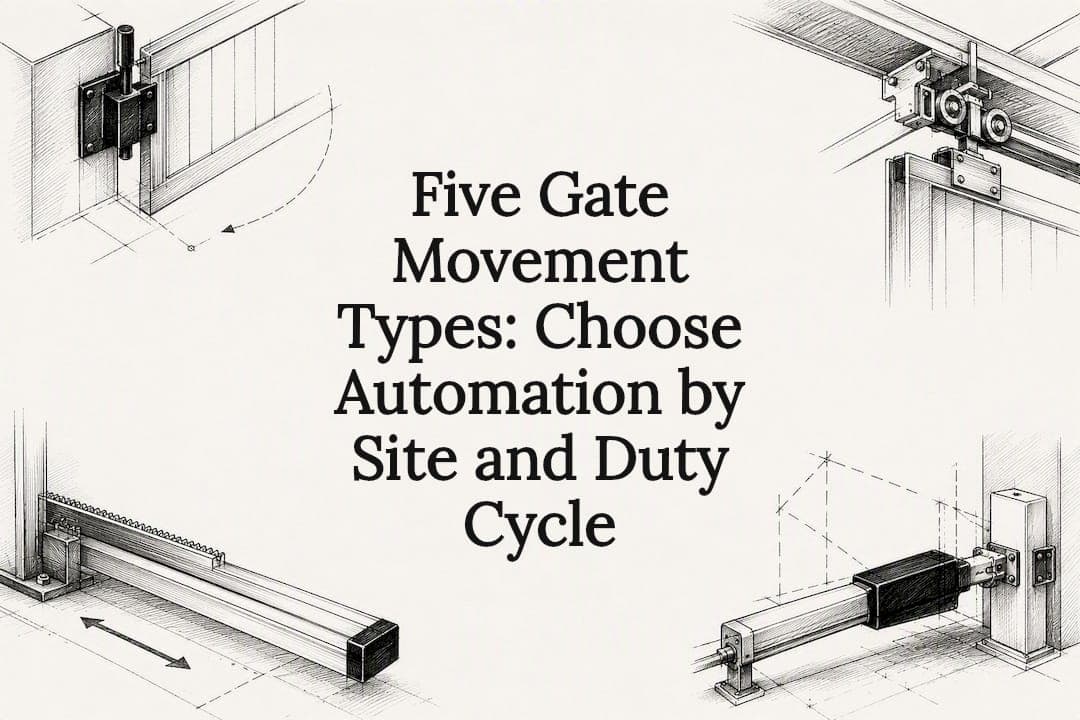
For tight or sloped driveways, sliding gates almost always win. For wide, flat frontages with room to swing, swing gates make sense. High-frequency commercial sites need barrier arms or heavy-duty sliding systems, and if you want the mechanism hidden entirely, an underground operator is worth the extra cost. Before comparing brands or styles, measure your opening width, side room, and how many times a day the gate will actually cycle.
TL;DR:
- Sliding gates are ideal for narrow, sloped driveways and handle constrained spaces better than swing gates, making them suitable for urban and suburban sites.
- Hydraulic operators are the best choice for heavy or high-cycle gates, especially in commercial or estate settings, while electromechanical systems suit lightweight residential gates.
- Power backup options like batteries and solar are important for security and reliability, especially in remote locations or during power outages, with GSM providing universal connectivity but requiring ongoing SIM management.
- Gate safety features such as auto-reverse, photocells, and manual releases are essential to meet safety standards and prevent liability risks.
- Proper site measurement, understanding duty cycle, and environmental factors are critical for selecting the correct automation system; style should be considered only after technical and safety needs are addressed.
Table of Contents
- Gate Automation Options: Matching Movement Type to Your Property
- Which Operator Technology Actually Suits Your Gate?
- Power Source and Connectivity: WiFi vs GSM Opener Debate
- How to Choose the Right Gate Automation Options for Your Site
- What Drives Installation Costs and Timelines
- Safety Features and Standards You Should Never Skip
- How Gatecon Assesses a Site Before Recommending Automation
- Why Site Data Beats Style Every Time
- Get a Custom Gate Automation Solution From Gatecon
- Where to Verify Safety and Technical Standards
- Sources
- FAQ
Gate Automation Options: Matching Movement Type to Your Property
Every automated gate falls into one of five movement categories, and the right one depends on geometry more than preference.
Swing gates pivot on hinges like an oversized door They suit wide, flat driveways with enough clearance for the leaf to arc open, and they tend to look the most traditional against period or estate architecture. The trade-off is space: a 4 meter gate needs roughly 4 meters of swing room on the inside, which rules them out for tight urban blocks.
Sliding gates track sideways along a rail or cantilever system, so they need side room instead of swing room. According to industry guides, sliding gates generally handle constrained spaces better than swing designs, which is why they dominate sloped driveways and narrow inner-suburban lots.
Vertical lift (overhead) gates rise straight up, using no forward or side clearance at all. They're common on commercial sites with tight boundaries but rare on residential properties because the overhead mechanism is visually heavy.
Bi-fold gates fold in on themselves like a concertina, giving a faster opening cycle than a single swing panel in about half the swing depth.
Barrier arms are the pole-style gates found at car parks and gated estates. They're built for high daily cycle counts, not for security against determined intrusion.
- Swing: best aesthetics, needs the most clearance, common on estate-style residential properties
- Sliding: best for slopes and narrow sites, lower footprint requirement, standard for tight suburban driveways
- Vertical/overhead: minimal footprint, mostly commercial, visually dominant
- Bi-fold: fast cycling, moderate clearance, less common residentially
- Barrier arm: built for volume, minimal security value, standard for commercial parking
Which Operator Technology Actually Suits Your Gate?
The mechanism behind the movement matters as much as the movement itself. Electromechanical operators use an electric motor and gearbox to drive the gate directly. They're the standard choice for typical residential gates because they're quieter, cheaper to service, and need less specialized maintenance than hydraulic systems.
Hydraulic operators use fluid pressure to deliver smooth, high-torque movement, and they're generally preferred for heavy or high-cycle gates, since hydraulic systems handle large estate or industrial gates with less strain over time. If your gate is a solid steel or masonry-clad leaf weighing several hundred kilograms, hydraulic is often the safer bet.
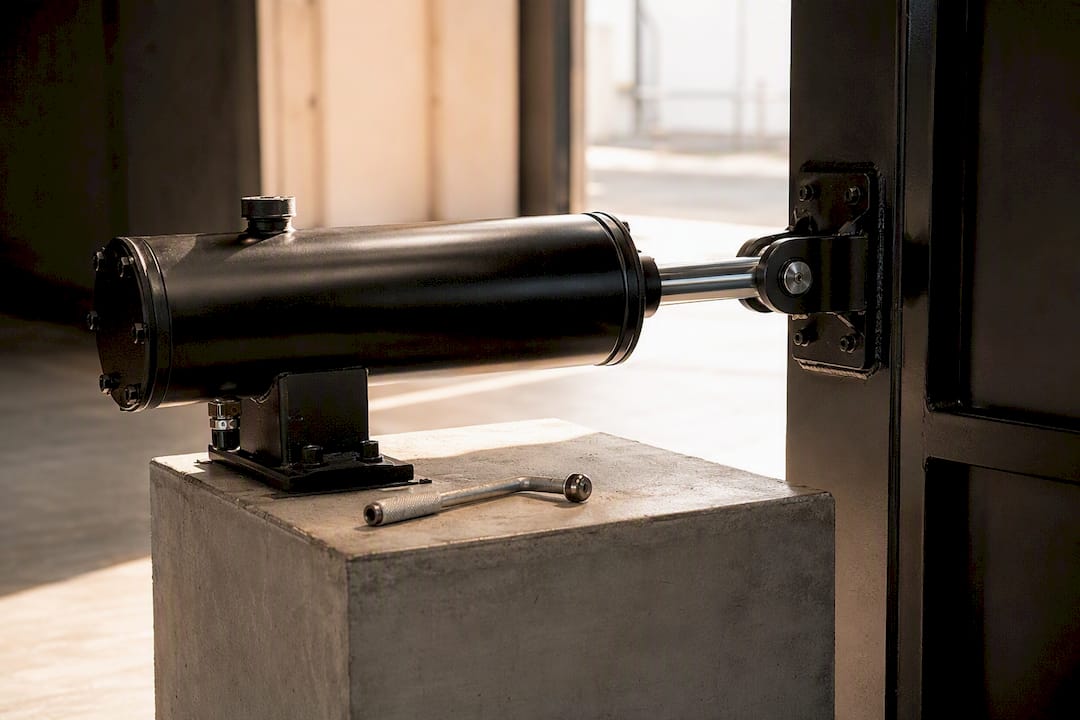
Linear actuators are a subtype of electromechanical drive, usually applied to swing gates, where a piston-style arm pushes the gate open. They're straightforward to service but limited to lighter and mid-weight gates.
Underground operators hide the entire mechanism below the driveway surface, leaving no visible motor or arm. The appeal is obvious for architectural gates, but the installation is more complex: underground housings need proper drainage provisioning to keep the motor dry, since flooding is a common and non-obvious failure mode for these systems.
- Electromechanical: standard residential choice, lower maintenance, moderate duty cycle
- Hydraulic: best for heavy, high-cycle, or commercial gates
- Linear actuator: simple and serviceable, suited to lighter swing gates
- Underground: cleanest look, highest installation complexity, drainage-dependent
Pro Tip: Ask your installer for the operator's rated duty cycle in cycles per hour, not just "residential" or "commercial." A gate opening 40 times a day at a shared driveway needs a higher rating than the entry-level residential units most showrooms display.
Power Source and Connectivity: WiFi vs GSM Opener Debate
Grid-powered (AC) operators are the default and the most reliable option where mains power reaches the gate location. DC/battery-backed systems keep the gate working during a blackout, which matters more than most owners expect, since a gate that fails locked or open during a power cut is a security gap either way. Solar is worth considering only on remote sites where running mains power is expensive or impractical.
Connectivity is where a lot of buyers get confused. WiFi access depends on router range and tends to drop out at the far edge of larger properties. GSM access uses a SIM card and mobile network, so it works regardless of your router, but it requires ongoing SIM plan management and carries some exposure to network sunsetting as telcos retire older cellular standards. Bluetooth is local-only, meaning no subscription and no network dependence, but it only works within close range of the gate.
- AC (grid): most reliable, no backup during outages unless paired with battery
- DC/battery: adds outage resilience, standard pairing for security-focused sites
- Solar: sensible for remote or off-grid sites, dependent on sun exposure
- GSM: works anywhere with signal, needs SIM management
- WiFi: simple setup, unreliable at property edges
- Bluetooth: no subscription, proximity-only
Whatever access method you choose, keep a physical remote or keypad as backup. Phones die, apps glitch, and networks go down. A gate that only opens through a smartphone app is one software update away from a lockout.
How to Choose the Right Gate Automation Options for Your Site
- Measure your opening width and side room. Sliding gates need side clearance equal to the gate's width; swing gates need forward or backward arc space.
- Check your driveway slope. Steep or uneven grades usually eliminate swing gates and push you toward sliding or vertical-lift systems.
- Estimate your daily cycle count. A single-family driveway used a handful of times a day is a different engineering problem than a shared driveway or commercial entry used 40+ times.
- Weigh your gate material. Solid steel, stone-clad, or timber-and-steel composite gates need higher-torque operators than lightweight aluminum.
- Factor in your environment. Coastal properties need weatherproofing and corrosion-resistant hardware; without it, salt exposure shortens the operator's service life significantly.
- Confirm maintenance access. Underground operators need serviceable, drained housings; recessed or hard-to-reach installations complicate future repairs.
When you're comparing quotes, ask each installer for the operator's duty-cycle rating, the warranty term on parts and labor, the safety features included as standard versus optional, drainage provisions for any underground component, and whether battery backup is included or an add-on.
Pro Tip: Treat a quote that skips duty-cycle rating or omits safety features as a red flag. A properly scoped proposal should read like an engineering spec, not a sales sheet.
What Drives Installation Costs and Timelines
Gate automation pricing spans a wide range because the variables compound quickly. A straightforward electromechanical swing or sliding gate on a standard residential driveway sits at the lower end of the market. Add a heavier custom gate, reinforced foundations, or a longer driveway run, and costs climb into the mid range. Underground operators, hydraulic systems for heavy commercial gates, and remote sites needing extra cabling or solar infrastructure push into the highest bracket.
- Low: standard residential gate, electromechanical operator, existing power on site
- Mid: custom or heavier gate, reinforced footings, added safety sensors
- High: underground operator, hydraulic drive, remote site power/connectivity work
A typical installation runs through site survey and measurement, design and material selection, foundation or footing work if needed, gate fabrication, operator installation and wiring, then commissioning and safety testing. Expect several weeks from signed quote to a working gate, longer for bespoke fabricated designs. After installation, budget for periodic servicing: sensors, hinges, and drive components all wear, and a service plan usually costs far less than an emergency callout.
Safety Features and Standards You Should Never Skip
A gate automation system without proper safety controls is a liability, not a convenience. Auto-reverse function is non-negotiable: the gate must stop and reverse if it meets resistance. Photocells detect people, vehicles, or objects in the gate's path and halt movement. Safety edges on the leading edge of the gate add a physical pressure-sensitive backup. A manual release mechanism lets you open the gate by hand during a power failure or motor fault.
Installers and property owners handling industrial or high-traffic gates should consult SafeWork NSW's industrial gate safety guidance, which sets out site risk controls and installer responsibilities. Ask your installer to demonstrate each safety feature at commissioning, and test them yourself every few months.
- Auto-reverse on obstruction: mandatory
- Photocell beams: mandatory for any gate crossing a pedestrian path
- Safety edges: strongly recommended on heavy or fast-moving gates
- Manual release: mandatory for power-failure access
How Gatecon Assesses a Site Before Recommending Automation
A site survey starts with the driveway, not the catalog. Rhys and the Gatecon team walk the boundary, check sightlines, and note the gate material and finish that will complement the building's architecture rather than fight it. That assessment then shapes the automation recommendation, since a hand-forged steel gate and a slimline aluminum panel carry very different weight and torque demands. Coordination with electricians and landscapers happens early, particularly for underground operators where drainage and cable runs need planning before the concrete is poured.
Why Site Data Beats Style Every Time
Most gate shopping starts backward. Owners fall in love with a look, then try to force an operator and connectivity setup around it. That order of operations causes most of the expensive mistakes in this category: an underground operator installed without proper drainage, a lightweight actuator straining against a gate it was never rated for, a WiFi-only access system that drops out the moment the router loses line of sight.
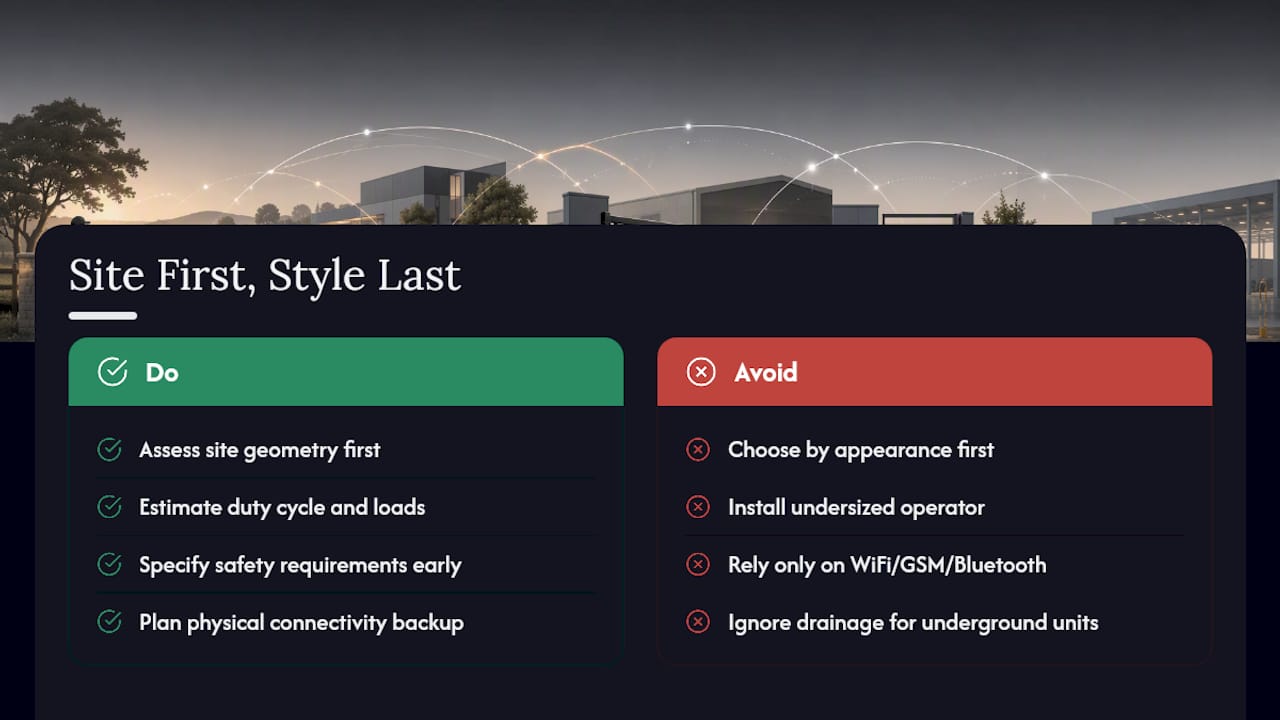
The conventional advice tells you to "pick a style that matches your home." That's not wrong, but it's incomplete, and treating it as the starting point is where things go sideways. Style should be the last filter applied, after the site geometry, duty cycle, and safety requirements have already narrowed the field to two or three sensible options. A sliding gate compared against a swing design on the same driveway will often produce a clear winner before aesthetics even enter the conversation.
If there's one thing worth pushing back on, it's the assumption that smart connectivity is a solved problem. GSM, WiFi, and Bluetooth each fail in different, predictable ways, and the gate automation industry doesn't talk about that enough. Build in a physical backup from day one. Don't treat it as an afterthought once the app stops working.
— Rhys
Get a Custom Gate Automation Solution From Gatecon
If you've measured your site and narrowed your movement type, the next step is a proper design and installation quote, not another catalog scroll. They design, fabricate, and install custom driveway gates and automation, pairing mechanical function with architectural detailing so the finished gate suits the building it sits in front of. That's the gap most standard gate suppliers leave open: they'll sell you a functional operator, but matching the gate's proportions, material, and finish to a specific home or commercial facade takes a design-led approach.
A Gatecon site visit covers the same fundamentals this article walks through, opening width, slope, gate weight, duty cycle, plus a design consultation on materials and finish, backed by warranty and service support once installed. If you're weighing architectural gate options for a Melbourne property, book a consult through Gatecon's service area page and get a site-specific quote rather than a generic estimate.
Where to Verify Safety and Technical Standards
Consult SafeWork NSW's industrial gate guidance and Gatecon's blog for further design and installation reading.
Sources
- SafeWork NSW — Industrial gate safety
- Types of automatic gates: complete guide to gate automation
- ZUMI — Automatic gate opener types explained
- PJ Motion — Complete guide to automatic gate operators
FAQ
Which Autogate Type Is Best?
There's no single best type. Sliding gates suit sloped or narrow driveways, swing gates suit wide flat frontages, and barrier arms suit high-frequency commercial access.
What Is the Best Automatic Gate Opener for a Home?
For most residential driveways, an electromechanical operator matched to the gate's weight and a swing or sliding movement based on available space is the standard, low-maintenance choice.
What Are the Different Types of Automatic Gate Openers?
The main categories are electromechanical, hydraulic, linear actuator, and underground operators, each suited to different gate weights and duty cycles.
Should I Choose WiFi or GSM for Remote Gate Access?
WiFi works well when the gate is near your router but can drop out at property edges, while GSM works anywhere with mobile signal but needs ongoing SIM management. Keep a physical remote as backup either way.
How Much Does Gate Automation Typically Cost?
Costs scale with gate weight, operator type, and site complexity, running from standard residential installs at the low end to underground or hydraulic commercial systems at the high end. Get a site-specific quote for an accurate figure.