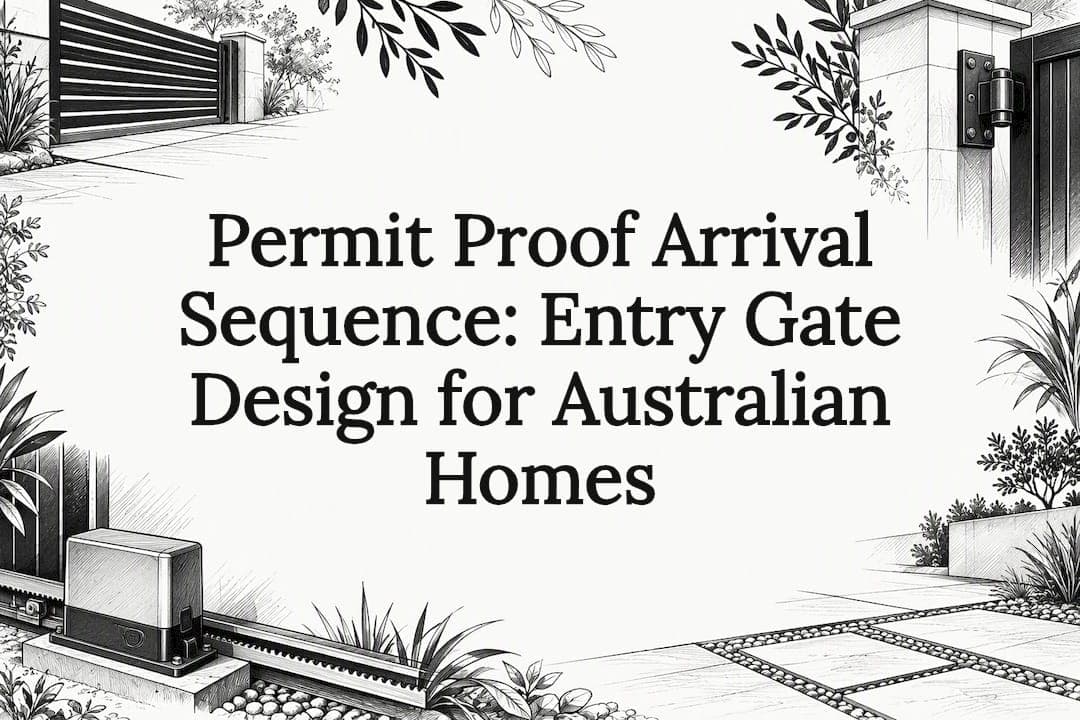
A true statement entry is never just a gate leaf bolted between two posts: it is a coordinated system of portal, gate, lighting, paving and planting, and treating it as your design brief from the start is what separates a bold frontage from a rejected permit application. We design these systems, and the real trade-off you will navigate is visibility against opacity: the boldest, most private-feeling gates still need to satisfy sightline and passive-surveillance rules.
TL;DR:
- A cohesive design for the entire entry system, including gate, portal, lighting, and landscaping, is essential for a bold and unified appearance.
- Material choices like aluminum, steel, or timber each have distinct aging characteristics, with maintenance needs varying based on environmental exposure.
- Proper scale and proportion, especially for height and width, must be confirmed on-site to avoid a gate feeling either flimsy or oversized.
- Design must account for planning constraints such as sightlines, permeability, and driveway access rules, which can limit solid or fortress-like fronts.
- Integrating lighting and landscape elements during the planning stage enhances night-time visibility, security, and overall coherence of the entry.
Table of Contents
- What design principles make a gate read as architecture
- Choosing materials and finishes that last
- Getting the scale and proportion right
- Planning rules and driveway standards that shape bold designs
- Using lighting and landscape to frame the arrival
- Planning the process and budgeting realistically
- Should your gate swing or slide, and what automation adds
- What a statement gate costs over time, not just upfront
- Building security into the design rather than bolting it on
- Designing for durability and lower environmental impact
- What installation actually involves, and where it gets complicated
- What actually makes an entry statement succeed
- Start designing your entry as one coordinated system
- FAQ
- Sources
What design principles make a gate read as architecture
A gate becomes a statement when it stops acting alone. The strongest entries treat the gate, the portal or pilasters that frame it, house numbering, paving and planting as a single composed frontage rather than a collection of separate purchases. The Creekside Estates entry illustrates this well: a stone monument, dual vehicle gates, a separate pedestrian access point, matching pilasters and lanterns, and coordinated paving all work as one arrival sequence instead of competing elements.
A few composition habits carry most of the visual weight:
- Symmetry and repetition: matching pilasters, lights, or planting on both sides of the drive make an entry feel deliberate rather than accidental.
- Proportion before pattern: get the gate's height, width and the portal's mass right before choosing a decorative motif.
- One dominant material, one accent: a steel frame with a timber infill, or aluminum with a stone-clad pilaster, reads as intentional where three competing materials read as cluttered.
- Sequencing the approach: the eye should move from portal to gate to driveway in a clear line, not jump between unrelated focal points.
Coordinating fabrication tolerances and fixing details between the gate supplier and the civil trades, drainage, conduit runs and pilaster setting out, early in the process avoids onsite compromises that quietly erode the design once construction starts, a lesson the Creekside Estates project makes explicit.
Pro Tip: Pick one hero material for the gate and let every other surface, paving, pilaster cladding, letterbox, play a supporting accent role instead of competing for attention.
Choosing materials and finishes that last
Material choice decides how your gate ages, not just how it looks on day one. Each option carries distinct trade-offs:
- Aluminum: light in weight, naturally corrosion resistant, and the easiest material to laser cut into fine decorative patterns before powder coating in almost any color.
- Steel, galvanized or stainless: carries structural strength across wide spans and heavy double-leaf gates, but needs a deliberate anti-corrosion strategy, galvanizing, quality powder coat, or stainless grade suited to the site.
- Timber: brings warmth and visual mass that metal cannot replicate, though it demands ongoing protective finishing or a shift to engineered timber-look alternatives for lower upkeep.
- Decorative infill methods: laser and plasma cutting, perforated panels, inlays and integrated LED strips let a flat gate face carry a custom pattern without adding bulk.
Plasma cutting in particular is a widely used fabrication method for producing intricate metal infill panels, letting a design team translate a motif, botanical, geometric, or abstract, directly into the gate face, as described in general references on plasma cutting as a metalworking technique. Powder-coated aluminum with a plasma-cut pattern is one of the more common combinations for a custom look that still resists coastal or exposed-site weathering.
Getting the scale and proportion right
Scale mistakes are the most common reason a gate looks either flimsy or oversized once it is installed, and they are easiest to catch before fabrication begins.
- Set height by context: most residential gates sit well below boundary fence height for sightline reasons, with taller elements reserved for a recessed portal or pilaster rather than the gate leaf itself.
- Match width to driveway and verge: single leaves suit narrow drives, double swing leaves suit wider frontages, and sliding gates often solve sites where swing space is tight against a slope or verge.
- Let the portal carry visual height: a well-proportioned portal or pilaster pair can make a modestly sized gate read as grand, so the gate itself does not need to carry all the scale.
- Check sightlines and approach speed on site: stand at the driveway's expected stopping point and confirm the gate design does not block a driver's view of the street before finalizing dimensions.
Planning rules and driveway standards that shape bold designs
Ambitious design still has to clear real constraints, and the two that matter most are streetscape permeability and driveway sightlines.
Planning guidance in Advisory Note 18 treats visual permeability and passive surveillance as first-order assessment criteria, meaning a solid, fortress-like frontage facing a street or public land is more likely to face objections unless the design clearly earns its boldness through streetscape integration. Where a frontage faces public open space, keeping visual openness at roughly pedestrian eye height supports that assessment.
Separately, a handbook for driveway access sets practical sightline and clearance rules tied to AS2890.1: gate swing paths must clear the trafficable roadway, gates should not force a vehicle to wait on the street while opening, and inward-opening gates with adequate setback are generally preferred over gates that swing out across a footpath.
- Inward swing avoids obstructing the footpath and pedestrians.
- Sliding gates sidestep swing-path clearance issues entirely on tight sites.
- Automation lets a heavier or larger gate open fast enough to avoid blocking the roadway.
Overly solid or continuous frontages can be refused or required to carry stronger design justification under current planning assessment criteria.
If your frontage touches a public footpath or council-controlled land, loop in your local council or a certifying engineer before finalizing the concept, not after fabrication drawings are signed off.
Using lighting and landscape to frame the arrival
Lighting and planting are what turn a well-built gate into a composed arrival sequence, and they matter as much after dark as they do in daylight. Uplighting on portal pilasters, slim strip LEDs recessed into the gate frame, and bollard or path lighting along the approach all add legibility and a sense of occasion without relying on a single floodlight.
- Match garden bed symmetry and paving patterns to the gate's own symmetry rather than treating landscaping as an afterthought.
- Use low hedges or screening planting to maintain sightlines while still softening hard materials.
- Plan wiring conduit and lighting access points during the civil works stage, not after paving is laid.
- Repeat one material or finish, mailbox, pilaster cap, fence capping, across the frontage for a cohesive look at minimal extra cost.
Small coordinated touches like a matching mailbox finish and consistent paving are frequently the most affordable way to lift a gate from functional to memorable, a point reinforced in entry statement design guidance focused on symmetry and matched landscape elements. For broader planting and hardscape inspiration around the entry, a resource like Hardscape Ideas is useful for visualizing paving and planting options before committing to a final layout.
Pro Tip: Install lighting conduit before paving goes down, retrofitting wiring through finished hardscape is one of the most expensive corrections on an entry project.
Planning the process and budgeting realistically
A statement gate project moves through a predictable sequence, and knowing the order helps you brief a designer efficiently and avoid rework.
- Gather inspiration: collect reference images and note which principles, symmetry, material contrast, portal scale, you are drawn to.
- Write a brief and moodboard: describe your site, driveway width, architectural style and must-haves before the first sketch.
- Develop a concept sketch: a designer translates your brief into a rough composition showing gate, portal and landscape together.
- Move to technical design: dimensions, materials, automation and fixing details get locked in.
- Check council requirements: confirm sightline, permeability and driveway rules apply to your specific frontage before fabrication starts.
- Fabricate: cutting, welding, powder coating and any decorative infill work happens off site.
- Install: civil works, fixing, automation wiring and final landscape integration tie everything together.
Cost is driven primarily by material choice, the complexity of custom cutting or laser work, whether automation is included, any civil works like driveway or kerb adjustments, and the finish specified. When you engage a specialist team or an engineer, ask for a written quote that itemizes material, fabrication, automation, civil works and finishes separately, so you can see exactly where the budget is going and compare quotes on equal terms.
Should your gate swing or slide, and what automation adds
Choosing between a swing and a sliding gate is as much a design decision as a mechanical one. Swing gates suit frontages with generous setback and a symmetrical portal, since both leaves can mirror each other and reinforce the composed look described earlier. They do, however, need clear space to open without crossing a footpath or trafficable road, which is why driveway handbooks generally favor an inward swing with adequate clearance.
Sliding gates solve sites where setback is tight, the driveway is on a slope, or the frontage runs alongside a boundary that leaves no room for a swing arc. A single sliding leaf can also carry a bolder, more continuous decorative panel since it does not need to split into two leaves at a central pivot point.

Automation changes what both types can do functionally. A motorized gate can open fast enough to avoid holding a vehicle on the roadway, which matters directly for the clearance expectations in driveway access guidance. Automation also allows heavier materials, solid timber infill or thick steel panels, that would be impractical to operate manually, and it pairs naturally with intercoms, cameras or keypad access for a frontage that needs to look elegant and function as a security point at the same time. The choice between swing and slide should be made early, since it affects portal width, pilaster placement and how the landscape either side of the gate is laid out.
What a statement gate costs over time, not just upfront
The sticker price of a gate is only part of the real cost. Material choice is the biggest long-term variable: aluminum with a quality powder coat generally needs the least ongoing attention, steel requires monitoring for coating wear or rust at welds and fixings, and timber needs periodic resealing or staining to avoid checking and fading.
Automation adds a maintenance line of its own, motors, sensors and safety edges benefit from an annual check, particularly on gates used daily. Decorative cutting, whether laser or plasma, does not add meaningful maintenance burden once the finish is applied, since the pattern is part of the panel rather than a separate component.
Longevity comes down to matching material to exposure. A coastal or high-wind site pushes the case toward marine-grade stainless fixings and a robust powder-coat system over bare steel, while a sheltered inland frontage has more flexibility to use timber or mixed materials without the same corrosion pressure. Budgeting for a realistic maintenance schedule, rather than assuming a "set and forget" installation, is what keeps a statement gate looking sharp a decade in rather than three years in.
Building security into the design rather than bolting it on
A gate that reads as architecture first can still function as a serious security layer, but the two goals need to be designed together rather than sequentially. Access control, keypad, intercom, or camera integration, works best when conduit and mounting points are planned into the portal or pilaster from the start, so hardware sits flush rather than looking retrofitted.
Height and infill density both affect security, but planning guidance pushes back against fully solid, high gates on street-facing frontages, so the more workable approach is often a gate that reads as substantial from the street while using spacing, pattern density or a layered infill to limit visibility without creating a blank wall. Automation adds a practical security layer too: a gate that closes automatically after a vehicle passes removes the window where a manual gate might sit open.
Lighting plays a dual role here as well, the same uplighting and path lighting that makes an entry legible at night also supports passive surveillance, which is one of the criteria planning assessments weigh directly. A well-lit, moderately permeable gate frequently satisfies both the aesthetic brief and the security brief better than a solid, unlit barrier.
Designing for durability and lower environmental impact
Material selection is also where a gate's environmental footprint is largely decided. Aluminum and steel are both widely recycled at end of life, and choosing a durable powder-coat finish over a lower-grade paint extends the interval between full refinishing jobs, reducing both cost and material waste over the gate's lifespan.
Timber sits differently: it is a renewable material when sourced responsibly, but untreated or poorly finished timber ages faster and may need replacement sooner than a well-coated metal equivalent, which can offset its lower embodied energy at the point of manufacture. Engineered timber-look alternatives can bridge that gap, offering the visual warmth of timber with closer to metal-level durability.
Automation and lighting both benefit from efficient components, LED strip lighting draws a fraction of the power older fixtures use, and a well-specified gate motor runs infrequently enough that energy use is rarely a significant factor compared with the embodied impact of the materials themselves. Choosing finishes and materials suited to your specific site exposure, rather than over-specifying protective coatings or replacing components prematurely, is generally the most meaningful sustainability lever available in a gate project.
What installation actually involves, and where it gets complicated
Installation typically starts with civil works, setting pilaster footings, running conduit for lighting and automation wiring, and preparing the driveway surface, before the gate itself arrives on site. This sequencing matters: conduit and drainage placed after paving is finished is one of the most common and most expensive corrections on these projects.

Fixing a heavy gate leaf plumb and level on uneven ground is a common challenge, particularly on sloped driveways where a sliding gate's track needs a perfectly level run or a swing gate's hinge points need to account for ground fall. Automation installation adds its own layer of complexity, sensors and safety edges need calibration, and power supply needs to reach the gate location without unsightly surface-mounted cabling.
Weather and trade sequencing can also cause delays: powder coating and fabrication happen off site on a lead time, so civil works and gate installation need to be scheduled around that fabrication window rather than assumed to happen simultaneously. Coordinating the gate supplier with civil and electrical trades early, as the Creekside Estates project demonstrates, is what prevents the kind of onsite compromise that quietly undermines a carefully designed entry.
What actually makes an entry statement succeed
In our experience, the projects that age well are the ones where cohesion, durability and architectural fit were decided before a single pattern was chosen. Clients often arrive wanting a bold motif first, and the harder, more valuable conversation is usually about material longevity and how the gate will read against the house in five years, not five weeks.
The recurring trade-off we help resolve is privacy against permeability: clients want presence and security without a wall-like frontage that works against both streetscape expectations and good design.
— Rhys
Start designing your entry as one coordinated system
A statement entry works best when one team carries the design through from concept to install, since that continuity is what keeps portal, gate, lighting and landscape reading as a single idea rather than a series of separate purchases. We design and fabricate Architectural Gates and Designer Fencing as bespoke packages, tailored to your property's architecture rather than adapted from a catalog.
If you are ready to turn a concept into a working brief, our Custom Packages page is the place to start a conversation about your site and your timeline.
FAQ
What is the best entrance gate design for my home?
The best design matches your home's architectural style and treats the gate as part of a wider composition with the portal, lighting and landscaping rather than as an isolated purchase. Aluminum with a powder-coat finish suits most contemporary homes, while timber or timber-look infills work well where warmth and texture matter more than low maintenance.
How do I build an entry gate from start to finish?
Building an entry gate generally moves from inspiration and a written brief through concept sketches, technical design, council checks where the frontage touches public land, fabrication, and finally civil works and installation. Checking driveway sightline and swing-path requirements before fabrication, as outlined in driveway access guidance, avoids costly redesigns later.
What gate colors are trending for 2026?
Specific color trend data for upcoming years is not covered in the sources available for this article, so we cannot cite a definitive answer here. As a general pattern, matte and textured powder-coat finishes in deep neutrals paired with one accent material tend to read as current without dating quickly.
What are some creative ideas for a statement gate?
Creative options include plasma-cut decorative infill panels, a sliding single-leaf gate paired with a stone or masonry portal, and integrated LED strip lighting that outlines the gate frame after dark. Matching garden bed symmetry and paving to the gate's own lines is a low-cost way to make even a simple gate design feel considered.
Do I need council approval for a bold entry gate?
Approval requirements depend on your local planning rules, your frontage's position relative to public land, and whether civil works affect the footpath or road reserve, so checking with your local council or a certifying engineer early is the safest step. Planning guidance generally favors visual permeability and clear sightlines over fully solid, high-enclosure designs on street-facing frontages.
Sources
- Entry Statements You Can Create • Geographe Landscapes
- Creekside Estates Entry - Township Design
- Advisory Note 18: Residential Courtyard Walls, Front Fences and Gates
- Handbook for driveway access to property