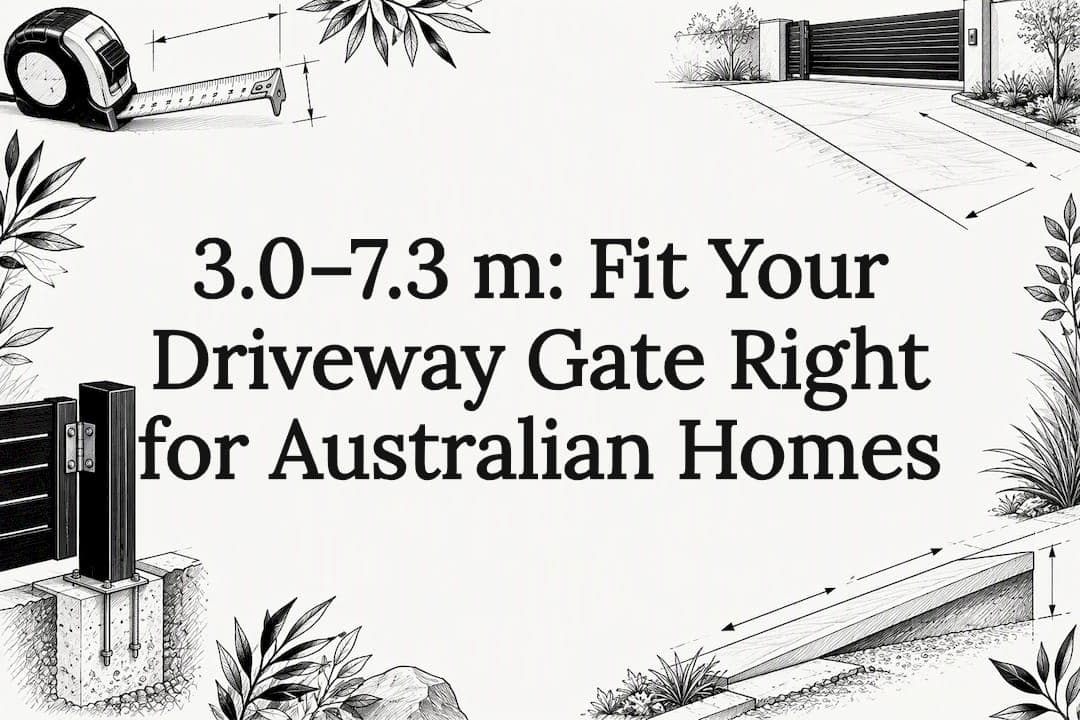
Most single-car driveway gates typically run within a certain practical range, double gates cover a broader span accommodating two vehicles, and estate or RV gates start at wider dimensions and increase from there, depending on vehicle size and turning requirements. The right number for your property depends on two things above all else: your widest vehicle's width including mirrors, and how sharply you have to turn off the street to line up with the opening. Everything else, including council setbacks and site quirks, gets layered on top of that.
TL;DR:
- Most driveway gates should be sized based on the widest vehicle including mirrors and the turn approach, not just the width of the vehicle itself.
- Final width recommendations must account for approach angle, ground slope, and clearance, often requiring 150 to 600 mm of extra space per side.
- Site-specific factors like setbacks, sightlines, and local regulations can significantly alter the optimal gate width, making a site visit essential.
- Measure the actual driveway opening at multiple heights and check for obstacles to ensure accurate sizing and compliance.
- Custom sizing and installation are recommended to accommodate unique driveway conditions and avoid costly rework later.
Table of Contents
- Typical Driveway Gate Widths for Single and Double Vehicles
- How Much Clearance and Turning Margin Do You Need?
- Setback Rules and Sightlines That Change Your Usable Opening
- How to Measure Your Driveway Opening the Right Way
- Swing vs. Sliding: How Motion Affects Your Width Decision
- Height, Materials and Structural Limits on Wide Gates
- Common Mistakes and a Quick Ordering Checklist
- What Installers Actually Check Before Confirming Your Gate Width
- Editorial Take: Where Most Gate-Sizing Advice Falls Short
- Get a Site Visit and a Custom Quote
- Sources
- FAQ
Typical Driveway Gate Widths for Single and Double Vehicles
A standard driveway gate width breaks into a few practical bands, and knowing which one applies to you narrows the decision fast.
- Single-car gates: 3.0 to 3.7 m (10 to 12 ft) — comfortable for a sedan or small SUV with a straight approach.
- Double-car gates: 4.3 to 5.5 m (14 to 18 ft) — fits two vehicles side by side or one larger SUV and a work vehicle.
- Estate, RV, or trailer gates: 5.5 to 7.3 m (18 to 24 ft) or more, depending on turning allowance, according to sizing guidance from TX Fence and Deck.
A full-size pickup or a caravan with a wide-body camper needs the upper end of that estate range, while a boat trailer often needs even more room to swing wide without clipping a gatepost. If you're weighing a second car, a future caravan, or a trade's van visiting regularly, size up now. Stock gate widths exist, but Melbourne properties rarely have textbook-standard openings, which is why custom sizing tends to fit better than forcing a driveway to match an off-the-shelf panel.
How Much Clearance and Turning Margin Do You Need?
Your vehicle's physical width isn't the number to order. Measure the widest vehicle including mirrors, then add a margin on top.
- Straight-on approach: add roughly 150 mm per side as a minimum buffer.
- Angled or turning approach: add 300 to 600 mm per side, since a vehicle turning into a gate sweeps a wider arc than one driving straight through.
- Service, delivery, or trailer access: plan for 5 to 6 m of clear opening if bins trucks, moving vans, or boat trailers regularly need to enter.
Quick math: A dual-cab ute at 2.0 m wide with mirrors, approached at an angle, needs roughly 2.6 to 3.2 m of clear opening once you add the turning margin. That's already pushing toward the top of the "single-car" bracket.
A 45 degree approach off a narrow street eats margin fast compared with a driveway that runs straight off the road. Before finalizing a number, walk your own driveway and note the sharpest turn any regular visitor has to make.
Setback Rules and Sightlines That Change Your Usable Opening
A gate that measures fine on paper can still fail council requirements if it forces a car to stop in the road while it opens. Many Australian councils require driveway gates to sit far enough back that a waiting vehicle clears the trafficable roadway entirely, with a design-vehicle clearance of about 6 meters commonly cited in access handbooks such as the Lismore City Council driveway access guide.
- Sightline standards under AS/NZS 2890.1 affect where a solid gate face can sit without blocking a driver's view of pedestrians or oncoming traffic.
- Outward-opening gates are generally not permitted over a footpath or road reserve, which pushes many properties toward inward opening or sliding gates instead.
- Constrained sites (narrow frontage, steep grade, close neighboring boundary) often need automation just to make an inward swing workable within the available setback.
- When in doubt, get a site-specific check from your local council or a certifier before you commit to a final width.
How to Measure Your Driveway Opening the Right Way
Getting this step right is what separates a smooth install from a costly rework. Fabricators consistently point to post-to-post measurement as the foundation of accurate sizing, according to GateFrames' driveway gate width guide.
- Measure the clear opening post-to-post at roughly hinge height, then repeat at a second height near the ground. Record both numbers, since posts aren't always perfectly plumb.
- Check the ground for slope. Run a tape or a long level along the base of the opening and note any high or low points, since cross-slope affects gate clearance and swing.
- Measure your widest vehicle including mirrors. Don't rely on the manufacturer's spec sheet alone. Fold-out mirrors, roof racks, and tow bars all add real width.
- Note the approach angle and any obstacles (letterboxes, retaining walls, garden beds) near the opening, then hand all four measurements to your fabricator or installer.
Pro Tip: Never measure an existing old gate and assume that number is correct. Fences settle, posts lean, and driveways get resurfaced. Measure the actual opening as it stands today.
Swing vs. Sliding: How Motion Affects Your Width Decision
A swing gate needs a clear arc to travel through, which is why inward swing is almost always preferred over outward. Steep driveways or a short flat apron near the street can make a full inward swing impossible, since the bottom edge will dig into rising ground.
- Sliding gates need lateral storage space roughly equal to the gate's own width, either along a fence line (tracked) or cantilevered above ground with no track at all.
- Swing gates are usually simpler and cheaper for openings under about 4.5 m, while sliding becomes the more practical choice for wider spans since it avoids the hinge loads that a single long panel puts on its posts, a point echoed in TX Fence and Deck's sizing guide.
- Either motion, once automated, needs to meet AS/NZS 60335.2.103:2024 for electric gate drive safety. For a side-by-side look at both options, Gatecon's guide to sliding vs. swing gates breaks down the trade-offs in more depth.
Height, Materials and Structural Limits on Wide Gates
Width decisions don't stand alone. Keep overhead clearance generous if tall vehicles, caravans, or roof racks use the drive, and avoid decorative toppers that eat into that clear lane height.
- Aluminum is light and low-maintenance but can sag across long spans without internal reinforcement.
- Steel resists sag over wide openings but adds weight, which usually means heavier hinges, sturdier posts, and a stronger drive motor, a trade-off noted in GateFrames' sizing guide.
- Two balanced panels often outperform one oversized single panel on hinge load and long-term sag, while sliding takes over entirely once the opening gets very wide.
- Keep proportions in mind too; design and safety considerations for tall gateways are well illustrated in this guide to practical door surround ideas. A gate that's much wider than it is tall can look squat against a two-story facade, so width and height should read as a pair, not two separate decisions.
Common Mistakes and a Quick Ordering Checklist
The same handful of errors show up again and again on jobs that need correction after the fact.
- Measuring the old gate instead of the actual opening, especially if posts have shifted over the years.
- Ignoring mirrors when checking vehicle width against the clear opening.
- Skipping the turning allowance for anything but a dead-straight approach.
- Forgetting slope, which changes how much ground clearance a swing gate actually has.
Before you call a fabricator, have these ready: post-to-post clear opening, widest vehicle width with mirrors, approach angle, ground slope, preferred motion (swing or sliding), automation needs, and any vehicle you expect to own in the next five to ten years.
Pro Tip: Ask any installer you're considering how they handle compliance with local setback rules, what their warranty covers, and whether a site assessment is included before you sign anything.
What Installers Actually Check Before Confirming Your Gate Width
A site visit usually turns up things a tape measure alone won't catch. Installers check whether hinge posts are sound enough to carry the intended panel weight, confirm footing depth is proportionate to the gate's load, and scan for underground services before any drilling starts, according to Gatecon's own architectural gates process.

It's common for a retaining wall, a leaning post, or an unexpected grade change to shift the final width recommendation once someone is standing in the driveway. Sometimes the fix is as simple as replacing one post; other times regrading a short section of apron changes what's possible entirely. This is also where automation choices and swing direction usually get locked in for good.
Editorial Take: Where Most Gate-Sizing Advice Falls Short
Most guides treat driveway gate width as a lookup table problem: tell them your car, get a number. That's backwards. The vehicle matters less than the approach.
Two identical driveways with identical cars can need meaningfully different widths if one has a straight shot off a quiet street and the other requires a 45 degree turn off a busier road. The margin math in this guide isn't decoration. It's the difference between a gate that works the first time and one that gets a scuff mark on the mirror within a month.

The bigger blind spot is setbacks. Homeowners fixate on getting the opening wide enough for the car and forget that a gate positioned too close to the road can be non-compliant regardless of how well it fits the vehicle. That 6-meter clearance guidance exists because plenty of driveways were built before anyone thought hard about a car idling in traffic while a gate creaks open.
If there's one thing to prioritize first, it's the site walk, not the catalog. Measure the opening at two heights, check the slope, and pace out the actual turn a driver has to make. The final number falls out of that far more reliably than any generic rule of thumb.
— Rhys
Get a Site Visit and a Custom Quote
Some providers offer on-site measurement, custom design, and full installation, ensuring that the width, motion, and materials are decided based on your actual driveway rather than a catalog size.
A typical site visit covers the post-to-post opening at multiple heights, the ground slope, the approach angle off the street, and any underground services near the dig zone. From there, Gatecon puts together a written quote that spells out gate width, motion type (swing or sliding), materials, and automation, so there are no surprises once fabrication starts. If your property also needs boundary work to match, designer fencing can be scoped in the same visit.
Ready to get an exact number for your driveway instead of a rule of thumb? Request a site visit through Gatecon's architectural gates page and get a custom quote built around your actual opening.
Sources
Council driveway handbooks and AS/NZS 2890.1 guide access rules. Always confirm site-specific requirements with your local council or certifier.
- Handbook for driveway access to property (Lismore City Council)
- Automatic driveway gate size guide — TX Fence and Deck
FAQ
How Wide Is a Colorbond Driveway Gate?
Colorbond driveway gates follow the same width bands as other materials: roughly 3.0 to 3.7 m for a single-car opening and 4.3 to 5.5 m for a double, since the sizing depends on the driveway and vehicles rather than the panel material itself. Colorbond is typically chosen for its low maintenance and color matching to existing fencing, not for a different sizing standard.
What Is the Standard Width of a Driveway in Australia?
There's no single fixed national number. Residential driveways commonly range from about 3 m for a single-vehicle crossing to 5.5 m or wider for double-width access, and the final figure depends on your council's crossover rules and the vehicles using the site. Check with your local council for the specific minimum and maximum widths that apply to your street.
How Far Off the Ground Should a Driveway Gate Be?
Most swing and sliding driveway gates sit with a small ground clearance gap to allow for drainage and to stop the bottom rail from dragging on an uneven apron. Sites with a noticeable slope or drainage channel may need a larger gap, which is exactly why checking ground level during measurement matters.
What Is the Width of a Standard Gate?
A standard pedestrian gate is a different category entirely from a driveway gate sized for vehicles. For vehicle access, "standard" really means the single-car range of 3.0 to 3.7 m or the double-car range of 4.3 to 5.5 m, since driveway gates get sized to the car, not to a person walking through.