The best driveway gate lighting combines three layers: fixtures on the gate or pillars, low path or bollard lights guiding the approach, and motion-sensor accents for security. This mix improves nighttime visibility, discourages intruders, and keeps energy costs down when you pair LEDs with sensors. A practical starting kit runs to four fixture types: pillar cap lights, bollards, recessed well lights, and a motion-sensor spotlight near the entry point.
TL;DR:
- Use a layered lighting approach with pillar, pathway, and motion-sensor fixtures to enhance security, visibility, and energy efficiency.
- Match beam widths to fixture purposes and maintain a consistent color temperature between 2700K and 3000K for a cohesive appearance.
- Properly space lights based on mounting height and driveway layout, adding fixtures at grade changes for safe navigation at night.
- Solar lights are suitable for accents in sunny locations, but wired systems are preferable for brighter, long-lasting security illumination.
- Opt for professional installation for mains wiring, automation, or custom stone or metalwork to ensure safety and integration.
Table of Contents
- Driveway Gate Lighting Ideas That Actually Work
- Layering, Beam Control, and Color Temperature
- How Far Apart Should Driveway Lights Be?
- Motion Sensors and Smart Controls for a Safer Entrance
- LED, Solar, or Low-Voltage: Choosing Your Power Source
- Installation and Maintenance: What to Plan For
- What Gatecon Sees on Real Driveways
- Three Things to Check Before You Buy or Quote
- When a Custom Gate and Lighting Package Makes Sense
- Sources
- FAQ
Driveway Gate Lighting Ideas That Actually Work
Most homeowners overcomplicate this. You don't need a dozen fixture types scattered across the property. You need a handful chosen deliberately, each doing a specific job. Here's what actually earns its place on a driveway approach.
- Gatepost or pillar cap lights. Mount these flush on top of stone or masonry pillars for a clean, architectural glow that reads as intentional rather than decorative. Choose a warm finish that matches your gate's hardware, bronze or black are the safest long-term bets.
- Uplights for metal gates. A narrow-beam fixture aimed upward at 12 to 18 inches off the ground highlights ironwork detail without washing it out. Metal gates, especially those with scrollwork or laser-cut panels, look far more expensive at night with this treatment than during the day.
- Pathway and bollard lights. These guide the eye and the car down the drive. Space them evenly, tighter on curves, wider on straight runs, and keep the tops below headlight height so they don't glare into oncoming traffic.
- Recessed or paver lights. For long driveways where above-ground fixtures would clutter the sightline, low-profile in-ground lights do the same guidance job invisibly during the day.
- LED strip or under-gate lighting. A thin strip tucked under a gate rail or along a step edge gives a modern, almost architectural glow. It also solves a real safety problem: uneven pavement or a step-down at the gate threshold.
- Motion-sensor floodlights or spotlights. Placed at the gate itself, these brighten instantly when a car or person approaches, then dim back down. That single behavior handles both convenience and deterrence.
- Solar post caps and bollards. Viable where the fixture gets consistent direct sun, less so under tree cover or facing south. Expect lower peak brightness than wired options.
- Accent lighting for trees or stonework. A single well-placed uplight on a mature tree or a stone wall near the entrance turns the whole approach into a framed scene rather than a lit corridor.
The fixture types recommended across most driveway entrance lighting guides consistently point to this same combination: pillar or column lights, pathway lights, motion sensors, and in-ground fixtures for longer approaches. Retailers selling driveway-specific fixtures report the same pattern in what actually sells: bollards, recessed lights, strip LEDs, and post lamps dominate the category, which tells you these aren't trend picks, they're the fixtures that hold up over years of actual use.
Layering, Beam Control, and Color Temperature
Individual fixtures only look good together when they follow a hierarchy. Lighting designers describe this as anchor, guide, and accent: the gate and pillars anchor the scene, the path or bollards guide movement, and selective uplights add depth without competing for attention.
- Match beam width to the job. Narrow beams (15 to 25 degrees) highlight detail on metalwork or stonework; wide beams (60 degrees or more) wash a broader area for general safety lighting.
- Stick to one color temperature. Somewhere between 2700K and 3000K reads as warm and cohesive. Mixing a cool 5000K floodlight with warm 2700K path lights makes the whole entrance look unplanned, like two different projects stitched together.
- Shield and tilt to kill glare. Recessed fixtures and shielded bollards keep the light source hidden while the light itself still does the work.
Pro Tip: Buy all your fixtures from a color-temperature-consistent line, even if it means mixing brands for style. A 2700K bollard next to a 4000K spotlight is the single most common mistake homeowners make.
How Far Apart Should Driveway Lights Be?
Spacing mistakes cause the two most common complaints: dark gaps and blinding hot spots. A few working rules solve most of it.
- Space bollards and path lights at distances appropriate for their mounting height, tightening the gap on curves and widening it on straight sections.
- Set pillar caps and uplights back far enough from the edge so headlights don't catch them directly, maintaining appropriate distance from the drive's border.
- Scale fixture size to the gate. A 10-foot masonry pillar needs a substantial cap light, not a tiny garden-store fixture that disappears against the stone.
- On wide or sloped driveways, add a fixture at each grade change so drivers can judge the transition at night.
Motion Sensors and Smart Controls for a Safer Entrance
Sensor-driven lighting does two jobs at once: it saves power and it makes an unexpected visitor visible the moment they're on your property. Motion-activated fixtures at the gate boost brightness only when triggered, then return to a dim or off state, which is exactly the kind of setup that improves both security and energy efficiency compared with fixtures left on all night.
- Set sensitivity to match your driveway's traffic. A busy street-facing gate needs a tighter detection zone than a long, private approach.
- Some smart systems support geofencing, so the gate lighting activates automatically as your phone approaches rather than waiting for motion at the gate itself.
- Integrate lighting triggers with gate automation and any driveway cameras so footage always has usable light.
- Aim sensor lights downward and away from neighboring windows. Adjustable burst brightness and a short timer setting keep the system useful without becoming a nuisance next door.
LED, Solar, or Low-Voltage: Choosing Your Power Source
Solar works best for post caps and bollards in spots that get consistent direct sun; shaded or south-facing corners will disappoint you. Panel size and battery capacity directly limit how bright and how long the light runs each night, so a small decorative solar cap simply won't put out the same output as a wired equivalent.
- Low-voltage DC systems power most recessed and paver lights, and they're the safer, easier option for a DIY install.
- Mains-powered (120V) fixtures make sense when you need higher output, long cable runs, or integration with smart gate controls.
- Choose fixtures with a higher IP rating and corrosion-resistant housing (brass, stainless, or powder-coated aluminum) for any site exposed to rain or salt air.
Installation and Maintenance: What to Plan For
- Check local electrical requirements before running any mains-voltage wiring. Most jurisdictions require a licensed electrician for permanent 120V outdoor circuits.
- Run cables through spare conduit wherever possible, and document each run so a future upgrade doesn't mean digging up the whole driveway.
- Clean fixture lenses seasonally, swap batteries in solar units annually, and inspect gaskets and seals for wear before the wet season hits.
- Avoid the two most common failures: mismatched color temperatures across fixtures, and over-lighting the street-facing side of the property, which reads as harsh rather than welcoming.
Pro Tip: Label every buried cable run with a waterproof tag at both ends. It costs five minutes now and saves an afternoon of guesswork during your next upgrade.
What Gatecon Sees on Real Driveways
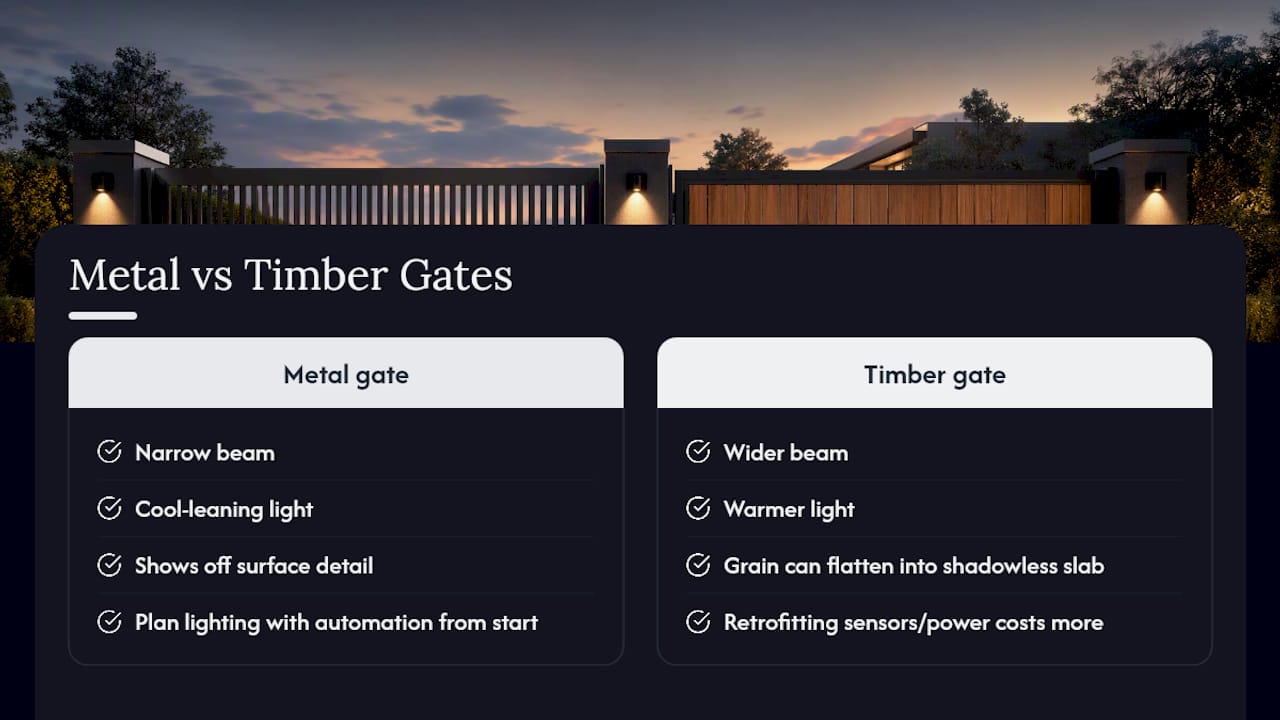
Gate material changes the lighting math more than most homeowners expect. Metal gates take narrow, cool-leaning beams that show off detail; timber gates need wider, warmer beams or the grain flattens into a shadowless slab. Gatecon typically plans the lighting layout alongside gate automation and control wiring from the start, since retrofitting sensors and power runs after a sliding or swing gate install usually costs more than doing it together. A solar bollard from a hardware store is a fine weekend project; for examples of layered permanent exterior lighting installations and practical placement guidelines, see permanent outdoor lighting. A wired system tied into automation, cameras, and architectural fencing is where a custom approach starts to pay off.
Three Things to Check Before You Buy or Quote
Confirm the gate's scale and sightlines from the street before picking fixtures, lock in one color temperature across every fixture on the property, and map sensor zones against foot traffic to avoid false triggers from the street or a neighbor's yard. Bring this list to any quote.
— Rhys
When a Custom Gate and Lighting Package Makes Sense
Retail fixtures and solar bollards solve a lot of driveway lighting problems on their own. But once you're pairing lighting with automation, security cameras, and a gate that has to match the rest of the property's architecture, the wiring and design decisions multiply fast. Custom driveway gates, automation, and integrated lighting can be designed and installed as one coordinated package, so the fixture layout, the gate hardware, and the control system get planned together instead of bolted on after the fact.
Call in a specialist when your project involves any of the following:
- Mains-voltage wiring that needs to run alongside gate automation and camera systems.
- Bespoke finishes on stone pillars or custom metalwork where off-the-shelf fixtures won't match.
- A driveway layout with curves, slopes, or multiple access points that need a coordinated lighting plan, not individual fixtures.
If your gate project is starting to look like more than a weekend of solar bollards, get in touch through Gatecon's Melbourne service page for a custom design consultation.
Sources
- Flood, spot lights & sensors | Lighting Superstore
- Layered landscape lighting ideas for luxury homes | Bondi Lights
- Energy
- Outdoor lighting for driveway entrances: gates, columns, and long approaches | Kings Outdoor Lighting
FAQ
What's the most effective way to light a driveway gate?
A layered approach works best: anchor lights on the gate or pillars, guide lights along the path or bollards, and a motion-sensor fixture near the entry point for security and energy savings.
What are good outdoor lights for a driveway?
Pillar cap lights, bollards, recessed paver lights, and motion-sensor spotlights cover the essentials for most driveways, with solar post caps as a viable add-on in sunny spots.
What color temperature should I use for gate lighting?
Stick to 2700K to 3000K across every fixture. Mixing warm and cool temperatures is the most common reason a lighting scheme looks unplanned.
Are solar lights bright enough for a driveway gate?
Solar performs well for accent and post-cap lighting in spots with consistent direct sun, but panel size and battery capacity cap how bright and how long the light runs, so wired fixtures still win for main security lighting.
Do I need a professional to install driveway gate lighting?
Simple solar or battery fixtures are DIY friendly, but any mains-voltage wiring, automation integration, or custom pillar work usually calls for a licensed electrician or a specialist like Gatecon.